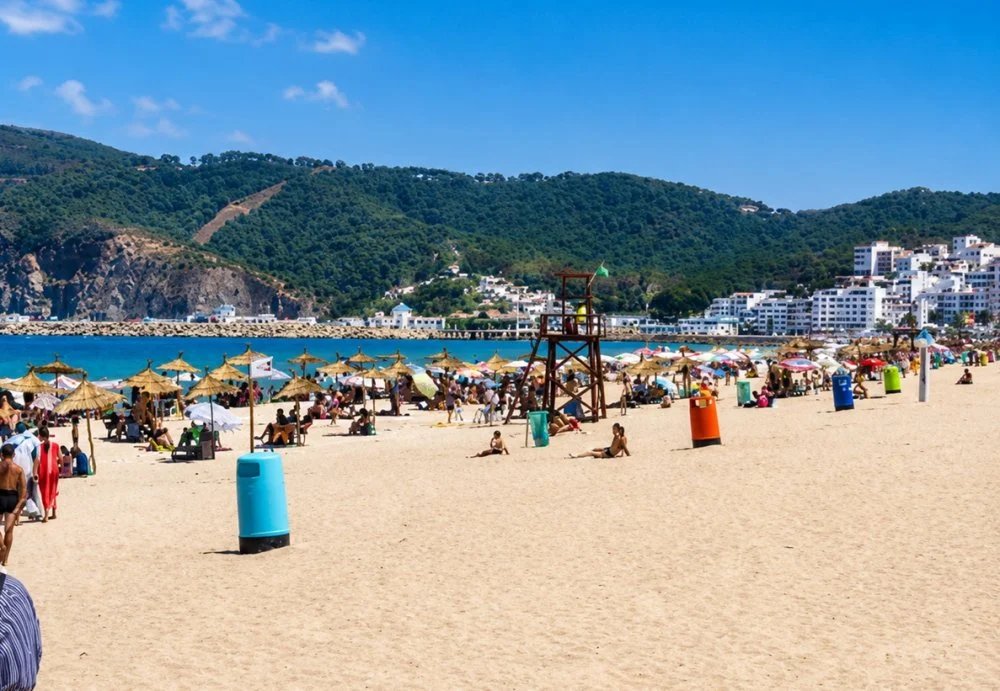
Every summer, the beaches of M’diq, Fnideq, Martil, Cabo Negro, Tangier, Al Hoceima or the blue streets of Chefchaouen attract hundreds of thousands of visitors in search of freshness and a change of scenery. With the arrival of the summer holidays, the region of Tangier-Tetouan-Al Hoceima regains its status as a locomotive of summer tourism in Morocco. Hotels, tourist residences, restaurants, cafes, shops and professionals in the sector have been working for several weeks to welcome the first flows of vacationers.
A destination ready to absorb a large influx
This year, the region is entering the summer season with encouraging indicators. According to Rkia Alaoui, president of the Regional Tourism Council (CRT) of the Northern region, all the conditions seem to be in place for a successful new season.
“The Tangier-Tétouan-Al Hoceïma destination is approaching summer 2026 with favorable momentum. Thanks to the strategic strengthening of air connectivity and the concrete developments of seaside infrastructure, the destination is ready to welcome the flow of visitors,” she said in a statement to the newspaper “Le Matin”. But, she warns, “the main challenge will now be to transform this preparation into a quality tourist experience during the months of July and August”.
If the investments made in recent years allow us to approach the summer with greater serenity, the main challenge remains that of managing ever-increasing attendance. Each summer season puts infrastructure and public services to the test, particularly on the coast where a large proportion of visitors concentrate.
For the president of the CRT, the success of the season is no longer measured solely by the number of tourists welcomed. “The Tangier-Tétouan-Al Hoceïma region today has many assets to make its summer season a success. Our main challenge is to support the increase in tourist flows while maintaining a high level of quality of service, mobility, security and preservation of our natural spaces, particularly in coastal areas which concentrate a significant part of summer attendance,” she explains.
Mobility, reception and infrastructure at the heart of priorities
This quality requirement is based on close coordination between the different stakeholders. Local authorities, local authorities, security services and tourist operators work together to ensure a smooth welcome for visitors throughout the summer.
“The North Morocco destination experiences very high influx during the summer period, which demonstrates its growing attractiveness,” underlines Rkia Alaoui. She specifies that “significant work is being carried out in coordination with local authorities, local authorities and various operators in order to improve reception conditions, mobility, parking, cleanliness and the organization of tourist areas, particularly in heavily frequented coastal areas”.
Added to these efforts are the investments made in recent years in road infrastructure, tourist facilities and transport networks, which are gradually helping to strengthen the destination’s reception capacity.
A diversified offer
But the strategy of the Regional Tourism Council is no longer limited to seaside tourism alone. For several years, the Council has been working to diversify the experiences offered to visitors in order to further distribute flows across the entire regional territory and reduce the destination’s dependence on the high season.
“Summer 2026 is a continuation of our strategy of diversifying the regional tourism offer. Beyond the seaside product, which remains a major asset of our destination, we are continuing our actions to promote nature, mountain, culture, heritage and tourism experiences of meetings, incentives, conferences and exhibitions (MICE) which are now bearing fruit,” indicates the president of the CRT.
The first results are already visible. “Recent statistics confirm that the destination is gradually freeing itself from its summer dependence. We are seeing a continued increase in arrivals from the first months of the year, confirming that the North is now attractive in all seasons,” she continues.
In this dynamic, the CRT encourages visitors to extend their stay beyond the seaside resorts by discovering the Rif mountains, the historic medinas, the villages of the hinterland, the hiking routes or even the numerous cultural events organized during the summer.
Value for money as a loyalty lever
Another major challenge this season: preserving the attractiveness of the destination in a context where travelers are particularly attentive to their spending. For Rkia Alaoui, the answer lies less in lowering prices than in constantly improving the quality-price ratio.
“In a context where travelers pay particular attention to their budget, our priority is to promote the diversity of the region’s tourism offering, which makes it possible to respond to different profiles and spending levels while offering a rich and authentic experience,” she explains.
She adds that “the best loyalty lever remains a good balance between quality of service, diversity of experiences and visitor satisfaction”. It is with this in mind that the CRT continues its work with tourism professionals to promote good practices in terms of reception, quality of service and customer experience throughout the high season.
Preserving the coastline in the face of summer pressure
The preservation of natural heritage is also a priority. Every summer, the high concentration of visitors puts significant pressure on beaches, natural spaces and the public domain. Local authorities, municipalities and competent organizations are thus increasing cleaning, control and awareness-raising operations. “The preservation of the coastline and natural spaces constitutes an essential priority today, particularly during the summer period when attendance is very high.
The objective is to reconcile tourist attractiveness and respect for the environment,” insists the president of the CRT. She wants to be confident that the season will go well. “Thanks to this clear distribution of tasks and the commitment of everyone, we are convinced that the 2026 summer season will take place in the best conditions for our visitors,” she assures. Thus, after several months of preparation, the North is preparing to experience its big summer meeting. If the crowds should once again be there, those involved in the sector especially hope that this 2026 season will confirm the move upmarket of the destination, by reconciling attractiveness, quality of welcome and sustainable development.