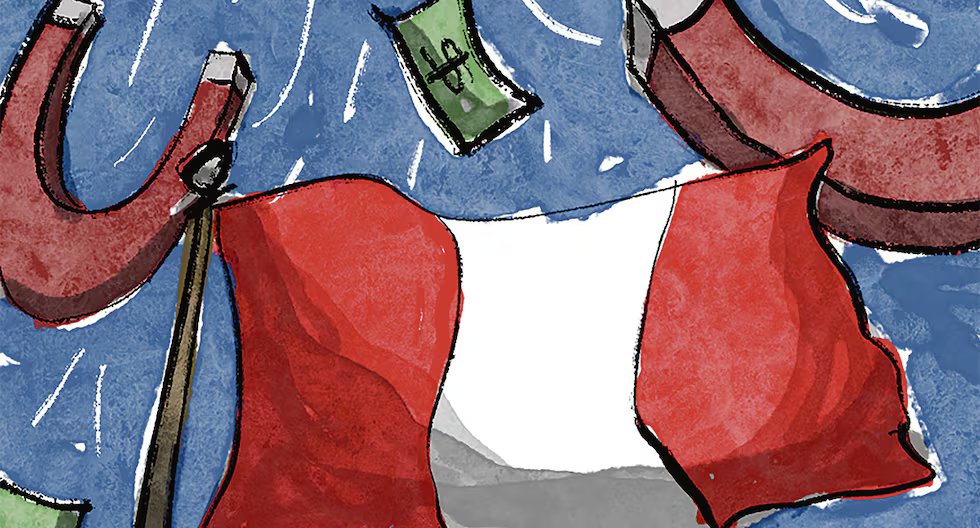

According to the latest Expectations Survey of the Central Reserve Bank of Peru (BCR), the enthusiasm of Peruvian businessmen for the economy in the following months remains at levels higher than its historical average. The election of President Keiko Fujimori boosted optimism to levels not seen, in a sustained manner, since before the pandemic. But you don’t live on expectations. The government needs concrete private investments if it is to accomplish most of its agenda, and the time it has is not unlimited.
According to the latest Expectations Survey of the Central Reserve Bank of Peru (BCR), the enthusiasm of Peruvian businessmen for the economy in the following months remains at levels higher than its historical average. The election of President Keiko Fujimori boosted optimism to levels not seen, in a sustained manner, since before the pandemic. But you don’t live on expectations. The government needs concrete private investments if it is to accomplish most of its agenda, and the time it has is not unlimited.
It is in that spirit that starting today a Peruvian delegation of more than 80 representatives from the public and private sectors will meet in New York (USA) with the largest international investors as part of the XIX inPerú Roadshow. It is positive that this entity that promotes investment and the development of capital and financial markets contributes to strengthening ties with international investors.
Among those summoned to participate in the meeting are the Minister of Economy and Finance, Elmer Cuba; the president of the BCR, Julio Velarde; and the executive president of Pro Inversión, Luis del Carpio. It will seek to promote the arrival of capital for sectors such as energy, infrastructure, mining and hydrocarbons.
Peru has a lot to offer potential investors. The macroeconomic outlook is one of the most solid in Latin America. Several indicators of domestic demand – such as VAT, cement shipments or imports of consumer goods – are advancing in double digits compared to 2025 figures. The economic potential in several sectors is vastly higher than what is found in neighboring countries. With a stable exchange rate, numerous free trade agreements and no capital controls, conditions for foreign entrepreneurs are generally friendly.
What is missing then? National representatives will have the mission of convincing investors about the political stability expected in the coming years and respect for the rule of law in the country. This is not necessarily simple. On the one hand, Peru has gone through too long a period of political volatility, with more presidents in the last 10 years than the average person can remember in order. On the other hand, for some time now, the country has been brought before international courts for breach of contracts more often than it should. There, possibly, will be the questions of potential investors.
The enthusiasm for the new administration and the good economic moment is there. But that won’t be enough. Now it’s time to really transform them into investments, employment and income. And that was always the hardest part.