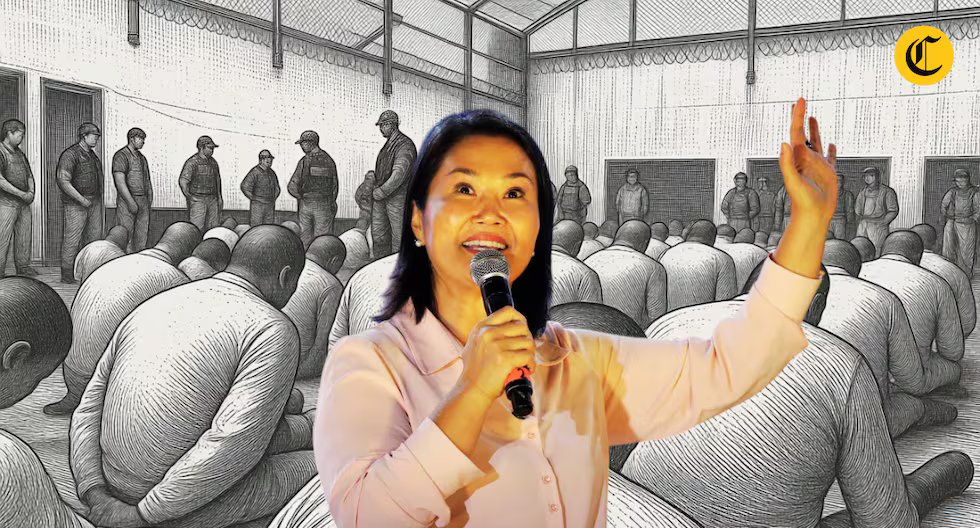
In less than three weeks, the former congresswoman Keiko Fujimori She will be sworn in as the new president of the Republic, after having defeated parliamentarian Roberto Sánchez (Together for Peru) in the runoff. 73% believe that the priority of the Fuerza Popular government should be to combat insecurity. This after the overflow of extortion and crimes against transporters, warehousemen and others in recent years.
According to the latest Datum survey for El Comercio, the other challenges of the new Executive are to generate employment and reactivate the economy (26%), improve health services (24%), improve the quality of education (20%), reduce corruption in public institutions (17%) and reduce poverty and inequalities (9%), among others (see infographic).
In the opinion study – carried out between July 3 and 6 – 48% indicated that Fujimori Higuchi’s administration should work more on citizen security and the fight against crime. And, also, in stopping corruption (11%), education (10%), public health (10%) and employment and economic recovery (8%).
The new government has also generated high expectations among citizens. For example, 42% believe that the Fujimori administration will be better than the Executive led by President José María Balcázar. 25% think that the situation will remain the same, 20% that it will be worse, and 13% do not know.
In Lima and Callao – where Fujimori Higuchi obtained 63.51% and 65.597% of the valid votes in the second round, respectively – 51% indicate that the orange government will be better than the outgoing one.
52% also thought that the general situation in Peru compared to the current situation will improve in the next five years, while 17% said that it will worsen.

(Infographic: El Comercio)
Regarding the first head of the Ministerial Cabinet of the Fujimori government, 61% prefer that he be a person who comes from another political force, 25% that he be from Fuerza Popular and 9% are indifferent to the origin. According to sources from this newspaper, Luis Galarreta, general secretary of the orange party and first elected vice president, is one of the main candidates to take over the PCM.
According to the Datum survey for El Comercio, only 19% support that the Council of Ministers is made up mainly of personalities close to Fuerza Popular.
34% believe that Fujimori Higuchi’s ministerial team should be composed of independent people, without political affiliation, while 39% by representatives of different parties. And 8% don’t know.
In addition, 61% indicated that their family does not have an action plan in case of a natural disaster, such as earthquakes, floods and/or El Niño Phenomenon, while 38% indicated that they do.
87% thought that the country is not prepared to face a situation of a large-scale natural disaster. Only 12% believe so.

(Infographic: El Comercio)
On the other hand, President José María Balcázar leaves office with an approval rating of 26%, four percentage points more than last May, according to the opinion study. 59% disapprove of his government, while 15% don’t know.
And Congress closes its unicameral stage with 80% disapproval and 14% support. This Parliament, it should be remembered, had legislators denounced for “low salaries”, Los Ninos (who, according to the prosecutor’s office, changed votes in favor of former president Pedro Castillo due to appointments and works) and a parliamentarian defrocked and later sentenced for sexual rape.
Political analyst Enrique Castillo considered that those surveyed are demanding that the new government address a problem that affects them daily, whether it be them or their families, which is insecurity. He added that the fight against crime is “a cry that has been going on for several years and no one has been able to give it a solution.”
“For the population, security is the most urgent issue, because they or their family members have been affected by criminal acts or see news about this type of situation, where a person’s life has been ended or has been put at risk. And, precisely, insecurity puts economic enterprises in trouble. So, it is natural that three-quarters of the population feel that this is the most urgent problem,” he stressed.
In dialogue with El Comercio, Castillo warned that “it is very difficult” for any government to have optimal results in this sector in its first 100 days.
“First, it will take a few weeks for any authority that accesses the Ministry of the Interior and related institutions, such as the INPE and the National Police, to gain a foothold in office. And the other thing is that joint work will be required with the prosecutor’s office, the courts and the PNP. In addition, Keiko Fujimori will have to make very creative efforts, because different formulas have already been tried, such as declaring an emergency, raking and incursions into prisons. And we have not had results,” he said.
Read also: Hugo De Zela: “The thesis of a massive conspiracy is frankly fanciful and ridiculous” | INTERVIEW
Regarding the citizens’ expectations that the country’s situation will improve with the new government, Castillo said that after the improvisation and informality of the management of public affairs by the administrations of Dina Boluarte, José Jerí and José María Balcázar, it is normal that the access to power of a “more or less” organized party generates that reaction.
“It is natural that at the beginning of any government, enthusiasm is greater than pessimism. But that does not mean that success is guaranteed (…) It can generate over expectations in certain areas, such as institutional management, fight against insecurity and economic growth, when there may be some frustrations,” he said.
Besides…
The ability to keep promises
By Urpi Torrado, CEO of Datum International
After a highly polarized electoral process, Peruvians seem to have decided to give the new government a chance. However, it is worth not forgetting that, in the first round, Keiko Fujimori obtained nearly 2.9 million votes, equivalent to 11% of the total number of voters. In the second round that figure exceeded 9.2 million, but the difference does not correspond to the traditional Fujimori vote, but to citizens who, for different reasons, ended up supporting his candidacy. Maintaining that support will depend on the government’s ability to meet the expectations it generated during the campaign.
The Datum–El Comercio survey reveals that more than half of Peruvians believe that the country will be better within five years and hope that the new government will have a better performance than the one that concludes. It is an important level of optimism for a country that, in recent years, has been marked by political instability and pessimism about the future.
That optimism, however, has a very clear focus. The main citizen expectation is placed on security. Peruvians hope that the new government will be able to confront crime and organized crime. That will probably be the main criterion by which his management will be evaluated.
Citizens also expect a government with the capacity to convene other political forces and independent professionals in the formation of the cabinet and the main management teams. There is a perception that the challenges facing the country are too complex to be addressed by a single political organization. Building consensus will be as important as making decisions.
Although the arrival of the El Niño phenomenon does not appear among the country’s main concerns, Peruvians recognize that Peru continues to be highly vulnerable to natural disasters and that prevention should not continue to be postponed. This expectation reveals that citizens not only expect answers to the emergencies of the present, but also a greater capacity to anticipate the risks of the future.
Every honeymoon has a limited duration. Expectation is a valuable asset, but it is also fragile. Citizens are willing to give time, as long as they perceive concrete progress.