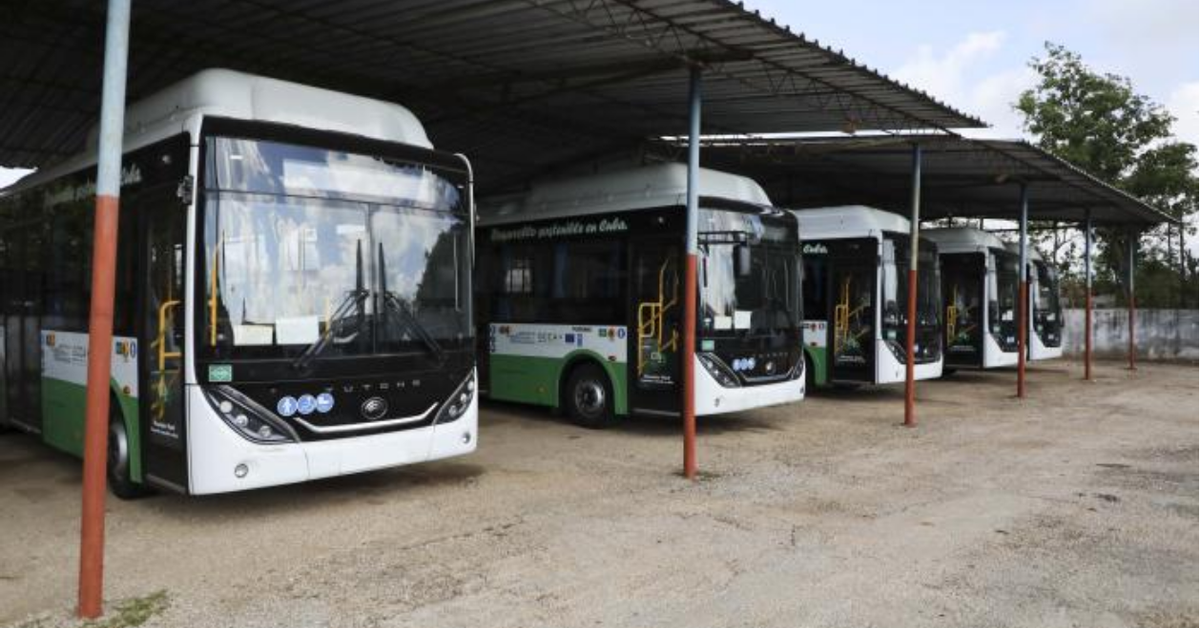
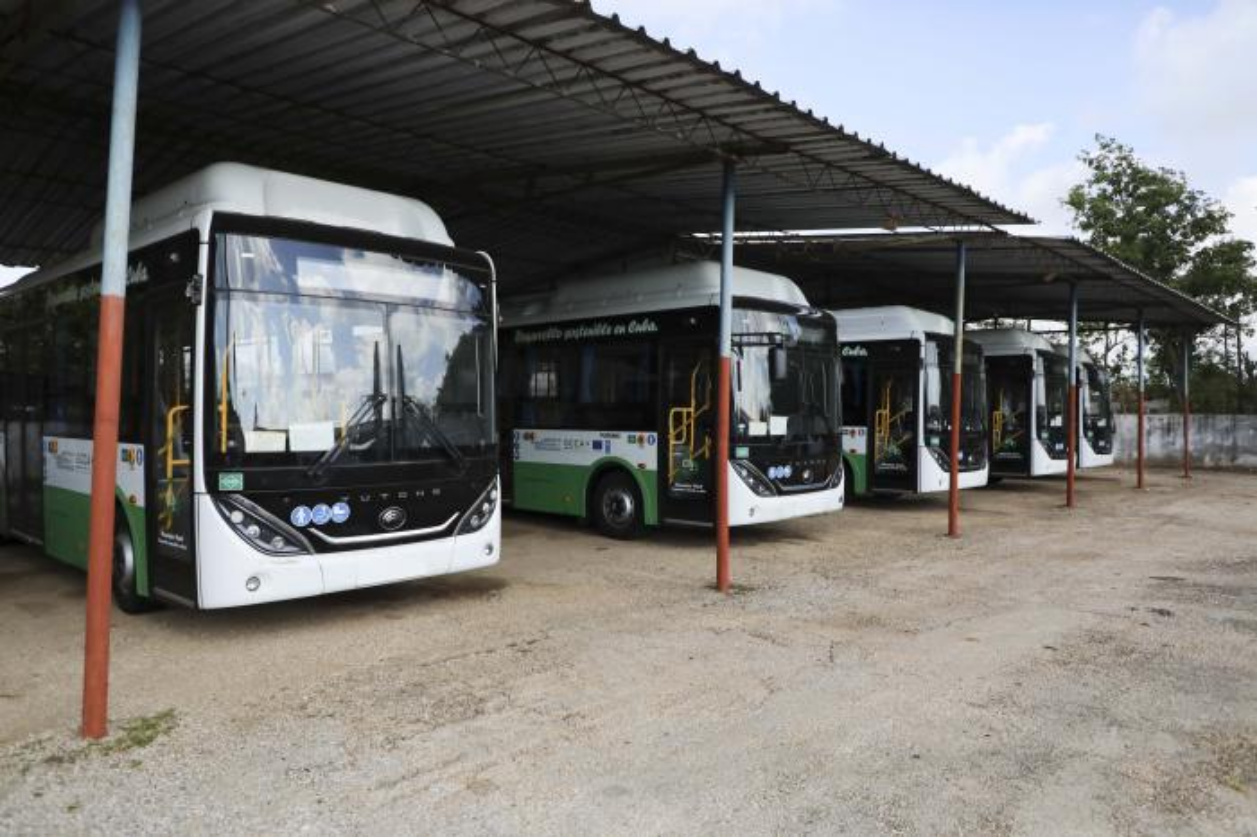
Madrid/The inhabitants of Martí, in Matanzas, have been waiting for eight months for the five Yutong buses powered by biomethane –or refined biogas– come into operation, a promise that was made to them in August 2025 and that still remains undated. The buses, which cost more than $3,600,000, are still stopped and waiting for the plant, which will supply energy from organic waste, to start up.
The process must involve spanish experts who have come to the Island to kick off this project, financed by the European Union and implemented by the United Nations Development Program (UNDP). Although the most difficult thing is yet to come, since the plant must be fed with pig waste, a complicated undertaking on an Island depleted of animal mass.
At the moment, the pigsty that supplies it has 1,000 pigs, despite having a capacity of 15,000. “In seeking solutions to improve their diet and acquire new specimens in the midst of the complex economic context, they have opted for cattle excreta and other waste, and even the processing of sargassum is planned,” says a note from Granma published this Tuesday.
The information, which explains the operation of the biogas plant, reveals that the State will once again rely on private companies – in this case, through agreements – to try to grow this pig mass. “One possibility to take into account, says (Ph.D. in Agricultural Sciences Giraldo Martín), is that the two largest pig farms be managed by public-private agreements, with better possibilities of guaranteeing the importation of feed for the pigs.”
“From there the gas is pumped to the plant through an 11 kilometer long pipe, buried one and a half meters underground”
Wilber Oliva Rodríguez, a guajiro and now an expert in supervising biogas production, says that the main pigpen is 100 meters away. From there, through the drains, the waste arrives, which is filtered and homogenized before being pumped to the biodigester, a pool seven meters deep, with two agitators, covered by a large rubber tent, where a boiling or gas release process is generated.
“From there the gas is pumped to the plant through an 11 kilometer long pipe, buried one and a half meters underground. The remaining residue is collected to be used as organic fertilizer, the same happens with solid particles. In a circular process where nothing is wasted,” says the specialist.
“The biodigester stores 3,000 cubic meters of gas out of a capacity of 4,000 and can pump up to 18,000 to the plant. Our main problem right now is managing enough raw material to sustain production,” he insists.
According to Granmathere are a dozen producers who have joined the project by delivering raw materials. In exchange, the farmers receive the biofertilizers that are produced in the plant itself.
The workers, says Oliva, are excited about the start of the project, both because of the money they believe they will earn and because thanks to it, seven kilometers of roads have been built. Furthermore, in an area where communications are a problem, buses are seen as a hope that, yes, is being desired.
“This is a territory that is far from everything. Even the distances between the popular councils are considerable. Hoyo Colorado is twelve kilometers from the municipal seat, Itabo is seven, and Camilo Cienfuegos is 21,” says Geovanny Castanedo Lareda, mayor of the municipality.
‘Granma’ does the math on the dairy and calculates that, if everything goes well, and gas production reaches the planned 150,000 cubic meters
In its description of the panorama, the note of Granma He does not spare details, which lead to a stranded Martí almost at the beginning of the 20th century, with “empty roads”, “donkeys” and almendrones for 1,500 pesos to Cárdenas, less than 45 kilometers away.
When the plant and the methane station – located in the Esteban Hernández popular council – are ready, the biodigesters will send the biogas through gas pipelines and, once the gas cleaning process is completed, which also involves increasing the proportion of methane up to 90%. It will then be when the product can be sent to both buses and small vehicles.
The server has, according to the official newspaper, a capacity for 1,800 kilos and the bus needs 60 to travel about 300 kilometers.
The note points out that the entire environment has been soaked in the project, and cites Javier Fal Vera – one of the agroecological producers “with the best results in the municipality” – as a contributor, through the waste of his animals. His farm produces vegetables, fruits and meats without chemicals, as well as milk and meat from small and large livestock from 100% organic food.
“At first, I recognize that some producers had their doubts regarding agroecology. Above all, because in terms of yield, it cannot compete with planting that uses chemical fertilizers,” says the farmer, who now talks about the wonders he has discovered in search of “sustainable alternatives.”
Granma He does the dairy calculations and calculates that, if everything goes well, and gas production reaches the planned 150,000 cubic meters, “a bus route of two trips to Matanzas, one to Cárdenas, one to Colón and two others within Martí itself can be sustained.” Not only that, but also an electric generator “could add up to three megawatts to the national electrical system, which is equivalent to 80% of the municipality’s consumption.”
It remains to be seen if the hope that the official newspaper of the Communist Party said it had observed “in the faces of the people” of Martí finally comes true or, once again, what was projected is not fulfilled.