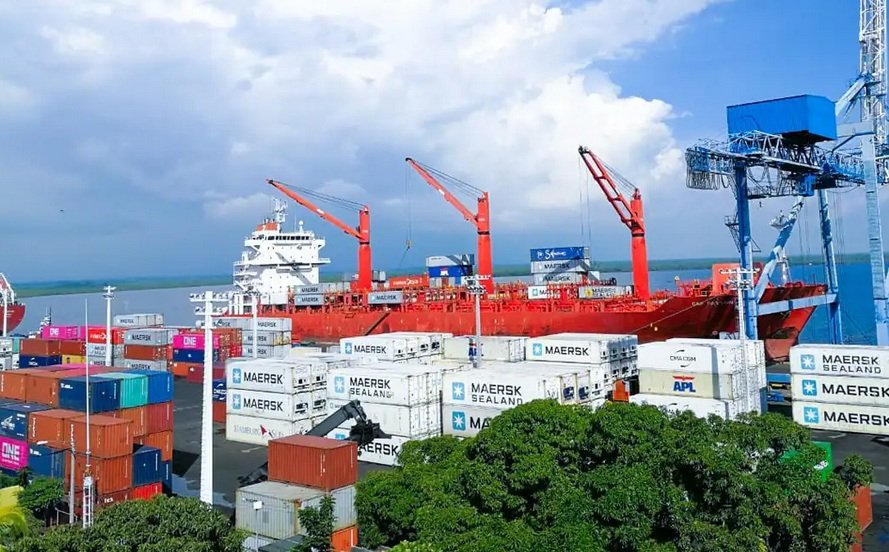
As of the first quarter of 2026, the People’s Republic of China became our main international seller, relegating the United States, which until now had been the historical leader, to second place. He Foreign Trade Report of the January-March period, published by the Central Bank of Nicaragua (BCN), shows that the country purchased merchandise for 553.4 million dollars from China, while purchases from the United States closed at 485.8 million.
This has two contrasts. The first is that The United States not only continued to be the first buyer (41.1%) of our productsbut did so by increasing the amounts from 435 to 814.5 million. The additional 379.4 million represent a growth of 87.2% compared to the first quarter of 2025.
The second is that China bought much less than in the reference quarter. If between January and March 2025 it had acquired 56.1 million dollars in Nicaraguan merchandise, the amount in that same period this year fell to 27.9 million. This is 28.3 million (50.4%) less than a year earlier.
As a result, the trade gap (comparing the first quarter of both years) between Nicaragua and the United States widened further in favor of Nicaragua, going from 32 to 329 million. A growth of more than ten times. On the other hand, the trade gap between China and Nicaragua widened further in favor of the Asian nation, going from 400.2 to 525.6 million, increasing dependence on the Chinese partner.
All of this happened before the Ministerial Agreement 005 – 2026that eliminated the customs duties that Nicaragua charged on imports from Chinabased on the Free Trade Agreement between both countries. It is expected that such a decision will further widen the trade gap between both nations.
The increase in the invasion of products from the Asian nation will represent a even greater challenge for commerce and small industry Nicaraguan, which has been suffering for several years from the invasion of Chinese stores and businesses throughout the country. Small Nicaraguan businessmen argue that newcomers compete unfairly, because they receive tariff advantages from the regime.
Gold grew 152.1%; coffee 60%, and meat 35.7%
The change in positions between the United States and China occurs in a context of high dynamism in Nicaraguan export growth. According to the Central Bank Report, “the value of total exports, which include merchandise and free zone goods, totaled 2,768 million dollars.” That is, 33.5% more than the 2,074 million dollars raised in the first quarter of 2025.
Although at first glance the numbers seem to depict an export machinery working at full capacity, the BCN qualifies the reality in two sentences. “This result was explained by the 61.5% increase in merchandise exports, which prevailed over the 7.2% year-on-year decrease in exports of free zone goods.” Next, he admits that the dynamism of exports benefited from the increase in international prices.
Two elements stand out when making the list of those who win and those who lose. The first is that most of the 694 million in which exports increased is explained by the dynamism of three products: gold ($542.2 million; +152.1%), coffee ($137.2 million; +60.0%), and meat ($76.1 million; +35.7%). This performance follows in the wake of what was observed throughout 2025.
The second is that only 17 of the 38 categories listed in the BCN document (including some that it only defines as “The Others”) had a positive performance. This count also includes eight items from the ‘Free Zone’ category.
Of the remaining 21 that are in negative territory, some of the country’s most important export items stand out, including peanuts (-36.3%); sugar (-23%); textiles (-19.8%); fresh fish (-18.6%); beans (-10.7%), and dairy products (-1.6%).
The report highlights that the increase in gold exports is explained “both by higher international prices and by greater exported volumes.” Something similar happened with “external sales of coffee, favored by better contracted prices and greater volumes.” In the case of beef, the increase was “driven by increases in price and volume.” That is, the same for all three products.
The Report shows that exports to the three North American countries had a highly notable performance: 111.0% to Canada; 87.2% to the United States, and 62.2% to Mexico, to round up 92.6%. The only other market with relevant amounts that grew double digits was Guatemala, with 20.1%.
January-March 2026 was the fifth consecutive quarter in which the country earned at least $2 billion from its exports.