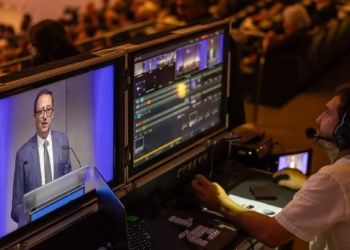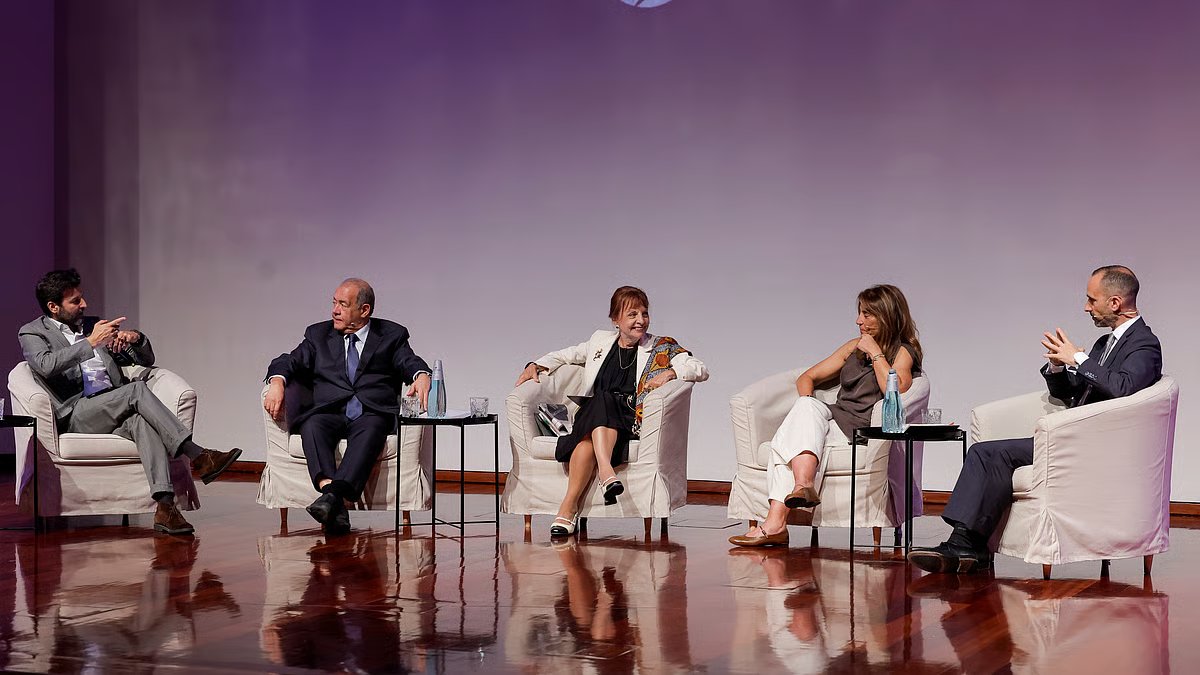
António Costa e Silva calls for “regulation in intelligent doses, because innovation is fundamental”, with regard to Artificial Intelligence (AI). The former Economy Minister’s statement was made in the panel “Technology and AI: Ethics, Innovation and Geopolitics” at the DN Grand Conference taking place this Monday, June 15, at the Champalimaud Foundation.
The panel is moderated by Nuno Vinha, deputy director of DN, and also includes Maria Manuel Leitão Marques, former minister of the Presidency and MEP, Luísa Ribeiro Lopes, president of .PT, and Diogo Madeira, director of Huawei Portugal.
The former ruler highlighted the need to invest in the development of AI in Portuguese. This is because possible models with Portuguese language will be important for Portuguese-speaking communities around the world. “It’s an aspect that will be crucial in the future”, he highlights.
At the same time, the need to regulate the use of AI was a point that united the participants, even if they left some warnings. “Regulation is almost as it was a century ago… and technology is always changing”, pointed out Maria Manuel Leitão Marques, former Minister of the Presidency and MEP.
She also highlighted the importance of having “algorithmic literacy”, as a result of AI-related tools being used for the most varied functionalities. “I may be selected for a consultation or a credit by an algorithm and I may want to know why I was or why I wasn’t (selected)”, she explains.
Diogo Madeira, director of Huawei Portugal, says that “we should talk more about how we can develop (AI)” and not “block it“, although he made it clear that he does not rule out the need for regulation. Added to this is the fact that these technologies deserve a “zero trust” status, he explained.
“We shouldn’t trust from the start, we should have clear rules”, from his perspective. Among other aspects highlighted by himself is the fact that Portugal is unable to compete on scale with other powers in the sector. Now, “countries that cannot compete at scale must compete at speed“, he reiterates.
The business manager also adds that Portugal lacks connectivity infrastructure, which would allow for greater capacity and lower latency. “I see no reason why Portugal should not be a country with 100% coverage”, he warns.
Returning to the topic of AI development in Portuguese, Luísa Ribeiro Lopes, president of .PT, understands that “We have to teach the machine to speak Portuguese”, he said. If so, we will have more power to “influence”, making the machine “more inclusive”, remember.
She also addressed the need to introduce “data that feeds the machines in Portuguese”, in order to provide these opportunities.
Regarding the topic of innovation with AI, Costa e Silva took the opportunity to highlight the work of Neuraspace. The Portuguese company is using it to optimize the trajectory of satellites, with the aim of preventing them from colliding with space debris and, as a result, ending up destroyed.