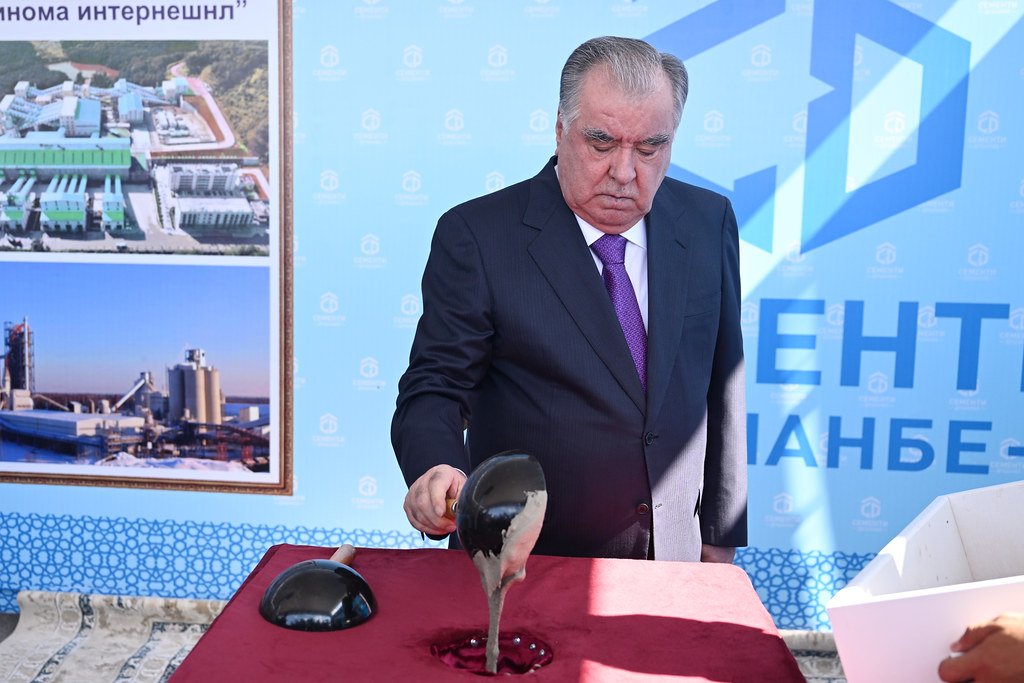
On June 23, President of Tajikistan Emomali Rahmon and Chairman of the Majlisi Milli Majlisi Oli, Mayor of Dushanbe Rustam Emomali launched the construction of two new cement plants in the Varzob region.
Projects are being implemented within the framework of the instructions of the head of state on the creation of four new cement enterprises in the country with a total capacity of 6 million tons per year, adopted at a government meeting on May 28, 2026, the presidential press service reports.

Dushanbe Cement LLC and Tajik Cement LLC will build two new plants in the village of Kharangoni-Bolo, on an area of about 18 and 16 hectares. Commissioning of the enterprises is planned within 17 months.

Production will completely cover the cycle – from processing raw materials to packaging finished products.
During the construction phase of the plants, it is planned to employ a total of more than 2,600 workers, and after the launch of the enterprises, over 2,000 permanent jobs will be created.

Construction work, supply of machinery, technologies, equipment and other necessary materials will be carried out with the attraction of domestic investments.

The equipment will be supplied and installed in cooperation with the Chinese company SINOMA, specializing in international industrial construction.
It is noted that the enterprise will comply with international standards of quality and environmental safety, and will also be located near raw material deposits.

Let us recall that earlier at a government meeting on May 28, against the backdrop of rising cement prices and supply disruptions in the domestic market, Emomali Rahmon instructed to build four new cement plants in different regions of the country in the next 2–3 years with a total capacity of about 6 million tons per year.
It was noted then that, despite the increase in cement production in the country – from 300 thousand tons in 2014 to more than 5 million tons per year – the market was faced with a shortage of products and rising prices.
Among the reasons cited were insufficient coordination between enterprises, underutilization of production capacity, weak market control and the activities of intermediaries.
It was expected that the construction of new plants would double cement production, fully cover domestic demand and create about 5 thousand jobs.
Cement paradox
Against the backdrop of a shortage and a sharp rise in cement prices, the Tajik authorities are betting on the construction of new plants that could more than double the industry’s capacity. But the main question is whether this will solve the market problem – or whether the country will again pay for rapid industrial growth in terms of ecology and human health.
Tajikistan intends to build and launch four new cement plants in the next 2-3 years. Their total capacity is expected to be about 6 million tons of cement per year. The authorities expect that the new enterprises will double production, fully cover domestic demand, stabilize prices and create about 5 thousand jobs.
Such an order was given against the background of a sharp shortage of cement and rising prices in almost all regions of the country.
At first glance, the solution seems logical: if there is not enough cement, more needs to be produced. Moreover, cement is one of the key materials for the construction of housing, roads, schools, hospitals, industrial facilities and other infrastructure. Any disruption in this market quickly affects the cost of construction and, ultimately, the wallets of citizens.
But this logic has a weak point.
Over the past 10-15 years, Tajikistan has already transformed from a country dependent on imported cement into a major producer and exporter. If in 2009 the country produced about 252 thousand tons of cement, and a year later – almost 384 thousand tons, then today we are talking about several million tons per year. During this time, the total capacity of the industry exceeded 5 million tons per year.

And yet, in the spring of 2026, the market was faced with something that, it would seem, should not happen with such capacities: cement disappears from the markets, deliveries are irregular, and prices per bag in some regions reach 80–90 somoni.
The recent cement shortage is a warning sign. But it does not automatically prove that Tajikistan urgently needs new factories. Rather, it shows that even a large production base can operate inefficiently unless there is a transparent market, accurate planning, control of intermediaries, stable logistics and priority for domestic supply during the peak season.
The construction of new facilities can only be justified under several conditions: if a long-term need is proven, if the plants operate according to strict environmental standards, if emissions data are open, if the domestic price really becomes more accessible, and not just the export potential increases.
Otherwise, the country risks finding itself in a situation where more and more cement is produced, but citizens still buy it at a higher price; There are more factories, but the air is not getting cleaner; export statistics are improving, and the environmental price remains within the country.
Tajikistan needs cement. But even more, he needs an industrial policy that considers not just tonnes and jobs, but also air, human health, water, soil and future costs. Because cheap cement can turn out to be very expensive if the country only sees its real price years later.
Read more about how Tajikistan became a “cement country”, read our material.