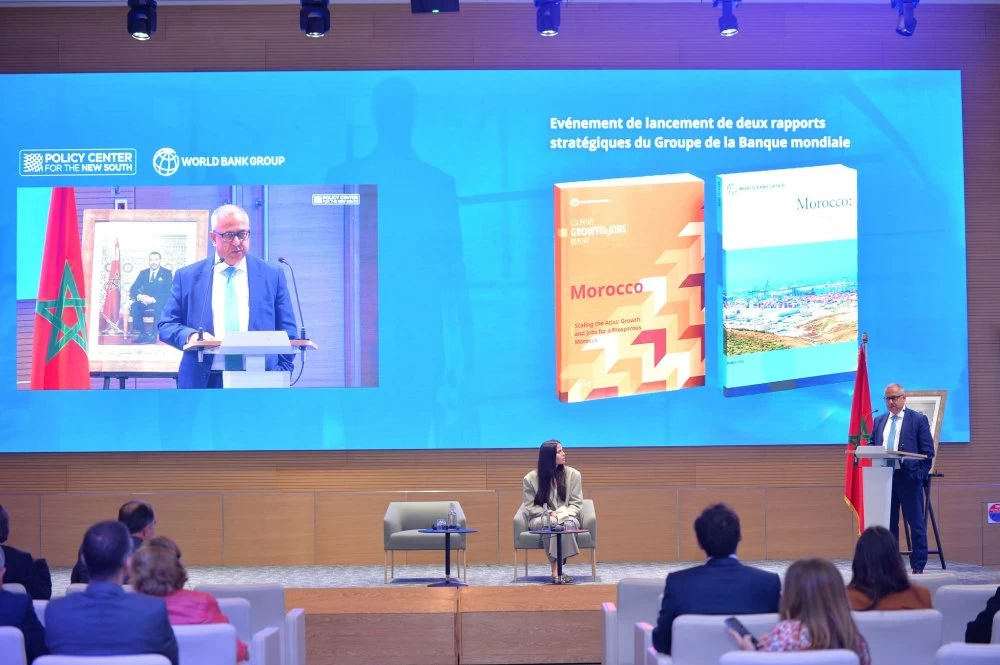
THE Morocco has solid macroeconomic foundations, but its growth model has not yet succeeded in creating jobs that meet the needs of an expanding active population. Closing this gap is possible, provided that coordinated structural reforms are implemented. This is what underlines the World Bank in a new report on growth andjob At Moroccodesigned as a contribution to the ambitions of the new development model. Between 2000 and 2024, the working age population increased by 47%, while the number of employed people increased by 20.7% and the number of unemployed by 19.7%. The activity rate thus fell from 53.1% to 43.5%.
The Moroccan economy created on average 215,000 fewer jobs per year than necessary between 2000 and 2024. This deficit went from 138,000 jobs per year in the 2000s to 208,000 in the 2010s, before reaching 370,000 per year between 2020 and 2024, a phase of more sustained economic growth. To explain this gap between growth and employment, the report analyzes the nature of Moroccan growth model. Since 2000, the country has maintained an investment rate close to 30% of GDP, a high level by international comparisons. This accumulation of capital supported growth, but without sufficient productivity gains.
Total factor productivity contributed only about 0.8 points of growth per year in the 2000s, 0.7 in the 2010s, and even less since the pandemic – well below high-growth emerging economies.
The composition of the investment also weighed on the results. Available data suggest that the public sector carries between half and two-thirds of total investment. This situation can limit the contribution of investment to productivity through several channels: insufficient selection and monitoring of public projects; a crowding out effect on the credit available to private companies, particularly young innovative companies; and a presence of the State in several sectors which may have slowed the emergence of more productive private firms.
Numerous companies, but still few creators of formal jobs
The report shows that the Morocco has a significant fabric ofcompanies formal, with around 363,000 companies declared to thetax administration in 2022. But this density of companies has not translated into sufficient creation of formal jobs. Around 94% of businesses are very small and concentrated in non-tradable activities, such as retail and construction.
Informality also remains high. More than two thirds of the employed population work without a formal contract, and formal companies themselves employ around half of their workforce informally. The report concludes that Morocco has a large business base which does not yet fully play the role of a dynamic driver of formal job creation.
The growth of young companies remains limited to create jobs on a large scale. The density of high-growth companies and so-called “scalers” also remains lower than that observed in several comparable countries.
The report also notes an important fact: large Moroccan companies are on average less productive than smaller ones. This pattern is different from that observed in more advanced economies, where size and productivity tend to be mutually reinforcing. For the World Bankthis suggests that market power may be a more important determinant of firm growth than productive efficiency. As a result, incentives to innovate and adopt new technologies are weakened, with second-round effects on aggregate productivity.
Markets where competition remains insufficient
One of the root causes of these distortions is the weakness of competitive pressures in a large part of theeconomy. The evaluation of product market regulations, conducted according to the methodology of theOECD (Organization for Economic Cooperation and Development), shows that the Moroccan regulatory environment is less favorable to competition than that of most reference countries. Constraints increase the costs of entry and scaling up, limit the contestability of markets and weaken competitive selection mechanisms. Around 40% of industries operate in a low-competition environment.
Added to these constraints are other cross-cutting obstacles: a historically progressive corporate tax system, currently being reformed; a high tax wedge on the low wages ; access to credit more favorable to large established companies than to SMEs and young businesses; and late payments that penalize small, productive businesses.
A more educated, but less active population
The report highlights another paradox: the level of education has increased significantly, but the activity rate has declined. This decline went from 53.1% in 2000 to 43.5% in 2024. The World Bank puts forward a cautious explanation: a gap seems to have widened between what the labor market offers and the expectations of an increasingly educated population. Entry wages have remained largely stagnant, driven by weak productivity gains. At the same time, reservation wages – that is, the minimum level of remuneration a worker accepts to enter employment – have probably increased. The report identifies two factors: the rise in the level ofeducationwhich increases income expectations, and the increase in transfers from Moroccans living abroadwhich represent around 8% of GDP and can reduce the pressure to accept poorly paid or poorly suited employment.
This mismatch between training and employment also results in overqualification: around 43% of higher education graduates occupy positions for which they are overqualified. The report sees this as a misallocation of both public investment in education and individual efforts.
Women, the main source of underutilized human capital
The participation of women At labor market constitutes one of the central points of the diagnosis. Despite the progress made in the education of girls and women, the female activity rate fell from 28% in 2000 to 19% in 2024, leaving a gap of almost 50 points with men, among the highest in the world.
L’female entrepreneurship is also presented as an underutilized lever. Women run only 14% of formal businesses, but businesses run by women employ a higher share of women than those run by men. The report estimates that targeted support for women’s businesses could contribute to both inclusion and strengthening of the productive fabric.
Four areas of complementary reforms
To address these constraints, the report makes recommendations organized around four interdependent outcomes: more efficient markets, more dynamic businesses, higher-impact public investments, and more active participation of women and youth. The World Bank insists that these axes should not be considered as separate tracks. Stronger competition promotes business dynamism; more dynamic companies create demand for work; better targeted public investments can attract private activity; and the inclusion of women and young people makes it possible to mobilize human capital that is currently underutilized.
The first axis aims for more efficient markets. The report recommends strengthening the application of competition rules. He also advocates pro-competitive reforms in several sectors: telecommunications, energy, transportprofessional services. It also calls for improving competitive neutrality between public and private companies, strengthening the governance of public companies and rationalizing their presence in competitive markets.
The second axis concerns businesses. The report recommends completing the corporate tax reform in order to reduce the threshold effects linked to progressive rates, to reduce the tax wedge on low salaries, and to improve access to financing for SMEs, in particular through the development of movable guarantees, the expansion of the coverage of credit bureaus and the strengthening of innovative financial solutions. It also recommends making hiring and separation rules more predictable, by associating them with an unemployment insurance system, and rationalizing business support programs in order to improve their consistency and effectiveness.
The third axis concerns public investment. There World Bank recommends strengthening the selection and evaluation frameworks of public investment projects, in particular through more systematic ex ante evaluations, in order to improve the effectiveness of public spending. It also recommends better integration of investments and debt of public enterprises into the budgetary framework, as well as strengthening debt management. Finally, the report highlights the importance of developing infrastructure financing by further mobilizing capital markets, public-private partnerships and blended financing mechanisms.
The fourth axis concerns the participation of women and young people. The report recommends strengthening legal equality between the sexes, protections against gender-based violence and combating discriminatory hiring practices. It also calls for improving access to affordable child care, strengthening the safety and reliability of transportand promote more flexible working arrangements. It also insists on strengthening fundamental skills, as well as better alignment of technical, professional and university training with the needs of the labor market. For young people furthest from employment, particularly NEET (neither in employment, nor in studies, nor in training), it recommends expanding active labor market programs and strengthening targeted support systems.
The report finally recommends facilitating programs of circular migration and to better mobilize the savings of Moroccans living abroad in order to support productive investment in Morocco.
Significant gains, subject to consistency
The simulations carried out by the World Bank indicate that a set of reforms simultaneously addressing market efficiency, business dynamism, the quality of public investment and the participation of women and youth could produce significant gains. THE GDP real would be 17% higher than the reference scenario in 2035 and almost 24% in 2050. The economy could create 1.7 million more and better jobs by 2035, then 2.5 million by 2050. Real wages would be 15% higher than in the reference scenario.