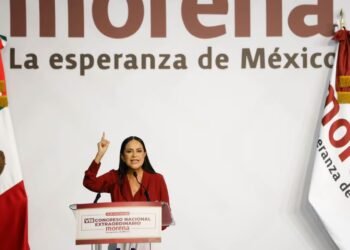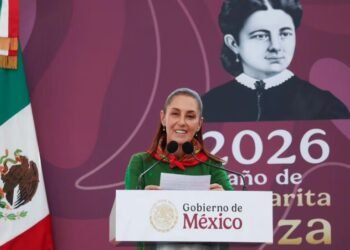
The president of the National Human Rights Commission, Rosario Piedra Ibarrawent from promoting the intervention of Committee against Forced Disappearance of the UN to publicly disqualify him by accusing him of “interference” and rejecting his conclusions.
In the first years of his management, in 2020, the CNDH He not only endorsed international intervention, he promoted it. It urged the federal Executive to recognize the competence of the committee and warned that “the widespread or systematic practice of forced disappearance constitutes a crime against humanity.”
He even maintained that this recognition represented a step to strengthen the protection regime against this crime.

Photo: CNDH
“This national body reiterates that the widespread or systematic practice of forced disappearance constitutes a crime against humanity, which requires strict compliance with the obligations on the part of the State to prevent forced disappearances and eradicate impunity with regard to this crime,” he said in an exhortation addressed to the former president. Andrés Manuel López Obrador to recognize the competence of the UN Committee on Enforced Disappearances.
In 2021, in front of that same committee, Piedra recognized the dimension of the problem: he spoke of a “disappearance crisis”, admitted the “institutional weakness to address it” and urged to settle “the historical debt” with the victims.
“The Mexican State has a pending issue with the victims of forced disappearances and their families, both in those cases committed by state agents and in those that are the responsibility of individuals, so it is urgent that authorities and society act jointly to settle this debt,” said the head of the National Commission during a meeting she held with the members of the CED.
This position marked an openness to international supervision that today contrasts with its current position.
But the tone changed. For 2025-2026, the CNDH began to question the external view and warned about what it considered an attempt to “impose the idea that the response to the problems in Mexico be the intervention of foreign organizations.”
“We are concerned that there is an attempt to impose the idea that the response to the problems in Mexico is the intervention of foreign organizations. At the CNDH we believe that international cooperation is fundamental, as long as it adjusts to the reality and needs of the people, and that it considers and puts the national human rights agenda at the center,” the organization said in a position released in October 2025.

Photo: CNDH
Read also Disappearances in Mexico; the scenarios that open up if the issue reaches the UN General Assembly
The break came in April 2026: the organization openly rejected the committee, described its conclusions as “biased” and “interference,” and accused civil organizations of “profiting from the human rights”.
In a statement, the CNDH stated that the committee based its decision on requests from NGOs and family groups and questioned in particular that it had privileged, as it said, positions of organizations such as the Prodh Center over the institutional, financial and budgetary efforts deployed by the Mexican State in the last seven years.
“Instead of taking into account the institutional, financial and budgetary efforts that have been carried out by the Mexican State in the last seven years, the CED chose to address the biased opinion of organizations such as the Prodh Center.
“The true nature of certain organizations that have posed as representatives of victims and defenders of human rights for profit, in order to justify its decision, the CED stopped considering the periods in which the reported practices were carried out, especially in response to the actions of the bodies of the Mexican State,” he noted.
The change occurs in a context in which, according to the National Registry of Missing and Unlocated Persons, as of March 26, 2026, the country accumulates 394,645 historical records since 1952; Of them, 132,534 people remain missing and not located.
Eunice Rendón, activist and coordinator of Agenda Migrante, warns that the role of the organization has fundamentally transformed.
“The CNDH, under the presidency of Rosario Piedra, stopped being a counterweight to the State to become, in fact, its defender. Instead of accompanying the victims, it questions organizations and groups and discredits international mechanisms that precisely exist to make up for internal failures.
“This is especially serious in a country that accumulates more than 130,000 missing people without being located, where the crisis is not discursive but humanitarian,” he emphasizes.
He highlights that “when a human rights institution attacks those who document, denounce and seek justice, it renounces its reason for being. International cooperation is not a threat to sovereigntyis a tool to guarantee rights when the State has not been able to do so. “Rejecting it in this context does not strengthen the country, it weakens it in the face of the victims.”
In this context, the researcher of the Citizen Security Program of the Ibero-American University, Carolina Jasso González, warns that the dimension of the crisis requires a different position from public organizations.
“I think the first thing that needs to be put on the table is the dimension of what we are talking about. Mexico has more than 132,000 missing and unlocated people. It is a crisis that did not begin in this six-year term, nor in the previous one, but has roots since the 1960s,” he points out.
He explains that the problem is aggravated by the militarization of public security and the evolution of criminal dynamics, which is reflected in the recent increase in cases, “between January 2023 and April 2025 alone, almost 29 thousand new disappearances are recorded.”

Photo: CNDH
For the specialist, this confirms that “we are facing a structural problem that goes through administrations and that has not been able to be reversed.”
He emphasizes that the CNDH has a clear mandate: “It exists to protect victims. Its constitutional mandate is to be a counterweight to public power, not an appendix. It is an autonomous body precisely because its function is to monitor that the State complies with its obligations in terms of human rights, to point out when it does not comply with them and to accompany those who suffer the consequences of these omissions or non-compliance of the State.”
He adds that in matters of disappearances this implies “documenting the cases, making the patterns visible and demanding that the prosecutor’s offices investigate, that the search commissions function and that the forensic crisis be attended to.”
It also highlights the relevance of the international cooperation“it is not interference, it is an act of cooperation in the face of a problem that exceeds institutional capabilities.”
Faced with the shift in the organization’s narrative, he considers that there is a fundamental contradiction: “What changed between 2020 and 2026 is not the crisis that worsened, the committee or its regulatory framework did not change, what changed is that the conclusions were no longer comfortable and the CNDH has responded in a very similar way to the position of the federal government, even taking a slightly more radical position.”
“And this is where you see the contrast, for example, with the position taken by the Human Rights Commission of Mexico City, which is an example of how an autonomous body can position itself responsibly.”
Adding to this diagnosis is the voice of Carlos Torres, an academic at the Faculty of Political and Social Sciences of the National Autonomous University of Mexico, who points out that the CNDH’s turn has profound implications.
“What we are seeing is a weakening of the role of autonomous organizations. When an institution like the CNDH stops bothering those in power and begins to align itself with it, it loses its essence as a counterweight and leaves the victims more vulnerable,” he says.
Torres warns that the rejection of international cooperation sends a worrying signal, “closing the door to international mechanisms in the midst of a crisis of this magnitude does not strengthen sovereignty, it weakens it, because it prevents access to technical tools and experiences that could accelerate the people search and access to justice.”
He also warns about the impact on public trust: “Disqualifying civil organizations and minimizing the role of international bodies not only polarizes the debate, it also erodes trust. In a country with more than 132 thousand missing persons“What is needed is to add capabilities, not subtract them.”
Torres is forceful about the change in position: “The turn of the CNDH is not only discursive, it is institutional. Going from promoting international supervision to rejecting it implies giving up a key accountability tool. In fact, it means weakening the pressure for the State to act.”

Join our channel EL UNIVERSAL is now on Whatsapp! From your mobile device, find out about the most relevant news of the day, opinion articles, entertainment, trends and more.