Synopsis: The Kingdom’s envoy at the UNSC Arria-Formula meeting underscores the necessity of respecting international law and binding court decisions to resolve territorial disputes and maintain global security.
Cambodia has stressed the importance of fully implementing United Nations Security Council resolutions and respecting the binding judgments of the International Court of Justice (ICJ) to maintain international peace.
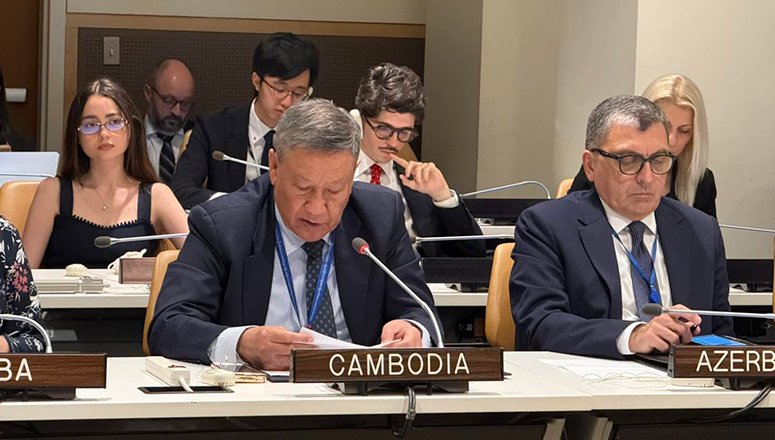
Speaking at a UNSC Arria-Formula meeting on June 23, Keo Chhea, Permanent Representative of Cambodia to the United Nations, said these measures are essential for the peaceful settlement of disputes and the prevention of conflicts.
“Given the considerable efforts required to achieve their adoptions, their implementation must be effective, timely, and consistent,” he said.
Chhea cited Article 25 of the UN Charter, which obliges all UN members to accept and carry out the decisions of the Security Council.
“Selective or partial implementation undermines the authority of the council and weakens its ability to fulfil its mandate,” he added.
According to a UNSC concept note published before the session, decrees frequently go unfulfilled due to a lack of political will, operational inefficiencies, or resource constraints. The council added that growing differences among member states regarding tools like sanctions and peacekeeping operations also hinder compliance.
At the meeting, which was co-chaired by China and Pakistan, the Cambodian envoy called on every UN member state to uphold ICJ rulings to preserve regional stability.
“While Security Council resolutions must be fully implemented, judgments of the International Court of Justice, given their legally binding nature, must not be violated under any pretext whatsoever,” Chhea said.
“Cambodia emphasises that achieving the objectives of Security Council resolutions ultimately depends on their full and effective implementation by member states, including parties concerned.”
The comments followed Cambodia’s border dispute with Thailand over the 11th-century Preah Vihear Temple and its surrounding areas.
In 1962, the ICJ ruled that the temple belongs to Cambodia, utilizing colonial-era maps. However, the exact boundaries of the surrounding land remained undefined, leading Cambodia to request a clarification. In 2013, the ICJ ruled unanimously that the promontory of Preah Vihear falls under Cambodian sovereignty and ordered Thailand to withdraw its military forces.
Last year, Cambodia submitted another request to the ICJ regarding other disputed border and temple areas. Thailand has maintained that it does not accept the compulsory jurisdiction of the ICJ—a stance it has held since 1960—arguing that territorial issues should be resolved through bilateral negotiations.
The disagreement has previously led to military clashes and a downgrade in diplomatic ties.
Pou Sothirak, a retired diplomat and distinguished senior advisor to the Cambodian Center for Regional Studies, said ICJ rulings are important because they represent international recognition of ownership and sovereignty.
“The ICJ is not an ordinary court. It is a respected institution that resolves disputes involving sovereignty and territorial ownership,” he said. “Therefore, Thailand should also respect decisions made by the international judicial system.”