Synopsis: Shenyang forum brings together regional officials and communication experts to address shared digital growth under an expanded strategic partnership.
SHENYANG, China – Cambodia yesterday outlined three priorities to strengthen ASEAN-China media cooperation, focusing on information integrity, digital capacity building and people-centered storytelling as the region faces technological change and cross-border information challenges.
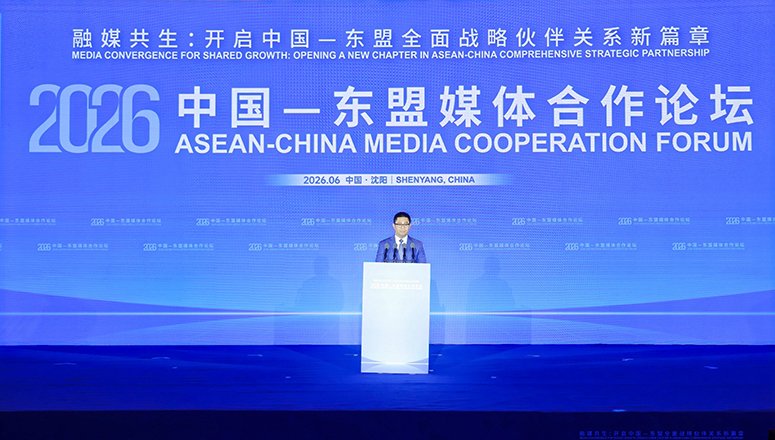
Speaking at the opening ceremony of the 2026 ASEAN-China Media Cooperation Forum on June 8, Prak Thaveak Amida, Undersecretary of State at the Ministry of Information, said closer collaboration between ASEAN and Chinese media institutions is needed to address emerging challenges and deepen mutual understanding.
The forum, held under the theme “Media Convergence for Shared Growth: Opening a New Chapter in ASEAN-China Comprehensive Strategic Partnership”, was attended by government officials, media representatives, communication experts and scholars from ASEAN member states and China.
The event in Shenyang, Liaoning province, China, was co-hosted by the ASEAN-China Centre and the China International Communications Group.
Thaveak Amida said the event marks the fifth anniversary of the ASEAN-China Comprehensive Strategic Partnership and the 35th anniversary of ASEAN-China Dialogue Relations.
Media cooperation has become an important component of the broader partnership, helping to promote cultural exchanges, public awareness and mutual understanding across the region, he said.
Cambodia sees three key priorities for future ASEAN-China media cooperation, Thaveak Amida said.
“First, we should strengthen information integrity and practical cooperation in fact-checking,” he said.
Public trust remains a valuable foundation of a healthy information ecosystem, he said, calling for regional mechanisms to share experiences, exchange early warnings on misinformation and coordinate responses to cross-border falsehoods.
“Second, we should promote inclusive capacity-building for the digital era,” he said.
Media professionals increasingly require skills in areas such as data journalism, the ethical use of artificial intelligence, audience analysis, digital safety and cybersecurity awareness, Thaveak Amida said.
Cambodia supports inclusive ASEAN-China training and exchange programs that help journalists, editors, spokespersons and digital communicators adapt to the evolving media environment, he added.
“Third, we should promote human-centered and constructive narratives,” he said.
Media organisations should continue highlighting the daily benefits of ASEAN-China cooperation in areas including culture, education, tourism, green innovation, trade and people-to-people exchanges, Thaveak Amida said.
He welcomed the launch of the ASEAN-China Social Media Creators Initiative, describing it as a timely effort to engage digital content creators in advancing public communication and cultural connectivity.
“This initiative is timely and important, as digital content creators are becoming influential partners in public communication, cultural exchange, and people-to-people connectivity,” he said.
Thaveak Amida encouraged content creators to produce reliable and culturally respectful content while helping strengthen ties between ASEAN and China.
“As we move forward into this new chapter of the ASEAN-China Comprehensive Strategic Partnership, Cambodia stands ready to work closely with all ASEAN Member States, China, think tanks, media institutions, and digital communication partners,” he said.
The forum should serve as a catalyst for practical cooperation, resilient partnerships and shared benefits for the region, he added.
China International Communications Group President Chang Bo said media organisations play a vital role in advancing people-to-people and cultural exchanges between China and ASEAN, as well as deepening efforts to build a community with a shared future.
The media serve as an important bridge for strengthening mutual understanding among people across the region, Chang said.
“People-to-people affinity is an inexhaustible source of strength for ASEAN-China friendship and cooperation,” he said.
Chang called for greater efforts to transform shared understandings into practical cooperation by overcoming geographical and language barriers and promoting exchanges among civilisations.
Such efforts would help strengthen public support for ASEAN-China friendship and provide a stronger foundation for building a community with a shared future, he said.
Chang added that digital transformation and innovation support regional development.
China has pursued high-quality development by fostering new quality productive forces and advancing science, technology and innovation cooperation with ASEAN countries, he said.
China’s experience in digitalisation and intelligent transformation offers opportunities for mutual learning with ASEAN members and aligns with the objectives of the ASEAN Digital Master Plan 2025, which seeks to establish ASEAN as a leading digital community and economic bloc, Chang said.
“We should embrace digital transformation and use media convergence to support the upgrading of the regional media sector,” Chang said.