This is the ninth article in a series about travel and the 250th anniversary of the Declaration of Independence.
In the run up to the Battle of Bunker Hill, some 1,500 newly minted minutemen were bivouacked in Massachusetts at Harvard University. Buildings were stuffed to the gills, soldiers spilling into barracks, and where students now crisscross Harvard Yard stood a row of privies and a slaughterhouse. Every tree for miles had been cut down for fuel, giving the colonial troops a clear view of their enemy across Boston Harbor.
According to recent research, some 10 percent of these troops were Black.
The history of abolition in New England has tended to obscure the region’s equally robust history of slavery. In Massachusetts, sprawling mansions down Brattle Street in Cambridge were funded by plantations in Antigua; churches in Andover had balconies where enslavers forced their captives to worship. In Newport, R.I., an enslaved child could be purchased for gallons of rum, and white citizens traded humans along with copper kettles.
The Black Americans who fought for our country emerged from that world. Living in postcard-pretty New England settings, these New England captives lived lives of genteel terror. Separated from their spouses — children sold or simply given away — their lives were as circumscribed as the narrow back stairs they took from the kitchen to the attic, blazing in summer, bone-chilling in winter.
When war with Britain was declared, these Black Americans faced a choice that was not really a choice. Either fight for their enslavers or stake their futures on an impetuous promise: Lord Dunmore, a loyalist governor who had not bothered to free the people he enslaved, offered freedom to indentured servants and people enslaved by patriots who joined “His Majesty’s troops.”
About 20,000 Black soldiers did just that. They fought for the British in what Dunmore called his “Ethiopian regiment.” The most famous of these men is Colonel Tye of New Jersey, who harassed the Continental Army in raids across Monmouth County after escaping his brutal Quaker enslaver.
Meanwhile, 5,000 to 10,000 Black men fought for the Americans. Some were forced to fight alongside their enslavers. Some were sent to fight in their enslavers’ place. Many, in the chaotic wake of the war, self-emancipated.
Some of their feats were so impressive that we remember them to this day: Peter Salem of Framingham, Mass., mortally wounded Maj. John Pitcairn on Bunker Hill; Salem Poor of Andover was known by his peers as a “brave and gallant soldier.”
Their heroism did not guarantee their liberty. The few who gained freedom still struggled: to find work, to buy land, to build wealth. Free Black veterans were forced to live on the fringes of their communities in poorhouses or on unprofitable land. They were denied pensions. Their lives were still circumscribed by laws that punished them for their race. The fight for freedom was far from over.
When I was a preteen in Massachusetts, trudging through Old Sturbridge Village and the battlefields of Lexington and Concord with my multiracial family, history guides didn’t tell tales of Black people’s bravery.
But as an adult, I came to realize that there must be more to our story. So in April, wearing inappropriate footwear (I had forgotten that in a New England spring, you should dress for all four seasons), I set out on a journey to better understand the lives of Black soldiers during the Revolutionary War. I found historians, museums and scholars working to resurrect this history, and to offer a fuller picture of the fight for — and contradictions of — American independence.
After all, I already knew the worst part of the story: The founders’ so-called commitment to liberty did not include us.
The Fight to Fight
When the Virginian planter George Washington arrived in Cambridge, he took up residence in a grand mansion, looking down with dismay on the prospective troops arrayed on the grounds below.
The minutemen, he complained in a letter were a “mixed multitude” and “under very little discipline, order or government.”
According to Leslie Brunetta of the Cambridge Black History Project, an organization working with the Cambridge Historical Commission and Harvard University, what most likely disturbed him was that white, Black and Native officers, to say nothing of their rowdy camp followers, mingled below, with no discernible boundaries or hierarchy.
“I think up until very recently the mental picture was that all of these men were white, and there were maybe a few Black men cooking or something,” Ms. Brunetta said. “But it’s very porous, and everyone was socializing.”
What Washington was seeing was not equality, but the peculiar brand of New England slavery.
In towns such as Cambridge and Newport, enslavement took on a very different guise than it did on the plantations of the South. These were deeply domestic arrangements, in an upstairs-downstairs setting where the Black families were enmeshed and often related, as were the white families who enslaved them.
Given differences in how the slave system operated in the North and in the South, New Englanders were more willing to enlist Black men. Southerners, however, were resolutely against arming captives, believing that Black soldiers could not serve as courageously as white men.
Washington issued a ruling: The Army must not enlist any deserter, “stroller, Negro or vagabond,” but only men “of courage and principle.” From the beginning, Black soldiers had to fight to fight.
Voices of the Revolution
In 1849, William Cooper Nell led what is believed to be the first major effort to uncover the history of Black revolutionary soldiers. As a Black reporter with “The Liberator,” an abolitionist newspaper, he conducted interviews, combed through newspaper notices and reviewed court files to craft “The Colored Patriots of the American Revolution.”
The Museum of African American History in Boston displayed an original copy of the book in its “Black Voices of the Revolution” exhibit, which opened in July 2025. The fragile 396 pages are held aloft on a stand. Wishing I could turn them, I thought how Nell must have had no idea it would be another century and a half before historians took up the topic again.
Leafing through a gift shop copy, I learned that one soldier, Pompey Lovejoy, is the eponym for Pomps Pond, in Andover. My grandfather, who was shut out of pilot training in the 1940s and who fought in the Korean War, grew up swimming in Andover’s ponds. I’m sure he never knew Pomps was named for another Black soldier.
The exhibit also featured a life-size hologram of Frederick Douglass that draws from a database of Douglass’s speeches and writings to answer questions using artificial intelligence. His booming voice was both arresting and slightly disconcerting, as Douglass, rendered like a Grand Theft Auto character in a frock coat, swayed gently. I thought of his famous quote from the speech “What to a Slave is the Fourth of July? “:
“Your high independence only reveals the immeasurable distance between us. The rich inheritance of justice, liberty, prosperity and independence, bequeathed by your fathers, is shared by you, not by me. This Fourth July is yours, not mine. You may rejoice, I must mourn.”
Bundled Spirits
I came to Rhode Island a few weeks ahead of tourist season to preview the new Newport Center for Black History, which opened on Juneteenth. Housed in the Wanton-Lyman-Hazard House, among the oldest homes in the city, the center focuses not only on slavery, but on what the director, Akeia de Barros Gomes, calls Black Newport’s “freedom-making.”
Chief among these types of displays is the museum’s most precious item, a Nkisi, or “spirit,” bundle that was discovered by a worker in the attic in 2005.
Bundles have been found throughout the African diaspora, but this is the first one unearthed in New England. Wrapped in checked fabric, it holds nails, shells, beads, even a pit — all objects with symbolic meaning to the owner. It is, Dr. de Barros Gomes said, proof of the continuance of African spirituality in this home — how people maintained their humanity in bondage.
The bundle may have belonged to Cardardo Wanton, a Revolutionary soldier enslaved here by the prosperous merchant and Quaker John Wanton.
Under pressure from the church, Wanton manumitted Cardardo. But he kept him under “guardianship,” meaning he was free only in name.
Cardardo, like so many, enlisted to gain his freedom. He served on a secret mission with the First Rhode Island Regiment, which, desperate for bodies, allowed Black and Native men to enlist and paid them the same as white soldiers.
Dr. de Barros Gomes crafted brief and moving audio narratives, based on archival research and historical papers, of those enslaved in the home. I listened to Cardardo tell us why he chose to fight:
“I know the dangers. We’ll take the hardest posts. The bloodiest battles. But I’d rather die in the open air than live another year in chains.”
Into the Woods
I wanted to be sure not to miss Sippo’s Garden in Weetamoo Woods, a nature preserve in Tiverton, R.I. Apparently, it was the homesite of the Revolutionary soldier Scipio Cook, where flowers from his garden still bloom.
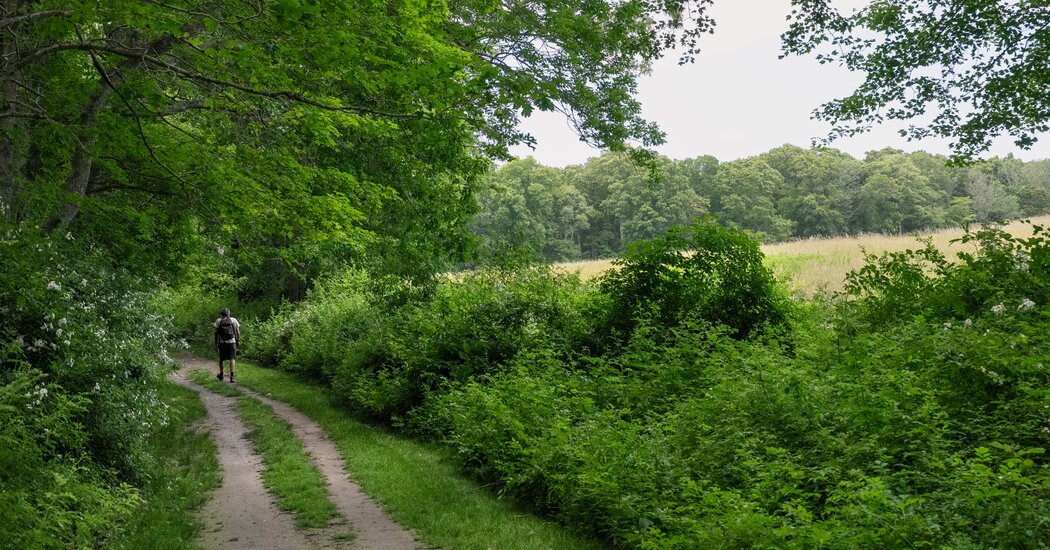
There is no mention of the site at the park’s entrance or in the trail guide, but a friendly dog walker circled it for me on a map. I set off in the dusk. Five minutes down a rocky path, I followed a small blue sign toward a beautiful place. The footprint of the house is evident in the tumble of stones, and a clearing is where the garden would have been. It was too early in the season for flowers, but I could hear the creek and occasional bird call, the wind settling in the trees.
According to the definitive book on enslaved people in the region, “If Jane Should Want to Be Sold” by Marjory Gomez O’Toole, Cook returned from war. In 1784, his enslaver granted him his freedom papers — whether he purchased his freedom or was given it for his service, isn’t known.
Cook and his family chose the Weetamoo Woods because Black people were increasingly unwelcome in Tiverton. The town had begun a campaign against “transient Blacks,” directing homes they built be torn down. The Cooks were only as free as the town allowed them to be.
Rethinking Thoreau
On a spring day, I drove north of Concord to the Robbins House, a historic home that houses the museum of Concord’s Black History. During my visit, I learned about Brister Cumings, who was enslaved for 30 years after he was given to John Cumings, a physician, when he was 9 years old. After fighting in the Revolution, he returned to Concord as Brister Freeman. With another veteran, he purchased land on the sandy soil near Walden Pond. That land allowed him to vote and speak at town meetings. Slowly, the town taxed him until it took the deed of the land back and, with it, his vote. But in an act of civil disobedience, he and his family refused to leave the land he had worked so hard to purchase.
About half a century later, Henry David Thoreau settled in the Walden woods along the edge of the pond. Freeman’s homestead and community became an inspiration for Thoreau, who settled near the site and wrote in “Walden” about Brister’s Hill and the legacy of the free man who lived there. The poet also chronicled drinking from Brister’s spring, and eating wild apples from the trees he had planted.
I became consumed with Brister’s story. It seemed inconceivable that a man featured in “Walden,” a mainstay of high school English, could remain so invisible for so long. Freeman and Concord’s captives fought on — and helped rebuild — the North Bridge. Freeman is also believed to be the first man in Concord to refuse to pay his poll tax as an act of protest, an action that Thoreau would mimic decades later. This community of freed Black people is inseparable from Concord’s history. Yet Thoreau’s legacy — honored by a gleaming National Park Service center only steps away — has entirely eclipsed theirs.
In 2023, Brister’s homesite was cleared by a high school student named Grady Flinn, as part of an Eagle Scout project. A large, heart-shaped piece of granite identifies where he and his wife, Fenda, made their home. The stone is lightly touched by lichen.
I walked down towards Brister’s Spring, located on the Emerson-Thoreau Amble. I had once thought such appellations — Brister’s Spring, Pomps Pond, Sippo’s Garden — were signs of a community’s affection. I now know they signify a people who had not merited surnames.
I missed the spring on my first pass, but turning around on the pine-strewed path, I saw a slim blue sign reading “Brister’s Spring” rising from a damp patch.
I had found the spring, I realized with delight. Untouched by tour bus or visitor’s center, it was precious in its isolation. But there is a point at which isolation can become obfuscation. Brister’s Spring, I could see, was alive and wild — filled with a history that is still bubbling up, trying to reach the surface.