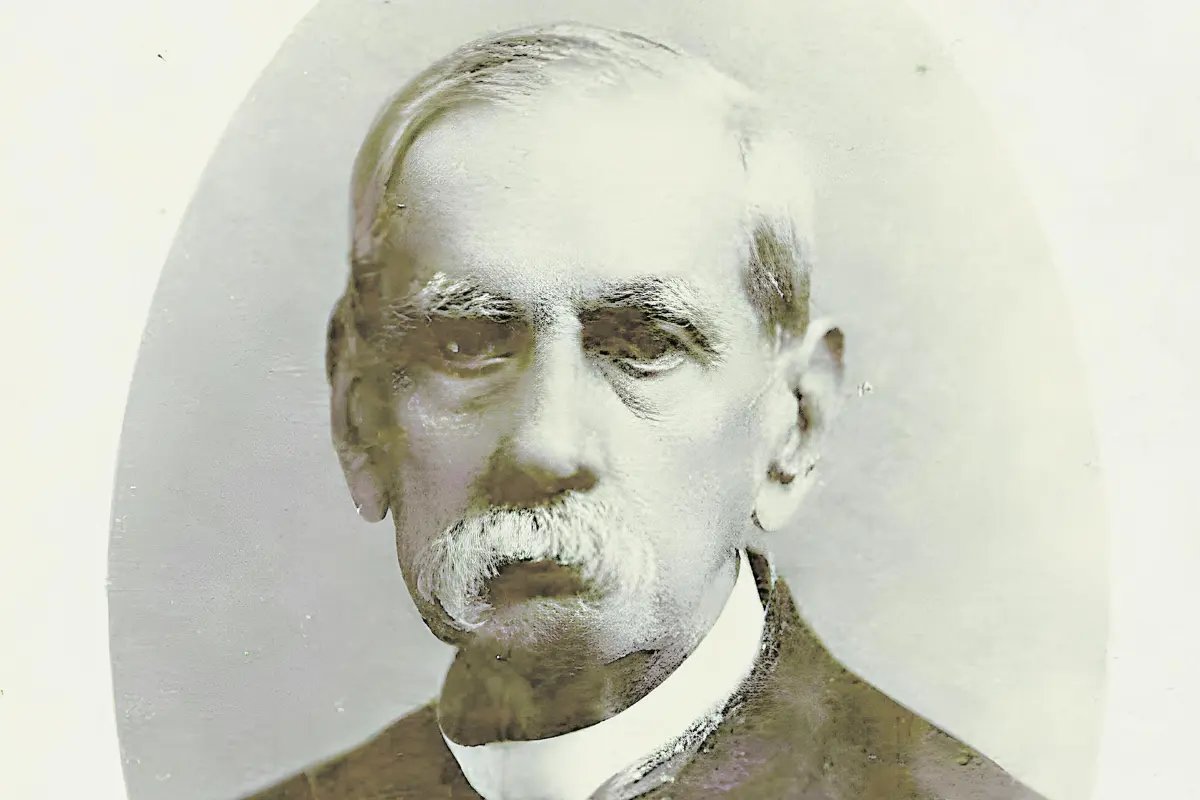
By honorable designation of the National Bar Association, a distinction for which I am extremely grateful, I have come in solemn pilgrimage to this citadel of silence, to pay tribute of admiration and respect to the venerable memory of that egregious Isthmian who, knowing how to live and die, like few others, with dignity, has left his immaculate name, his profound thoughts and his determined and firm actions, as a spiritual legacy to the new generations, not only of my country, but of Hispanic America.
And I say about Hispanic America, because although it is true that the distinguished figure of the enlightened patrician has filled us with the healthy selfishness of wanting him for ourselves and nothing else for ourselves; Its principles and doctrines, by transcending the limits of our borders, have necessarily distanced it to bring it closer and closer to all the peoples of this continent.
And it could not be any other way, gentlemen, since Justo Arosemena, spiritual sower and tireless reformer, without forging vain hopes, made room in his daily work for the exalting task of fighting for an America of union, peace and harmony; proud of its independence and sure of the future, where the rough edges and divergences that usually cause the thorns of diplomacy and government policy could be ironed out, and where cordiality and absolute trust would guide this alliance of nations along the true path of its greatness.
It is not surprising, then, that, with such noble designs, Justo Arosemena is the balm that flows from the very bowels of the earth and spreads throughout the continent, leaving us the aroma of these three words: union, peace and harmony. But if Justo Arosemena represents an ideal in the international field, neither his glory nor his fame end there, because when the men who reach, like him, at the height of prestige and power, manage to remain unscathed and instead of shreds of honor they leave us indelible traces of dignity, simplicity and patriotism, glory and fame are nothing more than pale shades before their true greatness of being able to take refuge in the fullness of a clear conscience.
Trying to frame within this funeral prayer the civic virtues that have made this illustrious man the greatest of Panamanians is not an easy task, especially if we take into consideration the intense emotion we experience when we find ourselves in front of the tomb that piously guards his venerable remains.
Therefore, it is enough to say that in Justo Arosemena we find the consummate journalist with a captivating pen, who, knowing the social and cultural function that the press must perform, did not use it as a springboard to obtain the canonries, perks and sinecures that rulers eager for flattery could offer him; to the educator who, seeing the youth as the officials and citizens of tomorrow, preached about the need to promote education as the main means of solving national problems; to the moralist who, considering that among the first duties of the governments of America was to preferably establish the teaching of political morality in the institutes where youth are trained, wrote a catechism entitled “Principles of Political Morals”, dedicated, as expected, to the youth of America; to the legislator of clear intelligence and knowledge of our public law, who called for radical reforms and who, when presenting projects of positive benefits for the Isthmus of Panama, supported them with enthusiasm and energy, displaying a dialectic that gave his verb an unassailable authority; and the politician, who – as Dr. Carlos A. Mendoza rightly said –, “Although he sometimes stayed away from the fiery struggles of politics, he always maintained the fundamental doctrines of the party to which he joined since he was a child, without the high positions that he more than once spontaneously abandoned or rejected with disdain in order not to accept any complicity with the criminals of that country to weaken his ideals.”
This was Justo Arosemena to whom we come to pay this heartfelt tribute. This was the Justo Arosemena who, considering the free expression of thought by word or print, one of the inalienable rights of the individual, did not accept any other limitation than holding responsible those who utter obscene, intemperate, slanderous or slanderous expressions, because, as he very well understood, freedom of expression cannot reach licentiousness or irresponsibility. But if Don Justo presents himself to us as the politician who knows no duplicity and as the philosopher who is a beacon and light for the new generations, we also see in him the lawyer who knew how to exalt the profession with his clean career on the benches of the courts.
For this reason, the First National Congress of Lawyers held last year in the capital city, did not hesitate to choose as a symbol this champion of noble causes, who in open antagonism with the criterion that has predominated among the majority of our rulers, of dismissing the importance of the Judicial Branch, expressed: “The administration of justice is the cardinal end of the government that men have established; because if they live in peace, government would be unnecessary. Political combinations have no other objective than to make individual guarantees positive and lasting, and these are only assured through a good judicial system.” The jurist in Arosemena made him rebel against the unintelligible codes, even for legal professionals, added, interpreted and altered by a multitude of acts that made them lose the harmony and correlation that should exist between all their clauses, to convert them into mere bodies of laws, heterogeneous and discordant, in perfect disagreement with the customs and needs of the time.
It is not possible, gentlemen, to fail to mention on this occasion the “Constitutional Studies on the Governments of Latin America”, a magnificent work, written with brilliance, which highlights the strong personality of Dr. Arosemena. The Master of the Panamanian youth and great admirer of Don Justo, Dr. Octavio Méndez Pereira, said of her: “Do you want to know Dr. Arosemena’s ideas about federation, centralism and the municipal regime, about citizenship and political rights, about public education, morality and popular elections, about dictatorship, justice, freedom and liberalism, about individual guarantees, sovereignty and government, about the jury, militarism, capital punishment, religion, etc., etc.? Read the Constitutional Studies. Of them it can be said what Ingenieros, of the Alberdi Bases, said: Science and inspiration went hand in hand there. What to admire most in that granite book? The synthesis? The accuracy? The firmness? Faith? The opportunity? Such a work could never have been written cold. It has the liveliness of a controversy, if you look at the past; He has the warmth of a prophecy to spare, when he contemplates the future. He is not silent in the face of the most grim scourges of colonialism, perhaps fearing that, by keeping quiet about his illness, the patient would resist taking the medicine; He is not intimidated by the responsibility implicit in his predictions of future well-being. His pessimism in judging the past had as a natural equivalent his optimism in foreseeing the future. The Arosemena of the Studies is a statesman in full virility. To appreciate it, to admire this work of science applied to the art of governing nations, you have to read it.”
Sirs:
Today, when we are going through a crisis of values and, above all, of men, the figure of Justo Arosemena rises through the sky like a shining star radiating flashes of hope. Let us remember his memory, but above all let us imitate his virtues, because the best tribute we can offer to this distinguished citizen is not pilgrimages or laudatory speeches, but rather the sincere desire to lead, like him, an honest, decorous and dignified life, tempered in the crucible of duty and patriotism.
Occupation: Diplomat and politician. He taught Public International Law at the University of Panama, where he was secretary, vice dean and interim dean. He was a deputy to the National Assembly, principal member of the National Council on Foreign Relations, president of the Board of Directors of the Institute of Housing and Urbanism and of the Gaming Control Board, Minister Counselor of the Permanent Delegation of Panama to the UN, governor of Panama before the World Bank, titular representative of Panama before the Inter-American Economic and Social Council, and before the V Assembly of Governors of the Inter-American Development Bank, where he was elected president of the same. He was Minister of Foreign Affairs, Minister of Finance and Treasury and Interim Minister of Labor and Social Welfare. Partner of the Tapia, Linares y Alfaro Law Firm, President of the Unión Club, president of the Nationalist Party, Secretary General of the Hispano-Luso-American Institute of International Law, member of the International Law Association, of The American Society of International Law, of the Panamanian Academy of Law, of the National Bar Association, of the Panamanian Institute of Hispanic Culture, of the Bolivarian Society of Panama, of the Latin American Institute of Advanced Studies, of the Panamanian Academy of History, of the Argentine Association of International Law, the Active 20-30 Club of Panama and the Kiwanis Club of Panama. Works: Civil Cassation in Panamanian Legislation (1968), Public International Law (1977), Treaty concerning Permanent Neutrality and the operation of the Panama Canal (1983) and Enrique Linares in the Political History of Panama (1869-1949) – Ordeal of a people to strengthen its sovereignty (1989).