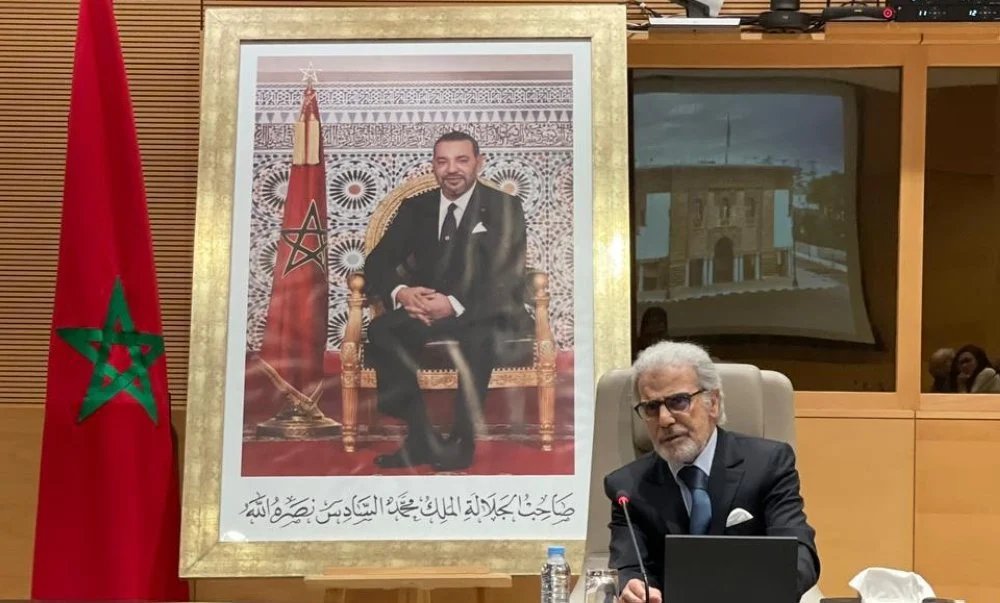
The site has entered its “final preparation phase”. It is in these terms that Abdellatif Jouahriwali of Bank Al-Maghrib (BAM)described the progress of the project inflation targetingduring the press conference which followed the meeting of the Council of the Central Bank, on June 23 in Rabat. A structuring project for the Moroccan economythe calendar of which is now becoming clearer with unprecedented clarity. According to the governor of BAM, the complete file will be submitted to the Council of the Emission Institute next September. A full-scale simulation could then be organized in December, before an official entry into force planned for 2027. “This timetable, however, remains conditional on the absence of new major shocks to the global economy,” he specified, with the necessary caution. To successfully complete this transition, the Central Bank benefits from technical assistance from International Monetary Fund (IMF) and has established partnerships with several foreign institutions. Face-to-face cooperation is notably planned with the Central Bank of Chile, considered one of the international references in this area. Internally, Bank Al-Maghrib is strengthening the skills of its teams and preparing its regional network to explain and support this new framework to economic players. “Communication is an essential element of successful inflation targeting,” Jouahri insisted. At the same time, significant awareness-raising work is underway with the private sector. The question will be among the topics discussed during upcoming discussions with the General Confederation of Moroccan Enterprises (CGEM)with a view to developing a memorandum intended for the future government resulting from the next political deadlines. The governor was calm: the project is progressing according to the planned schedule, and the foreign exchange reserves – projected at the equivalent of six and a half months of imports at the end of 2026 – offer the country the necessary margin of security to approach this turning point in good conditions.

MRE transfers at the heart of a European regulatory battle
It is an unexpected front which has opened for the Moroccan banks operating in Europe. The legislation adopted by the European Parliament in June 2025, resulting from post-Brexit regulatory adjustments, called into question their role of intermediation in transfers from Moroccans living abroad (MRE). Initially designed to prevent British banks from continuing to benefit from the “European passport”, the text has, due to its general scope, affected the relay activities of Moroccan banks established on the Old Continent. Faced with this situation, the Moroccan authorities reacted quickly, by setting up a task force involving the Ministry of Foreign Affairsthe main banks concerned, Bank Al-Maghrib and the Treasury Department. After an initial contact with the European Commission – of which the FISMA Directorate (Directorate General for Financial Stability, Financial Services and Capital Markets Union) has referred each Member State to its own transposition – discussions were first initiated with France, which concentrates most of the activities linked to MRE transfers. “The discussions made it possible to reach a solution which in no way calls into question the relay role played by these establishments,” indicated the wali. Negotiations now continue with the Netherlands and Belgium, with Spain and Italy the next steps. Each country has its own interpretation of the European text, discussions must be carried out on a case-by-case basis. “The approach that has borne fruit with France will not necessarily be sufficient everywhere,” recognized Jouahri, while saying he was “confident about the outcome of these discussions.” The process is likely to continue throughout 2026, but the first feedback from the Dutch and Belgian authorities is, according to him, “rather encouraging”.
Key rate: a real, but nuanced, transmission
Asked about the impact of reductions in key rate to credit conditionsthe governor wanted to reframe the debate. Of the 75 basis points of reductions decided by Bank Al-Maghribaround 77% have already been transmitted at the lending rates practiced by the banks. But this transmission is not uniform according to customer categories and types of credit.
On the real estate loanoften cited as an example of insufficient impact, Jouahri provided technical insight. “THE banks cannot simply mechanically pass on short-term variations in the key rate without taking into account the rate risk to which they are exposed” on commitments that can run over twenty years. Referring to an average rate of 5.43% observed in this segment, he urged not to interpret it in isolation: “A rate above 5% may seem high when observed instantly, but it must be appreciated within the framework of a contractual commitment which extends over two decades.”
Investment: the awakening of the private sector, absolute priority
On the growth outlook – 4.9% projected for 2026, then 3.1% in 2027 – the wali wanted to qualify fears of a slowdown in public investment after 2030. Many current projects will continue beyond this deadline, like the OCP group’s investment program, which represents around 20 billion dirhams per year. “Nothing suggests that this effort will decrease after 2030, particularly if new strategic directions such as the development of the green hydrogen sector continue to materialize,” he stressed. But the priority remains, in Jouahri’s eyes, the “awakening of private investment”. He cited the reform of public-private partnershipthe new Investment Charter, the role of Regional Investment Centers and the territorial development program endowed with 240 billion dirhams. A tripartite meeting is being prepared between Bank Al-MaghribTHE Ministries of Finance and InvestmentTHE Professional group of banks in Morocco (GPBM) and the CGEM to identify levers likely to further accelerate private investment.
On the aspect of very small businesses (VSE), the governor announced the completion of the development of a scoring system developed in collaboration with the credit bureaus, already presented to the banks. “The central project is now completed,” he declared, specifying that a coordination meeting is planned for the beginning of July to integrate the contribution of Maroc PME in terms of support and training.
Geopolitics: the Strait of Hormuz in the sights of Bank Al-Maghrib
On the external front, the current account deficit – projected around 4% of gross domestic product (GDP) – does not constitute “in itself a major source of concern”, according to Jouahri, who anticipates an improvement from 2027 if the geopolitical situation stabilizes. The main explanation for the degradation lies in the increase in energy billdirectly influenced by tensions in the Middle East.
But it is a more insidious risk that worries the governor more: potential disruptions in supply chains. He illustrated this danger through the case of sulfur used by OCP in the manufacture of fertilizers, the price of which has already crossed the threshold of 1,000 dollars per ton. “A significant portion of the group’s sulfur imports transit through the Strait of Hormuz. In the event of a lasting disruption of this strategic maritime route, OCP could encounter supply difficulties likely to affect its production capacities,” he warned. Bank Al-Maghrib also closely monitors automobile exports, exports of phosphates and derivatives, and foreign direct investment flows, which could suffer from a reallocation of resources from investing countries towards their domestic priorities or towards post-conflict reconstruction programs.
On all these fronts, the wali concluded on a note of adaptive lucidity: in a world marked by “an almost uninterrupted succession of crises since 2008”, the notions of agility, adaptability and innovation have become permanent requirements for public institutions. And digital mutations – artificial intelligence, cryptoassets, central bank digital currencies – “will continue to surprise economic players with their speed and intensity”. n