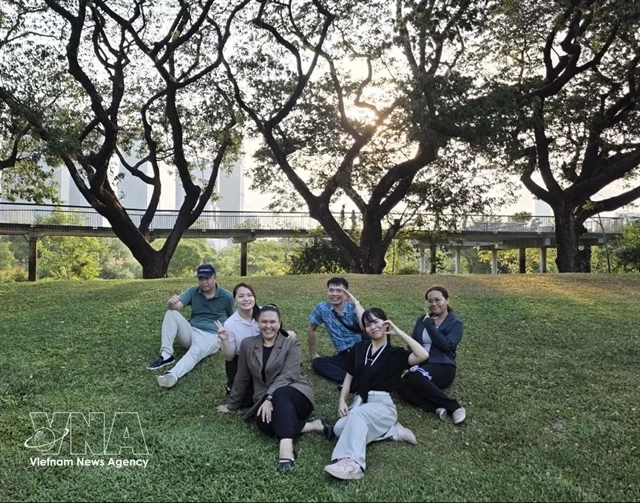
The park also serves many different users, including runners, cyclists, birdwatchers, families, yoga groups and people looking for quiet leisure. Their varied expectations make Benjakitti both lively and complex to manage.
Sanon said the park has become much more than a place for exercise. On weekends, it draws fitness groups, yoga and Pilates sessions, cycling communities, book clubs and families, turning it into a layered social space.
While Benjakitti shows planned environmental redevelopment, a separate change has taken shape more spontaneously along the Chao Phraya River.
At Phra Phutthayotfa, or Memorial, Bridge near Pak Khlong Talat, Bangkok’s historic flower market, a viral trend for lotus photography has made the area a new cultural attraction.
Pornphrom Vikitsreth, Chief Sustainability Officer and Advisor to the Governor of Bangkok, said the trend shows how the use of public space is changing, especially among younger people.
Instead of gathering mainly in shopping malls, more young people are using parks, bridges and riverfront areas. The lotus photography trend brings together cultural symbolism and modern visual storytelling, showing how tradition is being reinterpreted through contemporary urban life.
This shift is also visible in other parts of Bangkok. Streets are becoming more pedestrian-friendly, walkways are being improved, and high streets are gaining attention as alternatives to enclosed malls. Public space is increasingly becoming social, creative and experience-based.
However, such trends can also create environmental pressure, particularly from waste. Pornphrom said Bangkok has responded by designing waste systems around specific events and public behaviour rather than treating waste as an afterthought.
Lotus flowers, for instance, are treated as organic waste. Instead of being sent to a landfill, they can be directed into composting systems and reused as soil for tree planting, supporting the city’s circular economy approach.
Authorities have added separate bins and clearer signs, while public messaging encourages visitors to act responsibly. People are urged to reuse lotus flowers, take them home, or give them to family members. If the flowers must be discarded, organic waste bins allow them to be composted rather than sent to a landfill.
Pornphrom said this reflects Bangkok’s wider strategy of treating waste as a resource instead of a burden.
The city is also trying to cut waste at the source. Measures include discouraging single-use plastics, encouraging reusable water bottles and expanding a network of around 2,000 water refill stations.
According to Pornphrom, Bangkok’s long-term target is to reduce landfill waste from about 50 per cent to 25 per cent, while moving towards a more sustainable and people-centred urban system.
Thai officials also see room for shared learning with Vietnam. Sanon said Southeast Asian cities have similar urbanisation patterns and a strong cultural connection to public space. In both Thailand and Vietnam, young people often gather in parks, squares and open urban areas, creating opportunities to exchange ideas on green infrastructure, public space activation and sustainability.
After visiting major Vietnamese cities, including Ha Noi and Da Nang, Pornphrom said the similarities between the two countries were clear.
“Both Vietnam and Thailand are at comparable stages of development and face similar challenges in waste management and transportation. Shared food cultures produce similar waste streams, while heavy reliance on motorcycles creates parallel opportunities for electric mobility transitions,” he said.
“These shared conditions provide a strong foundation for regional cooperation between Vietnam and Thailand in advancing more environmentally sustainable urban development,” Sanon added.
Thai officials said the role of cities is expanding beyond physical infrastructure. Public spaces and urban systems now need to connect nature, culture, technology and human behaviour. Strengthening green areas and sustainable systems, they said, is essential not only for the environment, but also for more liveable, resilient and inclusive urban futures.
VNA/VNS