From finding a flat and applying for jobs to dating, does having a foreign name make life harder in Denmark? We spoke to our readers to find out.
Life in Denmark can be challenging sometimes. Whether it’s the stress of finding an apartment, trying to progress in your chosen career or navigating the world of online dating, foreigners face many of the same difficulties Danes do – but they may also face more disadvantages.
The issue of Danish names being favored over foreign-sounding ones is not a new topic in Denmark. It’s been discussed on repeated occasions on social media like Reddit and covered by several Danish media – see this article from Copenhagen’s TV2 Cosmopol as an example.
Aarhus University’s School of Business and Social Sciences concluded in 2017 that job applicants with Muslim-sounding names send 50 percent more job applications for every three interviews they are invited to.
From careers to dating apps, can a foreign name sometimes act as an albatross around your neck, making it harder to succeed in Denmark?
When The Local surveyed readers on the issue, the answer appeared to be “yes”. Around three quarters (73 percent) of respondents said that their name had affected their life in Denmark, with 23 percent saying it hadn’t and 4 percent saying they didn’t know.
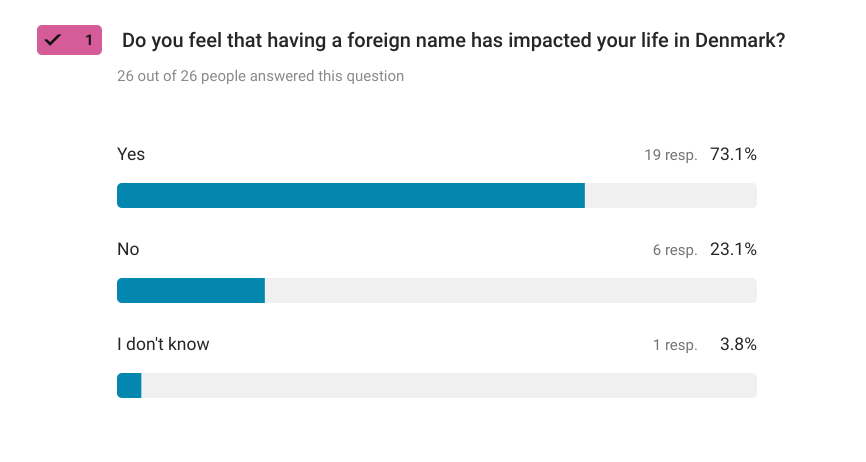
It’s worth keeping in mind that our sample size is relatively small and our method is not scientific, but rather a request for personal inputs. A number of the answers we received contained responses only to the first two questions, which asked for a yes/no answer and a score out of ten, and several didn’t leave a name. We’ve chosen to include all responses, regardless of how much further detail the respondent left.
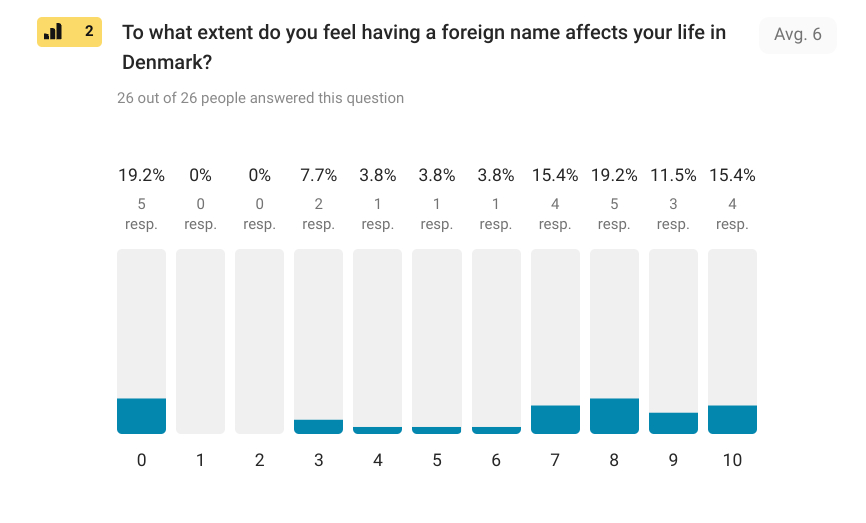
While 19 percent said their name had affected their opportunities in Denmark at a level of 0/10, over 60 percent gave a score of 7/10 or more. Around 19 percent were in the middle range, between 3/10 and 6/10.
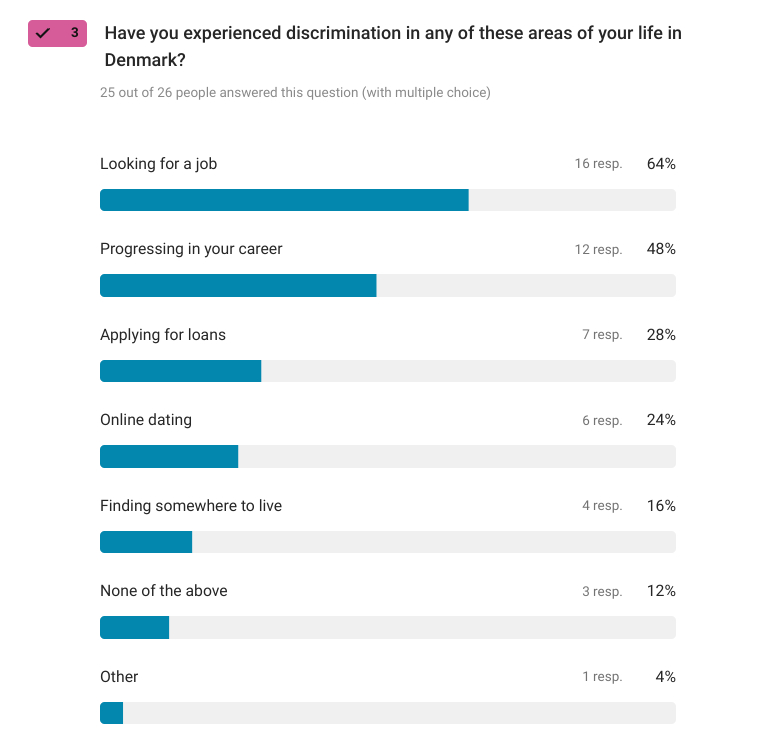
When asked to specify areas of life in which they had felt discriminated against because of their name, careers and job searching were the areas most people pointed to. After that came applying for a loan, while some also cited dating and looking for a place to live.
Copenhagen resident Ayse, 32, said her experiences left her with the clear impression that having a foreign and Muslim-sounding name was detrimental to her job prospects.
“Having changed my last name to a Danish one while applying for jobs has made it so much easier to get interviews, which is a shame but a sad reality, and I know others who have had the same experience too,” she wrote.
Even spelling differences can be crucial in how someone’s application can be treated, she said.
“I also know of someone who came here as a refugee with the name Noora, one of the things her municipal counselor (told her) was to change it to Nora so it sounds more Danish and would make it easier to apply for jobs,” Ayse said.
A similar account was given by Jamie, a 33-year-old in Aarhus who has faced difficulties landing a job to match his qualifications.
“It’s almost impossible to find work at the level I am qualified and experienced to do. There is huge discrimination in the workplace if you are not Danish,” he wrote.
“I find it hilarious that there is so much focus on bringing internationals to Denmark but the infrastructure is not capable of completing this task. Fifty percent of expats only last five years and I’m not surprised,” he added.
A 2020 study by the Confederation of Danish Employers found that highly qualified foreign nationals remain in Denmark for more than five years in 81 percent of cases if their spouse also found work, but this dropped to 68 percent when their spouse was unable to find work.
A foreign name may hinder job applications if it alerts employers to the fact the applicant is not a Danish speaker, Antony in Middelfart told us.
“Even though 95 percent of Danes speak English, the companies I have received feedback from want Danish speaking personnel,” he wrote.
A reader who did not leave their name wrote that “there is automatic bias looking at a non-Danish name, and an Asian name makes it much worse.”
“I have tried looking for work and I know that I have been passed over even for interviews for someone less qualified. I have heard of friends with similar origins who have encountered even more bias,” they said.
Another anonymous respondent to our survey wrote that they “went to a high end hotel I had applied for a job with to see if they had received my resume.”
“The woman at the desk told me they had and they were under no obligation to respond at all as I am ‘not Danish’. That was the day I learned the workforce can discriminate against foreigners as much as they want as long as it’s not traceable on paper,” they said.
While Danes are often open to foreigners it “sometimes seems that they have no clear (idea) about multiculturalism and multiracial differences” wrote Carla, 50, a scientist who lives in Copenhagen.
“Most of the time, as a single woman, people I meet assume that I have come here as a refugee or that I am in difficult circumstances. They believe I am not well-educated or financially stable. This prejudice arises from their assumptions based on my skin color and ethnic background, leading them to view me as inferior,” she said.
Not all readers who responded to our survey have experiences like the ones described above.
Philip, who lives on Zealand said he has “never experienced any adverse treatment because of my name”.
Almost everyone who related their personal stories described a situation related to the workplace or job applications, with topics such as dating or house hunting not coming up.
Some had more general observations about discrimination in Denmark, such as Mike in Copenhagen.
“Overall, Denmark is a great place with one of the lowest discrimination against foreigners in the world. Some bias in favor of Danish natives is expected as this is human nature,” he wrote.
“Nonetheless, most Danes don’t discriminate and actually welcome foreigners, are more forgiving for mistakes made by foreigners, and go out of their way to be inclusive. That’s at least my experience,” he said.