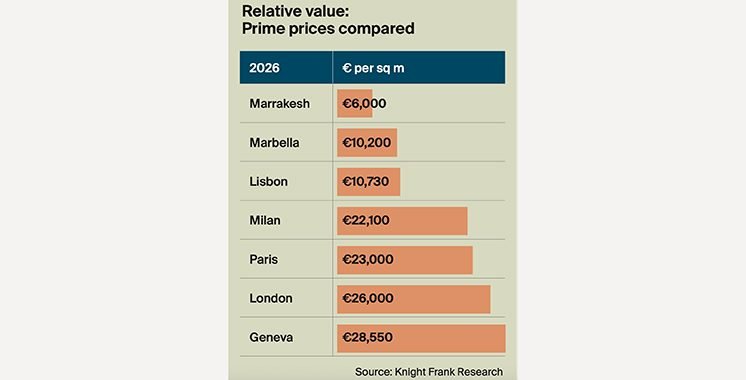
Relative value: A comparison of premium real estate prices which shows that Marrakech remains cheaper in this range.
Barometer: This is a first. The leader in international real estate consulting, Knight Frank (KF), released a study of the high-end residential market in Marrakech last week. Founded more than 125 years ago in Great Britain, the Knight Frank group brings its expertise as an international real estate consultant. The attractiveness of Marrakech is confirmed. The details.
The British consulting firm is recognized for its benchmark studies. Its Wealth Report on the wealth and luxury market published every year is a demonstration of this. This work presents global wealth trends and the performance of luxury real estate markets globally. Four weeks after the release of the 2026 edition, a specific report on the high-end “prime” residential real estate market in Marrakech was published for the first time.
Because it’s a fact: the ocher city has become as attractive and competitive as the classic European hubs. And the document reveals the keys to understanding the evolution of the real estate market in Marrakech. As designed, the report presents the sector, the advantages of investing in Marrakech, its attractions, the development of infrastructure, the financial and fiscal reality, the remaining obstacles. “The result was a growing market that is becoming more structured and more professional,” says Knight Franck. “It attracts new buyer profiles. High-end residential properties are generally between €5,500 and €7,000 per m². A sharp rise in prices is observed, supported by limited supply. The amounts have increased by around 10 to 15% in certain areas over the last two years, with demand for high-quality turnkey housing exceeding supply,” continues the specialist. The majority concerns furnished resale villas. Prices per square meter, however, remain lower than those in large European cities, which makes Marrakech very attractive in view of its other assets.
The study found that since the Covid-19 pandemic, property development activity has increased but uneven delivery standards have created a two-tier market, concentrating demand in established and professionally managed complexes.
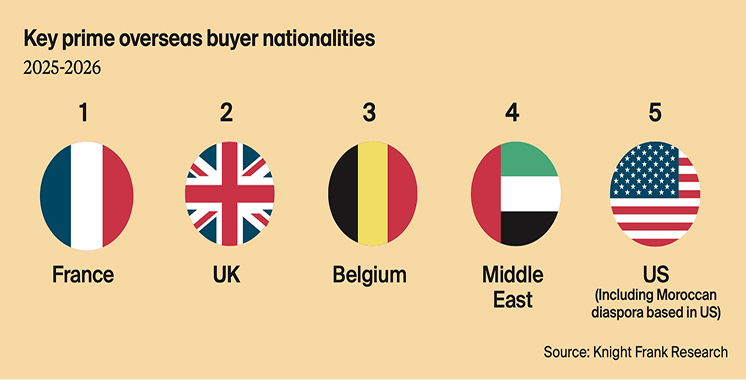
“The report identifies the 5 most popular areas based on buyer expectations. The medina for its riads. L’Hivernage and Majorelle, central, mainly composed of apartments. The other 3 mainly offer villas. These are Amelkis/Al Maaden/Route de Ouarzazate with its three golf courses, the Route d’Amizmiz which is becoming the most dynamic luxury corridor in Marrakech and the Palmeraie Nord/Route de Casablanca, which still stands out as the flagship segment thanks to its privileged location and its sought-after confidential properties with mature landscaped gardens over 50 years old,” continues the author of the study. The latter also highlighted the fact that “if France and the United Kingdom keep their places at the top, the Moroccan diaspora, buyers based in Dubai, and those from the Middle East and the United States are proving to be key drivers”. Clients were also identified as young (between 40 and 50 years old), mobile, with children in school. Stella de Bagneux, Knight Frank’s representative agent in the Marrakech-Safi region, rightly states that “buyers of high-end properties today are young families, professionals in the technology sector, households from the Middle East, the Moroccan diaspora and residents of Dubai looking for alternatives.”
The ocher city is attractive beyond its main asset linked to the climate. New buyers find offers in terms of culture, international schools, health, relative financial accessibility, daily security, developing infrastructure or even record levels of tourist attendance which reinforce the long-term dynamics of the market. “The demand is becoming more international and more thoughtful. Buyers are not just coming with a lifestyle perspective: they are comparing Marrakech to other global second home markets and recognizing the relative value it offers, particularly in the high-end segment,” comments Mark Harvey of Knight Frank.
In terms of infrastructure development, Morocco’s co-hosting of the 2030 FIFA World Cup accelerates the completion times for major infrastructure projects. The planned extension of the high-speed rail line linking Casablanca to Marrakech, and that of Marrakech-Menara airport which currently offers direct flights to 111 destinations, including New York and Riyadh, were recalled in the report of the international consulting firm. On another note, Knight Frank notes that “construction quality can vary considerably from one project to another, which makes prior verification essential”.
The report also provides information on the aspect of reassuring financial data for future buyers on transactional costs, annual taxes, capital gains tax. Morocco offers a relatively favorable tax environment, with no wealth or inheritance tax. It also has a network of conventions to avoid double taxation.
Ultimately, Marrakech is moving from an opaque, lifestyle-focused market to a more structured, international second home destination, with prices still lower than many comparable European cities. Its limited high-quality real estate portfolio aims to meet growing international demand. Improving infrastructure is expected to support continued growth and luxury property values are expected to increase by around 6% in 2026.