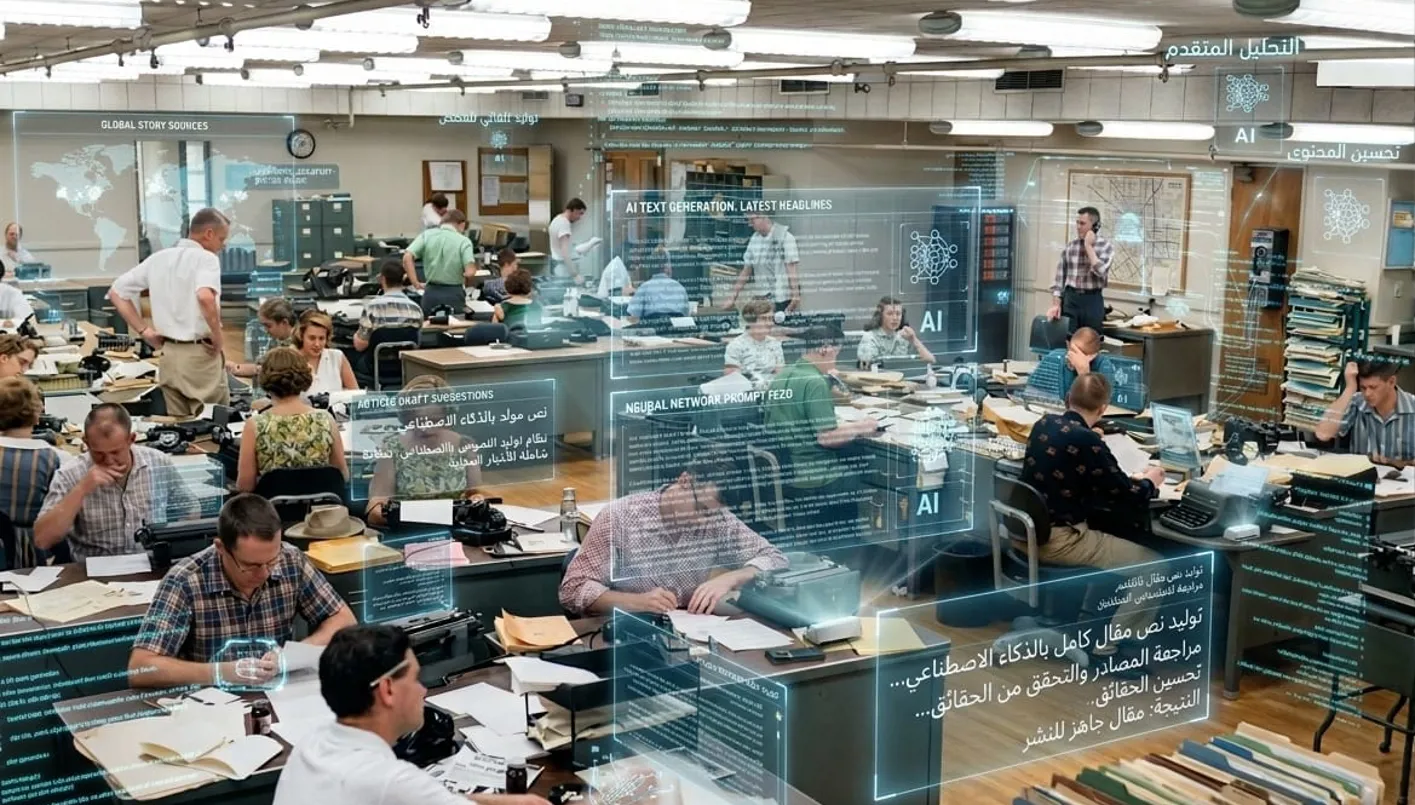
It may not be easy to distinguish between text written by humans and that produced by models artificial intelligenceRelying on recurring linguistic cues or stylistic markers, these models are constantly evolving, and their ability to mimic human writing increases. Therefore, the real difference does not appear in the form of writing, but in its source. The human writer writes from a personal experience and vision of the world, while linguistic models produce their texts by predicting the next word based on patterns they have learned from billions of texts.
In this context, an article published by The Atlantic reviews an experiment that examines the profound characteristics of the writing he produces artificial intelligencePointing out that the search for formal signs to detect automated texts is similar to the widespread belief in the late nineteenth century that facial features alone reveal a person’s personality or criminal tendencies. Just as that idea has been proven wrong, it cannot be said with certainty that a specific linguistic structure or punctuation mark reveals that the text was produced by a machine.
The article also confirms that every human writer has a style that reflects his own personality and experience, citing the difference between Jane Austen and Charles Dickens, who excelled in satirical writing, but each of them presented a different world that reflects his social background and life experience. As for linguistic models, they do not have a self or personal experience, and therefore they do not have a fixed style in the human sense. Rather, they can reformulate the same idea in multiple forms, because they depend on calculating the probabilities of words appearing together based on what they have learned from the texts.

GPT chat logo (sites)
To verify this, the author of the article conducted a series of experiments with GBT Chat, asking it to compose stories in different ways. In most cases, the model began with stories closer to symbolic tales or fantasy worlds, as if it assumed that the story should transport the reader away from their reality. When he was asked to write a story about the victory of evil, he wove a story that revolves around a city whose fate is controlled by a giant clock, before the story ends with a message warning against neglecting freedom.
The result did not change even after asking the model to rewrite the story in a more literary style, then with a wording that inspired the world of Jane Austen; The language, details, and general scene changed, while the moral structure of the text remained the same, as the story ended with a clear lesson. Then the matter was repeated in other stories, including the story of a frog who solves a riddle because he listened to others well, and another about a lighthouse keeper who refuses to reward the king because helping people is the real reward. Even when the model was asked to write a more realistic and less idealistic story, at the end he returned to offering general wisdom, reflecting a clear tendency towards preaching.
The article believes that this tendency is not due to desire artificial intelligence In satisfying the user, because he does not have desires or motives, but rather due to his nature, which is based on reproducing the most common patterns in the texts on which he was trained. Therefore, his messages seem familiar and his ideas traditional, because they reflect what people constantly circulate in stories, articles, speeches, and daily texts.
The article points out that humans tend by nature to accept familiar ideas, while new creative works seem strange when they appear because they break the prevailing molds and present a different vision of the world. From here, he concludes that true literary creativity is not based on mastery of language alone, but rather on the ability to express a human experience that cannot be reduced to linguistic patterns or deduced statistically.
The article concludes with an optimistic vision that the spread of automated writing may represent an opportunity rather than a threat to literature. This is compared to what was brought about by the invention of photography in the nineteenth century, when drawing was liberated from the task of documenting reality and turned to inventing new schools of art. Likewise, it may pay artificial intelligence Writers need to focus on what machines cannot produce: human experience, individual vision, and the ability to express the world from within.