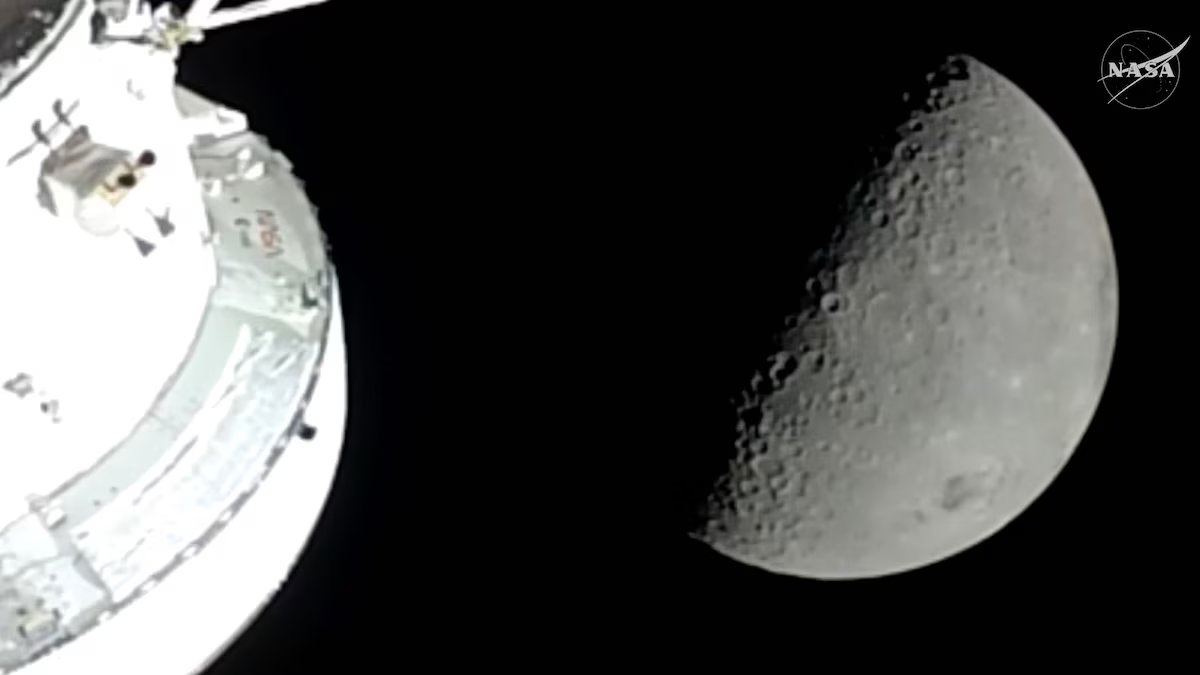
HOUSTON.– Humanity extended its frontier into deep space on Monday with a milestone that surpassed all previous records of the Apollo era. The four members of the mission Artemis II They transformed into the human beings who traveled the greatest distance in the world. Land in history. On board the capsule Orionastronauts Reid Wiseman, Victor Glover, Christina Koch and Jeremy Hansen broke the record of 400,171 kilometers held by the ill-fated but iconic Apollo 13 mission since April 1970.
The new limit was established at 406,778 kilometers of our planet, a figure that marks the pulse of the new lunar race and the definitive return to the satellite.
The day began with a deep emotional charge in the Houston control center. A message recorded by the veteran James LovellApollo 8 pilot who died last year, woke up the crew with a welcome to their old flight “zone.”
Before the critical maneuvers, the astronauts conducted tests of their pressurized suits, designed to guarantee survival for up to six days in the event of an extreme emergency.
The close flyby represented the core of the day’s scientific activity. The ship Integritythe name with which the crew baptized the capsule, began its detailed observation phase that lasted more than seven hours. The point of maximum approach to the surface occurred at 23:02 GMT (20:03 in Argentina), with an altitude of just 6550 kilometers on the lunar soil.
During this period, crew members used professional-quality cameras and mobile devices to capture high-resolution images of areas that until now were only known through remote sensors and satellites.
One of the main objectives of the observation was the Eastern Basina vast impact structure with three concentric rings that extends for almost 950 kilometers. The astronauts observed the entire formation with their own eyes, as well as the historic landing sites of the missions. Apollo 12 and Apollo 14.
They also identified the margins of the P regiononly Southa strategic area for future manned descents due to the presence of critical resources, such as ice, for water supply.
The intense previous training in geology It allowed the crew to describe craters and ancient lava flows with impeccable technical precision.
The mission included highly sensitive moments when astronauts proposed names for two anonymous craters on the far side. The crew requested to baptize one of them as Carrollin tribute to the late wife (2020) of Reid Wiseman. The second was named Integrityin tune with the spirit of the spaceship. The control center in Houston received the proposal after a respectful silence that moved the technicians and scientists on the ground, who took note of each description in real time.
The passage through hidden face of the Moon imposed absolute radio silence for approximately 40 minutes. During this period, communication waves were blocked by the satellite’s mass, leaving Orion out of reach. Deep Space Network from NASA.
After regaining contact, the astronauts witnessed a total solar eclipse which was only visible from its privileged position in space. For 57 minutes, the Moon blocked the Sun and allowed direct study of the solar crownthe outermost and most radiant layer of the star, with special protective glasses.
With the observation tasks completed, the ship began its escape from the sphere of influence lunar gravitational pull to begin the return journey.
The journey to Earth will require four days of navigation through the vacuum of space. He splashdown final is scheduled for next Friday, April 10 in the waters of the Pacific Ocean, near the coast of San Diego.
During the return journey, historic radio communication is planned between Orion and the International Space Stationa dialogue that will unite two manned missions in orbit simultaneously for the first time.
NASA avoided the moon landing this time to ensure the safety of critical systems in a capsule that is transporting people for the first time. The space agency’s strategy seeks to establish a long term presence on the satellite that functions as a testing platform for future trips to Mars.
The success of this mission represents much more than an isolated achievement: it reinforces and gives new impetus to the ambitious international project of installing a permanent base on the Moon. At the same time, it paves the way for Artemis IIIthe next stage of the program, whose objective will be to bring humans back to the lunar surface for the first time in decades. This future expedition will also have strong support from the private sector, through companies such as SpaceX and Blue Origin, who will have a central role in the development and logistics of the mission.
AP and AFP Agencies