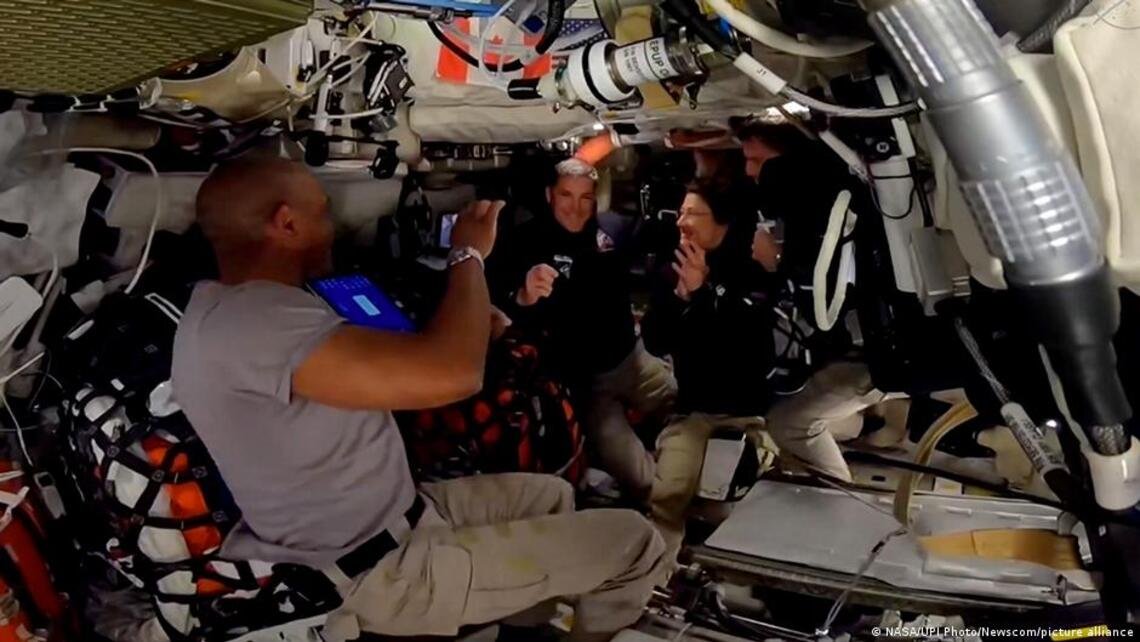
The four astronauts Artemis II They entered lunar orbit on Monday, March 6, 2026, officially marking the return of humans to the Moon since Apollo 17, launched in December 1972. Likewise, the Orion capsule of the POT It broke the record for the furthest manned space mission from Earth, surpassing Apollo 13, which in 1970 traveled 400,171 kilometers from our planet.
The new mark occurred while Orion was traveling towards the sphere of influence of the Moon, and less than an hour before observations begin during the flyby of the natural satellite, according to the space agency. In addition, the mission also broke the record for the message that has traveled “farthest” in human history, as space officials sent an email to the crew.
“Here in the ‘Integrity Cabin’, as we travel the greatest distance humans have ever traveled from planet Earth, we do so by honoring the extraordinary efforts and feats of our predecessors in human space exploration,” said the mission’s Canadian astronaut, Jeremy Hansen.
“We will continue our journey further into space before Mother Earth manages to draw us back to all that we hold dear. But, more importantly, we want to challenge this generation, and the next, to ensure that this record does not stand for long,” Hansen added. It is expected that during this day Artemis II will exceed the previous mark by more than 6,600 kilometers, to reach a distance of 406,778 kilometers.
The hidden face
One of the key moments of Artemis II’s lunar orbit will be the astronauts’ passage through the far side of the Moon, which will allow them to photograph and see this part of the satellite with their own eyes. The last time a human being contemplated this region of the Moon, which is hidden from our planet by the satellite’s synchronous rotation, was in 1972, when the crew of Apollo 17 became the last expedition to set foot on the lunar surface.
The flyby of the Orion – equipped with 32 cameras – will allow the lunar far side to be studied in greater detail, but will also cause the astronauts to lose communications with the Earth for about 40 minutes, the time that the Moon is between the planet and the ship.
“It’s a historic day and I know how busy you will be, but don’t forget to enjoy the view,” Jim Lovell, who participated in the Apollo 8 and 13 missions, told the new generation of astronauts in a recording made shortly before his death last year. “I am proud to pass the torch to them as they orbit the Moon,” he added.
The American mission, which took off last Wednesday from Cape Canaveral, Florida, aims to orbit the Moon and return to Earth in ten days. Artemis II will exit lunar influence on Tuesday at 1:25 p.m. Eastern Time (17:25 GMT).