We have all experienced people arguing in public. We often do not know what preceded the insult, but we are inclined to get involved and break up the parties. This can turn out to be surprising, because it can happen that both people who were opposing each other a moment ago now turn together against you. Suddenly they have found a common enemy.
If things threaten to get out of hand, the police are often called. This will then manage to calm things down. Or take those who misbehave to the station to cool off. But some people are just quarrelsome, and they always find themselves in conflict situations. Then you may wonder who the guilty party is. That is the case now, but of course it also happened in the past.
Transfer of inventory
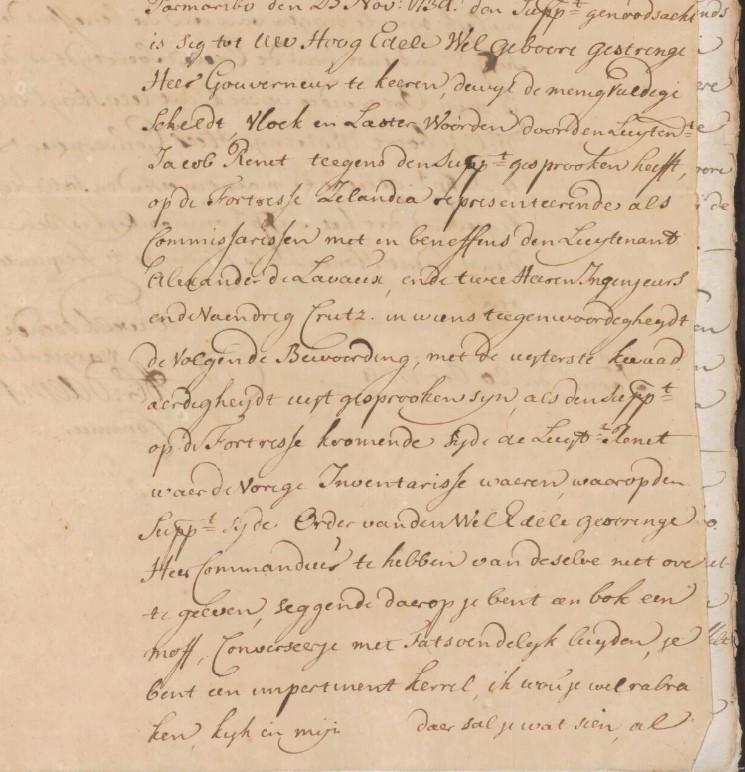
On December 20, 1734, Abraham Daems addressed the governor, Jacob Alexander de Cheusses, also Colonel of the fortresses, etc. Daems was commisioner of the land store of the Noble Society, and felt compelled to address the Court because Lieutenant Jacob Renet had repeatedly treated him to insults, curses and slander at Fort Zeelandia. He managed to do this in the presence of the commissioner Lieutenant Alexander de Lavaux. This was an ensign and well-known mapmaker, who later deserted from Suriname because he was not promoted. The long arm of the law reached as far as St. Eustatius, where he had fled. He was taken back to Suriname and imprisoned in Fort Zeelandia.
Furthermore, two engineers and Ensign Contz were present. In their presence, Renet expressed the utmost malice as soon as Daems arrived on location. He had commented on the inventories that Renet had to draw up, which, according to Daems, were not in order. He therefore refused – on the instructions of the commander – to take it over.
Swearing
Renet scolded him for ‘buck, a brat, converse with decent people, you are an impertinent guy, I wanted to break your wheels. Look in my…you would see something there.’ (We can guess what was said here, but the writer didn’t mention it because of its extremely indecent charge). ‘Even if I were in custody for six weeks, I would hit you. This one is too honest, but with a bag stick, you damn canal, are you commies? How much do you sell the pound of currants, crossing the bridge against the people? What the hell are you up for like that?’
To all these dirty expressions, the applicant (complainant) has said nothing other than: ‘Why are you cursing me? What have I done to you? I will write down all this, all which slanderous words it is not proper to say, against one who is also in the service of the noble Society. Daems submitted a request to the Governor, asking him to allow him to seek satisfaction. Otherwise it would be impossible for him to remain in service. And to frequent his position with Honeur (honor) as commies. So far we think we are dealing with a reasonable gentleman who is scolded by a subordinate because he was caught in a mistake.
Argument over a rye barrel
But Daems turns out to be no sweetheart either. On March 4, 1735, he had another quarrel with a subordinate. He mentioned the above case and further complained to Captain Pieter Bleij about the impertinences of Thomas Kerk, he had allowed an almost empty barrel of rye to roll into the bakery. Some men then entered the bakery and wanted to take the barrel, causing a discussion as to whether or not this was allowed. Later that evening, the men continued to argue in the street and insults were thrown back and forth at Daems. This one complained about others, but seems not to have been such a good guy himself, or he must have miraculously attracted conflict.
Of course, who was higher in rank and which witnesses were present during the argument played a role here. Whoever of those involved was the first to complain to the governor probably had an advantage.
Hilde Neus