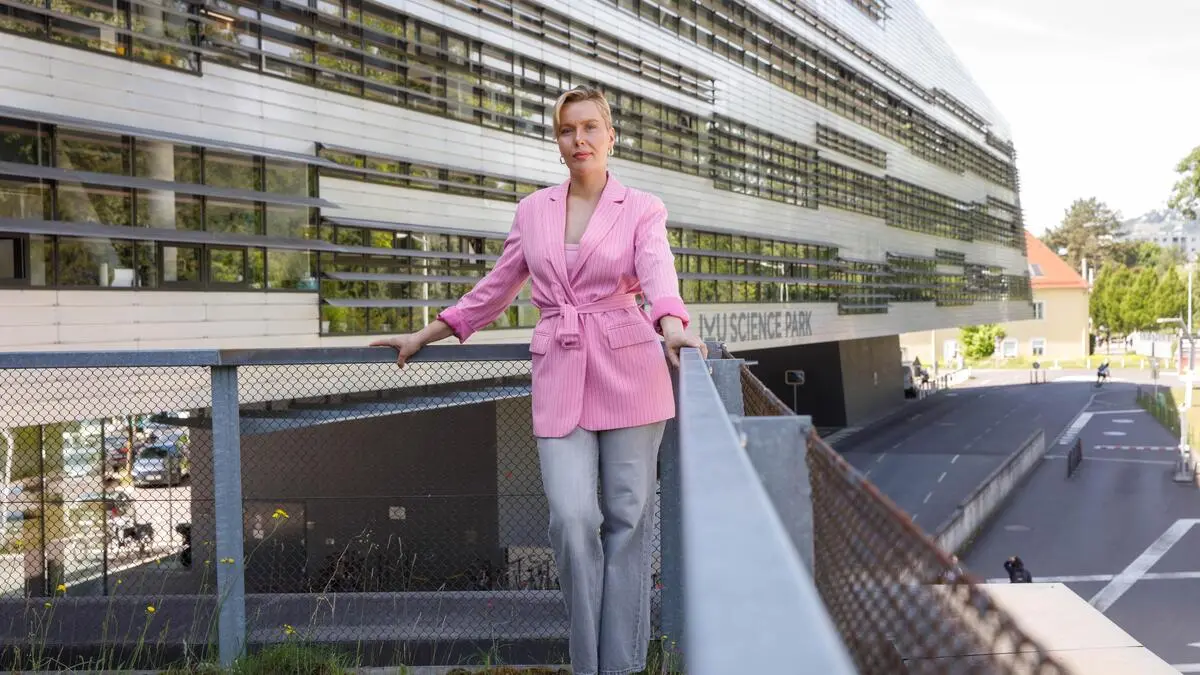
The war – the answer to the question of why she decided to study electrical engineering is as frank as it is to the point. “I spent the first five years of my life during the war in Bosnia,” explains Medina Hamidovic. “And that has really influenced what I do with my life.” Her father attached great importance to her and her sister’s technical and scientific education. “Technology was seen as a profession with which you could secure a good future,” says the 34-year-old.
Because the opportunities for women in technology in Bosnia seemed limited, Hamidovic immediately set his sights beyond the country’s borders after studying in Tuzla. After positions – funded by the EU – in Edinburgh (GB) and Budapest (Hungary), she has been researching technical topics in medicine at the Linz Institute for Communications Engineering and High Frequency Systems at the Johannes Kepler University (JKU) since 2017. “I enjoy working on new questions in interdisciplinary projects and always discovering new fields such as biology or chemistry.”
“There’s this idea that you send tiny chemical-biological ‘devices’ through the body through the bloodstream that look for tumors and kill the cancer cells locally,” says Hamidovic. “This saves you from major therapies that put strain on the entire body.” She controls an international one projectwhich is also funded by the FWF Science Fund, is contributing a technical mini-version of the human vascular system in which so-called nanobots or nanocarriers – these are the smallest particles – are tested (lab-on-a-chip). Given the current state of research, the efficiency of targeted drug administration is very low, as only a small proportion of carriers achieve their goal.
Young research
In this series we portray young researchers: what excites them about science, which findings or role models are particularly important to them and what their work-life balance is like.
The technical models are now intended to reproduce the vascular systems as realistically as possible in order to understand what influences the journey of nanorobots and how more of them can make it to the tumor. The team led by the Linz researcher is experimenting with different sizes and materials. There are also different diameters of arteries, veins and capillaries, branches and confluences, the pulsating blood flow caused by the heartbeat and flexible vessel walls.
“These nanodevices can specifically kill tumor cells locally.”
Medina Hamidovic,
University of Linz
“We want to find out what happens to the nanoparticles when the environment or temperature changes. To do this, we are replicating the system in the laboratory and also modeling it theoretically,” she says. Ultimately, all of this work also serves to reduce animal testing to a minimum. Initial studies in the mouse model have already been successfully completed based on Hamidovic’s work.
“When I started this research in 2017, it was just concepts, but now experiments are already being done with animals,” she says, making her optimistic about the progress. The technology for a paradigm shift in cancer treatment would be available in a few years – if the pharmaceutical industry gets involved. The result of another project (“Min“) by Hamidovic, in which she developed a digital, AI-supported initial check for infections and high blood pressure. “We want to use this to reduce visits to the doctor that are not absolutely necessary.”
The single mother – her children are five and six years old – is very concerned about introducing even the youngest children to scientific questions. So she designed science workshops for kindergartens, first on her own and now supported by the JKU.
With so much commitment, there isn’t much room to clear your head. “Luckily, I really enjoy cooking, it’s like free time for me,” laughs Hamidovic. The only downer is that she hasn’t yet convinced her children about the Bosnian cuisine from her homeland. “They prefer pasta.” But she’s happy to serve it to them – with homemade pasta, of course.
To person
Medina Hamidovic (34) studied electrical engineering and physics in Bosnia, Great Britain and Hungary. Her focus is on the connection between technology and medicine, something she has been devoting herself to since completing her doctorate at the JKU in Linz (doctorate: 2024). Here she researches nanorobots in cancer therapy and AI support for medical practices.