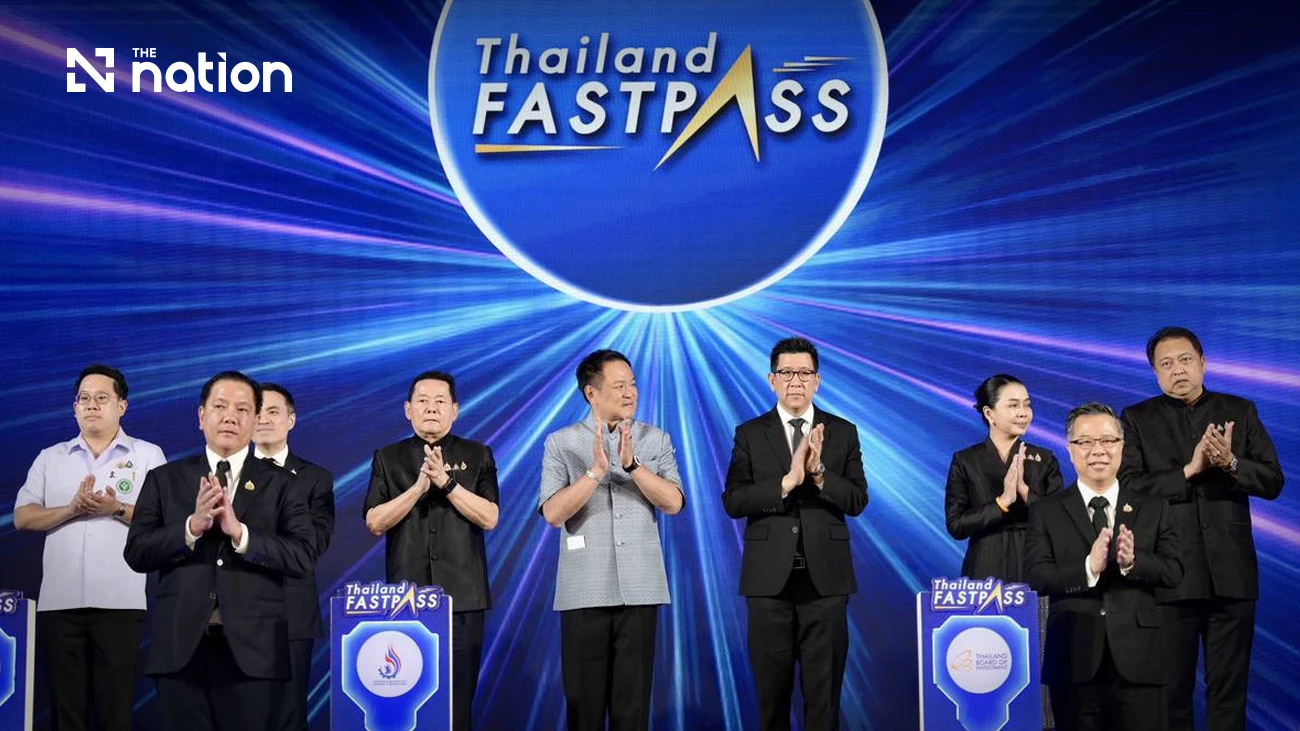

Ekniti said the government is focusing on “real investment” that enters the economy. Thailand FastPass has been created to resolve obstacles facing projects that have already received investment promotion approval but have not yet been able to proceed fully.
The government has already helped unlock more than 76 investment projects worth a combined 474 billion baht. This led to the upgrade of Thailand FastPass into a permanent mechanism for strategic national projects.
Ekniti said the scheme would help accelerate capital flows into the economy, providing a short-term economic stimulus while creating a more efficient model of government work in the long term. It will also promote high-quality employment and spread economic benefits more widely.
The eight participating state agencies will work together to speed up key procedures, including factory permits, free-zone establishment, environmental impact assessment reports and electricity connections.
Ekniti said the government had selected and granted Thailand FastPass status to 25 important investment projects from 23 companies in strategic industries. These projects are worth more than 223 billion baht and are expected to create over 13,000 high-quality jobs.
When combined with projects previously unlocked by the government, total investment being pushed into the economy will exceed 700 billion baht.
“This will be an important driver of investor confidence, both domestic and international,” Ekniti said.
“It will also be the starting point for changing the way the public sector works to better serve business and create tangible economic opportunities for people in the future.”
He said FastPass is not only a fast track for investors, but also a fast track from investment capital to real outcomes for the Thai economy and Thai people.
The investment is expected to generate benefits in five areas.
First, it will support Thailand’s economic recovery, led by investment. While investment provides short-term stimulus, its long-term impact is stronger economic growth.
Second, it will create new jobs and new careers. Faster-moving projects mean not only quicker factory development, but also earlier job creation for engineers, technicians, accountants, IT workers, logistics staff and service providers in local areas.
Third, it will bring new skills and knowledge transfer. Modern investment does not bring only machinery, but also new know-how, helping Thai workers move into higher-skilled and higher-income jobs.
Fourth, it will create opportunities for SMEs and domestic producers. Large investors should not operate in isolation, but should connect with Thai parts suppliers, contractors, logistics providers, food businesses, accommodation providers, service operators and local SMEs.
Fifth, it will circulate money in local economies. Each investment project creates demand for food, accommodation, transport, repair services, contractors, logistics and surrounding services.
Companies selected for Thailand FastPass said investors view Thailand as a ready base for future industries, citing the country’s location, infrastructure, supply chains and workforce.
They said the mechanism would help reduce obstacles, speed up coordination with government agencies and build confidence that projects can proceed as planned. Most companies plan to expand investment, develop human resources and strengthen research and development activities in Thailand.

Narit Therdsteerasukdi, Secretary-General of the BOI, said Thailand FastPass would prove that when all agencies work in the same direction, approved investment projects can move forward efficiently.
“In an era when global supply chains are being reshaped, investors need clarity and speed,” Narit said.
“Thailand must send a clear signal that we are ready to attract quality investment projects that build the industrial base of the future.
“The BOI will continue expanding the Thailand FastPass mechanism to cover more types of permits and support additional key projects in national strategic industries. This will accelerate high-quality job creation, strengthen supply chains and raise Thailand’s long-term competitiveness.”