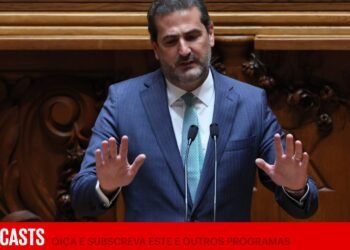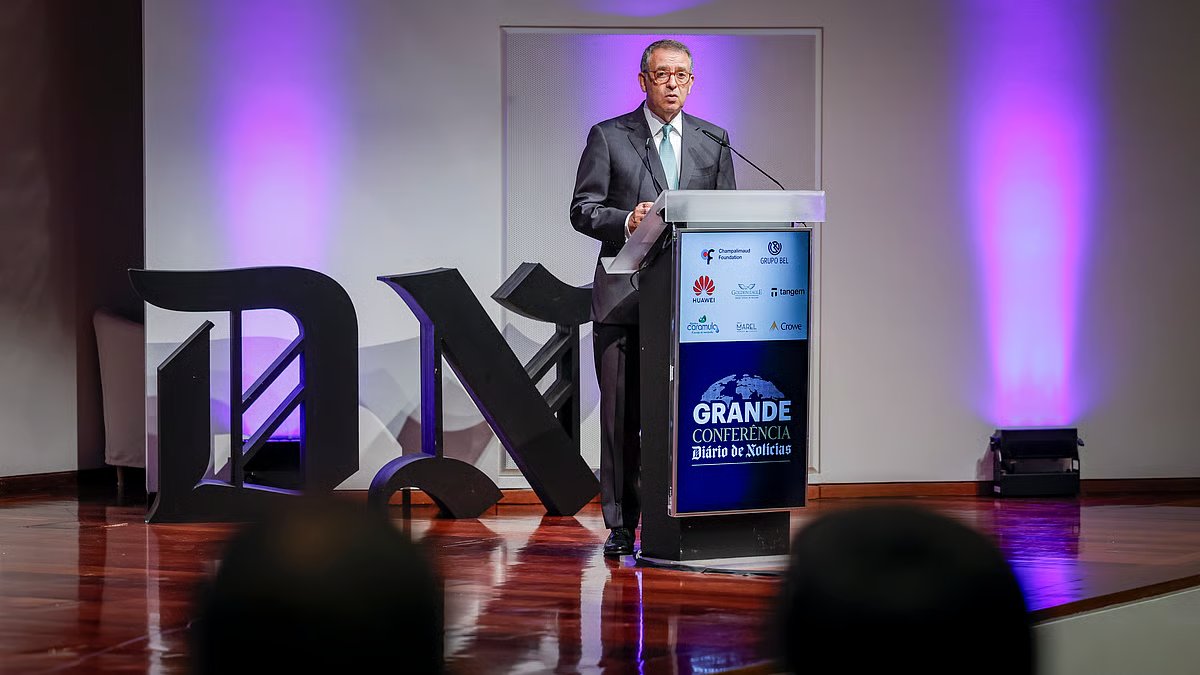
The President of the Republic, António José Seguro, closed the Diário de Notícias Grand Conference, with the warning that, “in a world of disinformation on an industrial scale, quality journalism is a critical pillar of democracy”. But references to the risks of Artificial Intelligence were also heard in the Grand Auditorium of the Champalimaud Foundation, in Lisbon, and even a quote from the encyclical in which Pope Leo XIV said that it could jeopardize human dignity.
“Without free journalism there is no power scrutiny, there is no quality debate, there are no citizens with the information they need to make good decisions. The quality of our democracy also depends on the quality of the journalism that is done. And the country has to seriously assess what it wants to do, the values it wants to guarantee in order to have free and plural journalism”, said the Head of Stateat the end of his intervention.
Precisely one year after officially presenting his candidacy for the Presidency of the Republic, in Caldas da Rainha, when he had not even guaranteed support from the PS, the party of which he was secretary general, António José Seguro paid tribute to DN, saying that “a newspaper with more than a century and a half of history is not just a communications company, it is a part of the country’s collective memory”.
But he also took the opportunity to warn about “the almost always delayed responses” given to the digital revolution that is underway. “The scope of this permanent technological innovation also leads us to the realization that the countries that were able to integrate these technologies into their companies and societies came out stronger. The others are left in line at the supermarket, with the status of an ordinary consumer”, he warned, adding that this is “one of the reasons why Portugal and the European Union cannot have a passive attitude”, waiting years for a plan “which aims to make up for years of delay”.
“The absence of rules and agreements can be a fertile context for the proliferation of new instruments and technological networks with offensive strategies, the final effect of which is to increase the power of the strongest and nullify any desire for regulation”, said António José Seguro. Likewise, he drew attention to the fact that “we live in an era in which algorithms influence our choices”, “disinformation is produced on an industrial scale and personalized to each citizen” and “cybersecurity is no longer a technical issue, but has become a central dimension of State sovereignty”.
Another reflection made by the President of the Republic had to do with “what remains” of the international order, following previous interventions. Referring to the “Russian aggression against Ukraine”, the “cycles of violence that crush civilian populations and challenge the conscience of humanity” in the Middle East, while on the African continent “we don’t even have real information about the almost permanent violation of human dignity”, and the “rivalry between the United States and China increasingly structures all other international relations”, Seguro identified as a common denominator the erosion of the principle, “which we thought was acquired”, that relations between States are governed by rules and not just by force.
Welcoming the agreement reached hours earlier between the United States and Iran to unblock maritime navigation in the Strait of Hormuz, Seguro said that such an understanding “represents a clear sign that negotiation, compromise and mutual respect continue to be the most effective paths to promoting stability, security and peace among peoples.” And he reiterated that Portugal “will remain committed to defending multilateralism and an international order based on dialogue, peace and the peaceful resolution of differences between States”.
At the beginning and end of the intervention, the story from the newspaper was heard The Truthwhich the now Head of State made 50 years ago, on a typewriter, with three other friends when he was a teenager from Penamacor. “Looking at the world I described, where many rely on misinformation, force against the law and technology without scrutiny, I realize that that title of youth was, after all, a program for life.” This is because, in his opinion, all ongoing transformations impact the truth of the facts, “without which there is no democratic debate”; in the truth of rules, “without which there is no international order”; in the truth of human dignity, “without which no technology deserves the name of progress.”