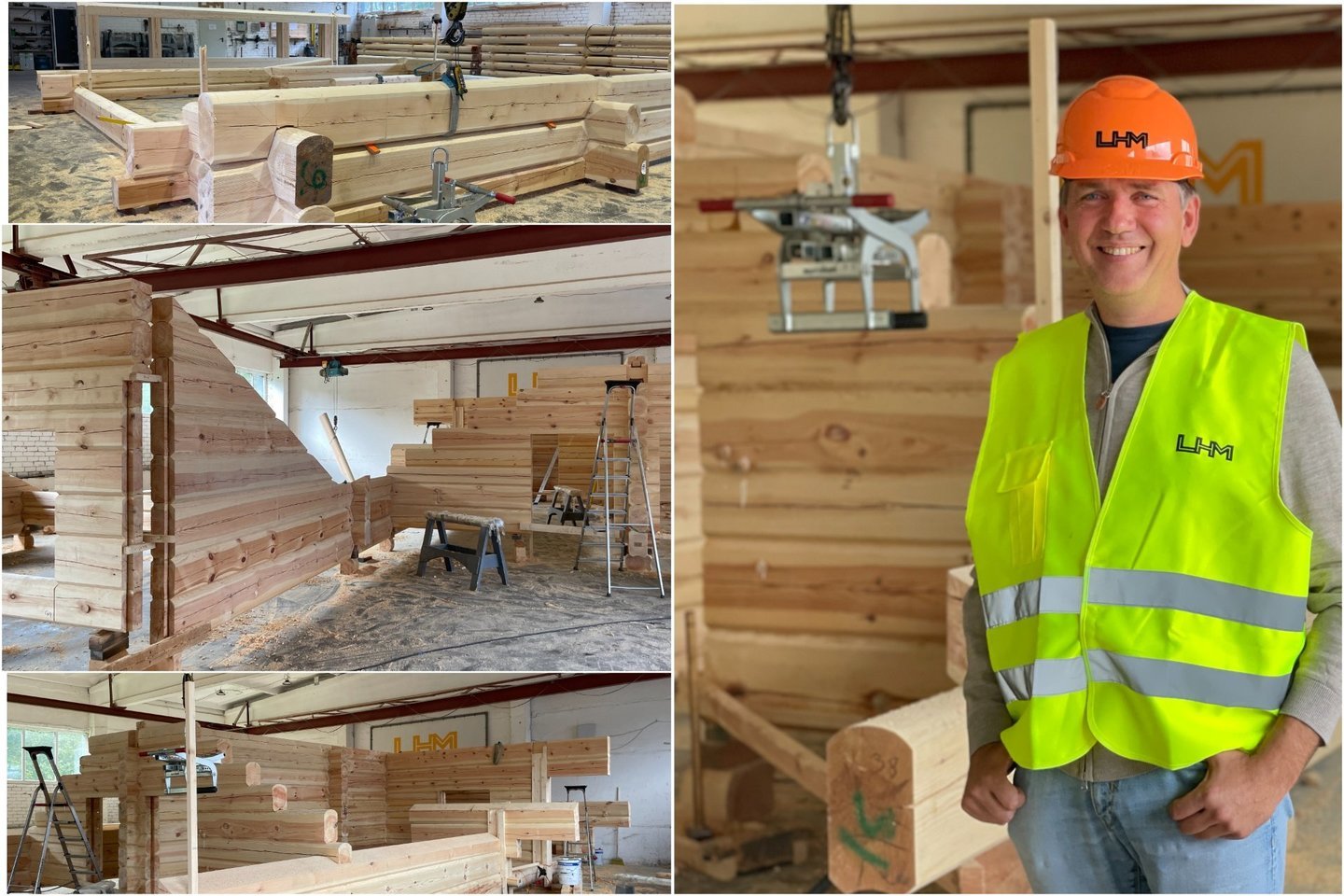
LHM Group, operating in Plungė district, Kaušėnai, designs and builds traditional Scandinavian mountain houses, manufactures individually designed stairs and furniture for Norwegian customers. And last year it also entered the US market.
“We have sold the house two days after the ad appeared. There have been cases when we have bought before the ad appeared. We have had to wait for a buyer for two months, but this rarely happens – exceptional objects are bought very quickly,” says Laurynas Mitkus, head of the LHM group, in agreement at the factory in the Plunge district.
All of this could not have happened if not for Lauryn’s persistence. “I never give up,” he says with a smile.
The very beginning was 23 years ago, when 25-year-old L. Mitkus and 22-year-old Nerijus Eimutis met. They met by chance: while Lauryns and his wife were talking about how their house could look like, they thought about log cabins, and Lauryns’ wife remembered that one of her acquaintances’ husband was building them.
After meeting with Nerijus, he said that the Norwegians were looking for log houses – at that time there was a huge demand for them in Scandinavia, so they looked for suppliers and factories in Lithuania.
As a news portal Morning says L. Mitkus, Nerijus knew how to build log houses, he himself had advertising and small trading businesses.
Freshly baked partners found 14 registered inquiries about log houses on the website of the Norwegian Embassy. Lauryns prepared to call them while he was at work, but since he was working in a shopping center at the time, the beeping of cash registers could be heard in the background. In order to be quieter, he moved into a car – it is still standing in the factory area as a fun memory.
The adventure did not pass without results – one Norwegian prepared to visit Lithuania to inspect the Nerijaus and Laurynas factory. “It took us four and a half weeks to figure out how to turn two people into a factory,” Laurynas laughs today.
Building a log house is one thing. But before that, the logs need to be cut, and even before that, they need to be bought. In order to be able to buy, you need to have something for it. In the case of Nerijas and Lauryns, this meant getting an order first.
“We put everything together in days and realized that we need to get the order today or tomorrow. At worst, tomorrow, because otherwise we have no chance: drying alone takes a certain number of weeks and everything becomes physically impossible.”
After opening the address book, we started calling everyone we know in a row. Here is really good advice for sellers: if you really really want something, open the book and call everyone you know – you will definitely find what you are looking for. But usually nobody does that because they don’t have time.
And we called everyone back because we had nowhere to go. And there was one who said: “Yes, I need a sauna”, recalls L. Mitkus.
The next step is to find premises that at least somewhat resemble a factory.
Nerijus, who hails from Jurbarkas, found there the premises where a wood workshop operated seven years ago.
“You could say that it was a wood workshop, but the sawdust has turned into black mud over the years. The size of the factory is about 5,000 square meters, almost like all of our current premises. We still took them,” says one of the founders of LHM and laughingly tells how Nerijus sent him to buy logs.
“He tells me to drive those logs and says, ‘Just make sure they’re good.’ I ask what are good logs? They explain to me that they must be straight, without branches. I went to the forest, they were loading logs. I look at it from the end – it’s crooked, I show that it doesn’t fit, put it to the side. I selected in such a way that the loader finally said: “Dude, if you sort like that, I won’t collect the logs for you”, remembers L. Mitkus.
After buying the logs, the next step is to cut them. The new entrepreneurs go to the sawmill, and there, according to Lauryn, “they say normal things”: they will start in four to five days and they will cut within a week.
“I explain to them, ‘You have to start today and finish tomorrow.’ They’re like, “Are you serious? This is at least a week’s worth of work.” And we press: “Look, it’s very necessary. We can help ourselves, we can mow at night.”
You come and don’t let go, because there is no other option. You already have the order, you have received the money. Norwegian December 7 will be here – there is no plan B.
We pressed and pressed the sawmill and pressed it – they cut the logs”, says Laurynas.
Since there was a log dryer in the purchased premises, and with the help of acquaintances, they managed to resurrect it from the dead, part of the trouble receded.
Logs are drying, but an office is needed – after all, the client will come. And the building itself is completely abandoned: holes run through the roof, toilets are torn, pipes are broken, everything is moldy. The rooms are scarier than each other. Finally found one where the two walls are still tolerable.
“It was the best we could find. The situation was that when we ran through the ceiling, we were just hoping for a good cold, because we didn’t have anything to repair the roof.
We did everything possible. We covered the hole in the door of the future office with a poster. We plastered the worst wall with the cheapest white plastic paneling because the wallpaper didn’t hold up on such a wall.
The office needs internet. Now it’s easy, and then you either have cable or you don’t have internet. We contacted the connection provider that was operating at the time, and told them that we were establishing a new company in Jurbark, so we needed the internet. We were told that we were too far away from the wires: either we pay to build them or there would be no internet.
I managed to call the boss in Vilnius. Of course, I got the internet from him,” Lauryns laughs and adds that he connected the internet that time just to have it in case the Norwegian thought to check his e-mail.
“I wouldn’t bother now – I would say that today the Internet is down, and that’s all. But how much effort did we put in then,” says the businessman.
Finally, he and Neri had a couple of days to build the lower crown of logs and place at least one log to show how the corner was injected. He worked non-stop, finished at midnight in Jurbarka, and in the morning – a meeting with a guest at a hotel in Klaipėda.
“Completely exhausted like zombies, we got into the car and drove to Klaipėda, where we lived. I returned home, and here I realized that in the morning I would have nothing to wear: it was 25 degrees outside the window, and my only winter jacket was the one I was wearing at work.
At three in the morning I have a new project – to borrow a jacket. I call one of my friends and ask to borrow some of my winter outerwear. And he told me: “Lauri, you’re much taller than me, it won’t suit you.”
I was so emotionally drained that I started yelling at him, “Do you feel sorry for that coat?!” I drove away. As I see it now: a sleepy friend hands me a coat, I put it on – the sleeves are too short. I return my coat, I return home – as it will be, yes, I will go with that wet washed jacket.
What’s more, Nerijus calls: “Come, help, the pipes are frozen.” But that time I basically refused to help my friend – at least one of us had to be alive in the morning”, Lauryns surprises with his persistence.
Went down in the morning to fire up his Audi 100, which had gas equipment for economy. Only when it is 25 degrees outside, the gas reducer freezes and the car does not start. To thaw the reducer, Lauryns poured boiling water over it.
The engine was able to start, but when the system finally warmed up, it put a lot of heat into the window – due to the difference in temperature, the crack in the window widened as it should.
“It was the only moment when I thought that maybe I should stop. That bad thought lasted maybe two seconds,” says L. Mitkus.
As if that wasn’t enough, while driving he noticed that coolant had leaked out of the system. Hence, if you continue to drive like this, the engine block may be missing. Nerijus and Laurynas entered the hotel to see the guest without a plan of what to do if this happened – after all, the client had to be taken 150 km to Jurbarkas.
On the way to Jurbarkas, they realized that they had not managed to fix the toilet, which was just an abandoned room without water. And the Norwegian, as if on purpose, as soon as he entered the office, almost the first question he asked was where the toilet was.
“We stand and think: this is where we screwed everything up. We felt very bad. That same evening we went to a restaurant with him and frankly told everything, as it really is.
We said that we know how to build log houses, but the factory was made only before his visit. We told the whole story: how we received the order, how we bought logs for the first time, how we created production from scratch, how we set up the office, how we introduced the Internet specifically for him.
In my opinion, this is what determined about 90 percent. Norwegian decision”, the interviewer thinks.
It is ironic that the guest compared the “factory” of Nerijas and Lauryns to the largest manufacturer of log houses in Lithuania. And the client was very difficult: there was an intensive correspondence for several months, receiving several letters a day. During that time, the large manufacturer stopped responding to the foreigner’s letters. Probably afraid that Lauryns and Nerijus might also disappear, the Norwegian signed a contract with them.
“The amount is 57,500 euros. When they put in an advance, I even took a picture of the balance in the account – several thousand euros was an amount never seen in my life,” recalls Laurynas.
Lithuanians were waiting for everything to move on their own after the first order, but they had to wait a long time for the second and then the third customer. The interviewer says bluntly: “We languished.”
There were no opportunities for them to establish themselves in Lithuania. As L. Mitkus tells us, they did not compromise on quality from the very beginning. At that time, many did not dry the logs enough to save money. LHM didn’t, so from day one, even when they had no experience, their products were more expensive than others.
The turning point in the Norwegian market came with the appearance of a client who had a vision to build more houses, and now the LHM Group wants to repeat the Norwegian success story in the US, where, according to Lauryn, there are a lot of super-rich people – much more than in Norway.
You can see what the house built by the LHM group in Montana looks like here: