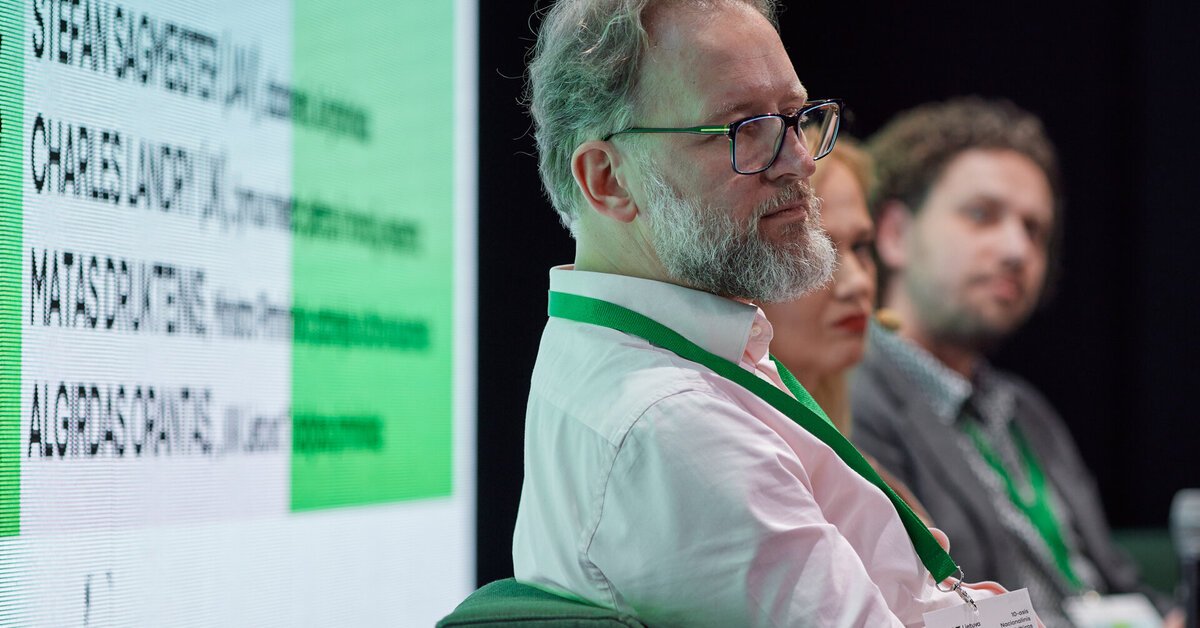
Creativity will also be the main topic at the 11th National Cultural Forum “Creativity: Talents in the Spotlight”. On May 14, the forum will be held at Vilnius TECH Faculty of Creative Industries. Developers, cultural professionals and international experts will look for answers at the forum on how talent ecosystems work in different countries. What limits them? What strengthens and what value they create for society. Is talent an innate gift, or is it the result of consistent work?
Leadership and innovation expert Christer Windelov-Lidzelus, creative leadership practitioner Caitlan Maggs who worked with Cirque du Soleil, Swedish composer, songwriter and copyright specialist Alfons Karabuda are coming to read presentations and participate in discussions. Science journalist Goda Raibytė-Aleksa will take a critical look at the myth of natural talent, and psychologist, lecturer Gintarė Buinickaitė will try to debunk it. The forum will host discussions about future talents, the phenomenon of multitalent and the place of creativity in the age of artificial intelligence.
Before the forum, Laisvė Radzevičienė spoke with the Chairman of the Board of KIK Lietuva Algirdas Orantas about creativity, talents and the concept of genius.
– Creativity seems to be talked about a lot today. Why is it important to talk about it?
– Because today, creativity is no longer just an aesthetic category or a decoration for free time – it is an existential tool for the resistance of society and the state. We live in a background of spiritual nihilism and aggressive propaganda, where public space is poisoned and society is systematically trained to be a passive, top-directed mass. Creativity in such an environment acts as an antidote to this dangerous stagnation.
It is the ability to critically rethink reality, create new meanings and find solutions where standard political mechanisms are hopelessly stuck. When vulgarity and divisiveness begin to dominate the debate, creative imagination becomes our shield against cultural stagnation. To discuss this today is to decide whether we, as a country, will be able to rethink ourselves and remain authentic in the face of pressure.
– At the national cultural forum, there will be a lot of discussion about talents, multi-talents, their place in today’s society, challenges and needs. I wonder what your definition of talent is, since you work a lot with talented people?
– For me, talent is primarily not a privilege, but a great responsibility. It is a specific sensitivity to the truth and, above all, the courage to express that truth even when it is uncomfortable. In today’s society, talent should no longer be considered a mere addition to GDP or a phenomenon remaining on the margins of the economy. Talent must become the axis of the state.
Creative sectors are a space where high added value is created, but talents are also those civic leaders that we are so lacking in the regions and national politics. By their example, they consolidate the community, teach us to communicate between generations, prevent incompetence from dominating the public space and the incitement of political conflicts that disregard the laws of ethics.
– Do you observe how the attitude towards creativity in the global cultural market is changing?
– Today, creativity has finally become a strategic tool of competitiveness. The global market values not only a technically sound product, but also authenticity, history of origin and value. Design and creative industries are no longer just an aesthetic layer – it is a strategic way to solve complex social, ecological and economic problems.
I would say that this is a huge opportunity for Lithuania. We can definitely transform from a country of cheap labor to a country of high creative value. But it will not be easy to achieve. This requires integrating creative industries into the long-term perspective of the state, understanding that an investment in design or artistic research is an investment in the country’s international competitiveness and security.

Photo of the authors of the report/Algirdas Orantas
– What do you think young developers lack the most today? Opportunities that politicians and society could provide? Financing? Mentoring? Or maybe just courage?
– Young people do not lack talent and courage – this was proven by their active involvement in civil protests and initiatives. They lack social spaces and institutional support. I would single out three things that young people miss. First, real mentorship. Not formal, but practical transfer of experience from those we call cultural authorities. Second, financial sustainability. And that is why we are talking about the Private Untouchable Cultural Fund. The young creator must not be dependent on whether his values coincide with those of the party in power at the time. Finally, systemic trust. A young person must feel that his work is a strategic part of the state, and not a line in the list of recipients of support, when support is viewed as alms.
– Does the current education system in Lithuania recognize creativity and talents? Are they encouraged?
– Frankly speaking, we still strongly feel the inertia of top management and standardization. The education system desperately lacks the flexibility to recognize children and young people who do not fit into the framework, who think more broadly, go beyond the boundaries of linear thinking.
We aim for civic education and cultural imagination to become not an additional activity recorded in occasional programs, but the foundation of education. Talents need to be not only identified through tests but also empowered through live mentoring. They need not to be given the tools to adapt to the existing system, but to encourage the courage to create their own future and that of the country. If education does not educate the creator, it will only educate the executor, and the executors are the first to succumb to manipulation in a moment of crisis.

Photo of the authors of the report/National Culture Festival
– Does the myth of genius still exist in the field of culture today?
– This myth undergoes an interesting transformation. We are gradually moving away from the romantic image of the 19th century: a reclusive genius suffering in a tower. Today’s genius is more like a connecting creator. He is a person who not only masters his craft, but also has the ability to gather horizontal connections around him, mobilize a vibrant community, as the Culture Assembly does, and initiate real change.
The myth of the lone creator gives way to collective intelligence and cooperation, but personal mastery and moral authority remain the foundation upon which cultural autonomy rests. If there was no fire of individual talent, there would be nothing to connect. However, without community, gray conjunctures quickly extinguish that fire today.
National cultural festival – on May 14, from 11 hours, Vilnius TECH Faculty of Creative Industries. The organizer of the forum is the National Association of Creative and Cultural Industries. The forum is partially financed by the Lithuanian Culture Council, Vilnius City Municipality, the Office of the Northern Council of Ministers in Lithuania, partners – VilniusTech, The Critical, Lithuanian Composers’ Union, VšĮ Erdvės, VšĮ Urbanistinio Šokio Teatras “Low Air”, “Talent Garden”, “Art communication”, “Words of Freedom”. More information: https://creativeindustries.lt/kulturos-forumas/