For decades, Colombia has been narrated through images and texts that have attempted to account for its complexity. A country of diverse regions, overlapping cultures and landscapes that change in a few kilometers, has found in the illustrated book one of its most solid forms of memory. In these pages, not only photographs and stories have been gathered, but also ways of looking at, interpreting and understanding the territory and its inhabitants.
However, much of that visual and cultural memory has not always remained within the reach of readers. Many of these books, produced in large-format editions, circulated at specific times, driven by business initiatives that brought them to libraries, institutions, and homes. Today they survive as valuable pieces, present on isolated shelves, separated from each other by the years and by the difficulty of finding them together.
This dispersion has left an important part of the country’s image fragmented. Not because it has disappeared, but because it is ceasing to circulate. In an era marked by the immediacy and fragility of the digital, books continue to be a medium capable of preserving with rigor and permanence what a society considers significant because in them a memory is preserved that does not depend on speed, but on attentive gaze and time.
For more than half a century, artists, photographers, writers, scientists and explorers have participated in the construction of this archive. His works have addressed the most diverse topics and the multiple ways of life that make up the country. Each of these books has been, at the time, a way of approaching Colombia from a particular angle.
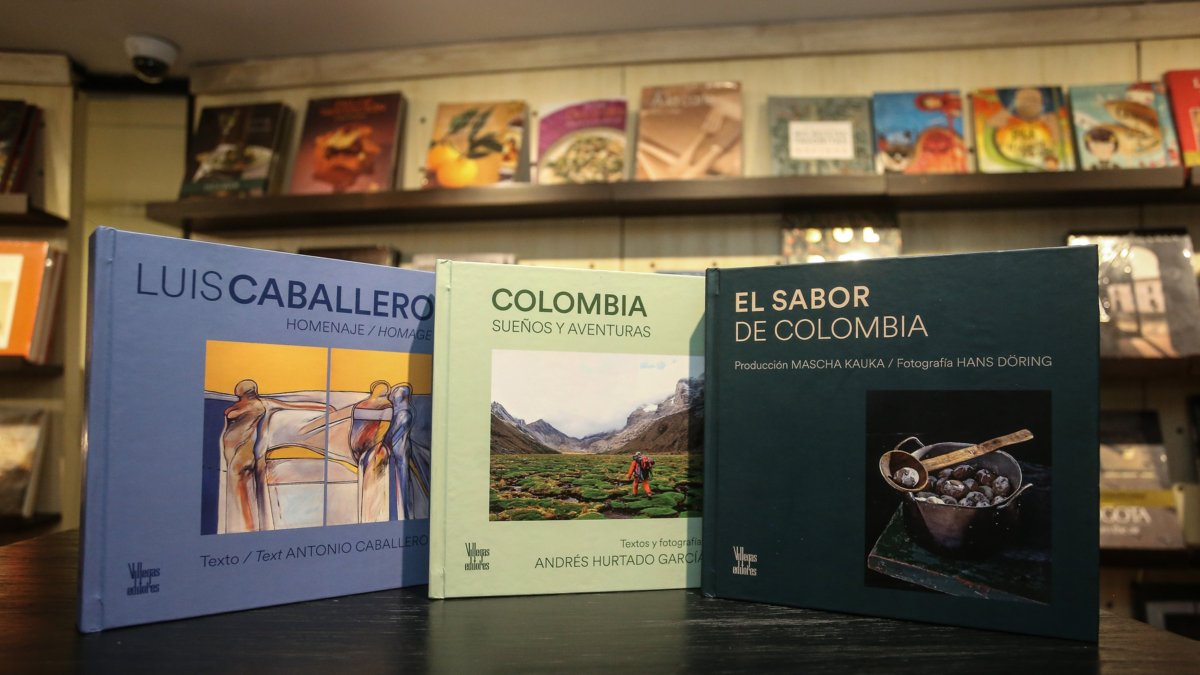
The books will be available on the websitetiendaeltiempo.com Photo:Néstor Gómez / EL TIEMPO
Today, part of that set is put back into circulation. With the support of El Tiempo, the publication of Antología de Colombia begins, a collection by Villegas Editores that brings together a selection of those titles in a renewed format: more accessible, lighter and designed for a broader audience, without losing the editorial and visual care that has characterized them.
new air
As part of this support, and in continuity with its tradition of accompanying the country’s cultural processes, El Tiempo will present each of the books in the collection in its culture pages as they appear. Not as a simple review, but as a journalistic reading of the themes they propose: art, nature, cooking, memory, ways of life. In this way, images and texts that once marked an era will re-enter contemporary dialogue, in an exercise that is part of the very function of cultural journalism.
The collection opens with three books that, from different perspectives, allow us to approach fundamental aspects of the country. ‘Luis Caballero. Homenaje / Homage’, with text by Antonio Caballero, proposes an entry into art through one of its most intense figures. ‘Colombia, dreams and adventures’, with photographs and texts by Andrés Hurtado García, covers the territory from the experience of travel. ‘The Taste of Colombia’ is presented as an essential work for those who wish to know, preserve and share the culinary wealth of the country.
Together, these titles offer a first approximation to the diversity of views that make up the collection. It is not just about recovering books, but about putting themes, images and stories into dialogue that help understand the country in its complexity.
From these first volumes, the collection will configure different lines: art, photography, cooking and, in the next titles, anthropology, nature, archeology and period books that today are also read as documents. They record moments of the city and country that have changed over time and that can only be seen again, in their original form, through these pages.
Most of the books are in a bilingual Spanish-English edition, in continuity with its vocation for international circulation, although some will appear in separate editions. In all cases, these are works that have contributed to projecting an image of Colombia abroad and that are now also proposed as knowledge tools for new readers.
The project is conceived as a continuous collection. A new title will appear every ten days, until there are 36 books per year. In this way, more than a sum of isolated publications, the aim is to build a library that brings together, in the same editorial space, some of the most significant views on Colombia.
In a context in which the digital seems to dominate the ways of accessing information, the book maintains a particular place. Not only because of its materiality, but because of the experience it proposes: stopping, observing, returning to an image, reading with time. Far from disappearing, interest in the physical book today finds new forms, especially among generations that, without having had access to the original works at the time, are looking for more direct and tangible ways to approach knowledge.
A new title will appear every ten days, until there are 36 books per year. Photo:Néstor Gómez / EL TIEMPO
In that sense, the format of this collection, primarily visual, also responds to a contemporary way of reading. It allows a first approach through the images and a subsequent deepening of the texts so that new readers can take ownership of these contents.
For those who are today building their homes and libraries, these books also offer a different possibility: that of gradually gathering together a collection that allows them to explore the country in its multiple dimensions and share it with future generations. In its pages there is a part of Colombia’s cultural memory, available to be rediscovered, transmitted and preserved over time.
At the end of April 2026, the first title in the collection will appear, up to 36 books per year. The collection is available on the website:tiendaeltiempo.com
READ ALSO