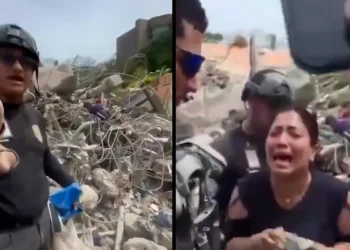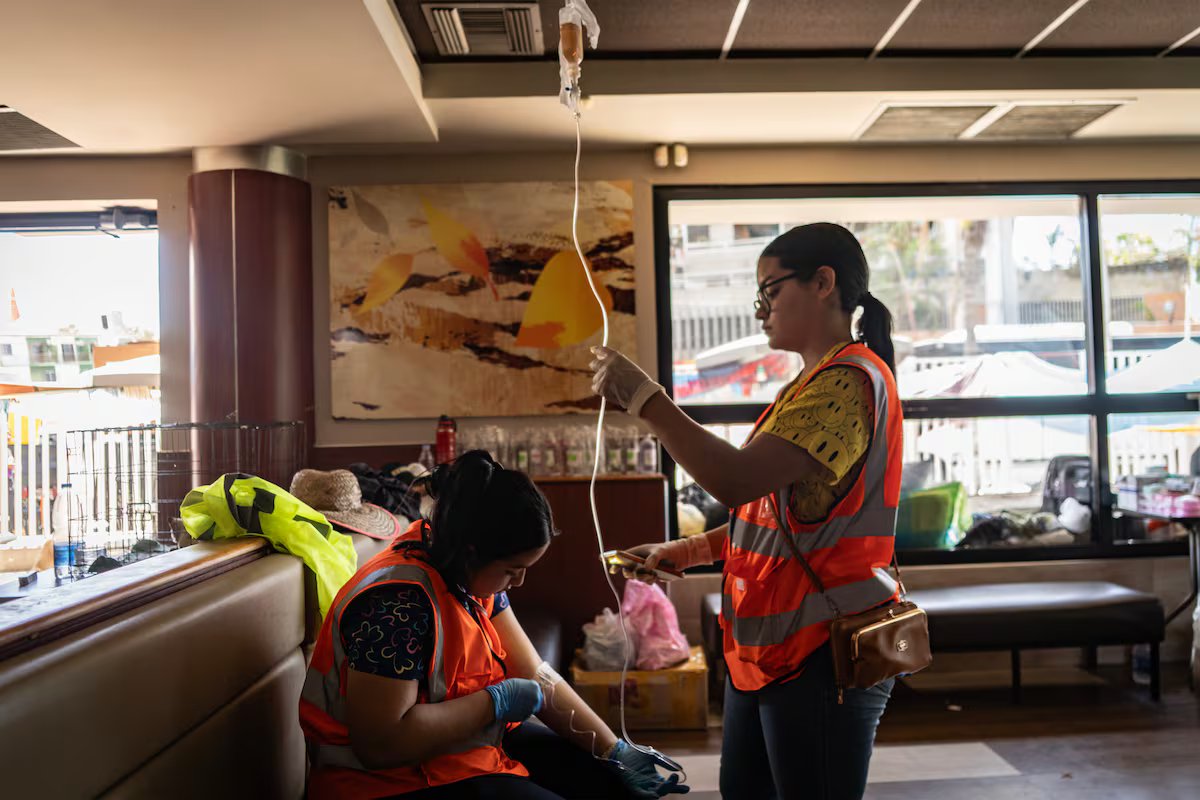
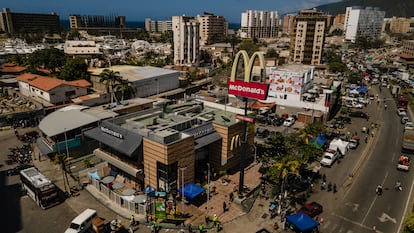
Dr. Romero remembers that the woman arrived “walking like a little penguin and dripping.” She had just given birth alone and still had remains of the placenta lodged. Two nurses rushed her to the operating room and the operation began to prevent her from bleeding. With a cannula, the doctor made his way and in less than an hour he managed to extract all the remains with tweezers. kocher surgical precision. It was not the first time that surgeon Romero performed this type of intervention, but it was the first time that he did it at more than 40 degrees, in the dark, with the only light from the nurses’ cell phones and on the sidewalk of a McDonald’s. The hamburger restaurant has become a field hospital in the midst of the La Guaira disaster, in the middle of ground zero of the Venezuelan earthquake. The precarious hospital, set up by volunteer doctors and donations from civil society, symbolizes extreme needs, institutional helplessness and the improvisation a week after the worst natural tragedy in more than a century in Venezuela.
The window of hope for finding life among the rubble is increasingly narrowing, but the numbers of devastation do not stop growing. The balance in one week exceeds 1,900 deaths and 10,000 injuries. According to the Venezuelan Government, which provides a daily war report without many details, the number of buildings affected reaches 855, of which “189 suffered a total collapse.” Jorge Rodríguez, the president of the National Assembly in charge of the brief daily communication, announced this Tuesday that they have set up 50 camps on the outskirts of the capital to house the survivors, while they have improvised eight new morgues where the bodies are piled up.
The port of La Guaira accumulates hundreds of bodies waiting to be identified by relativeswho queue for miles on the street. While they wait to enter the facilities of the most important port in the country, they take the opportunity to grab some clothes among the mountains piled in the middle of the street. The coastal state concentrates the worst part of the tragedy, with tourist towers of more than 10 floors now converted into masses of rubble and buried corpses. But there are also more humble areas where hardly any type of help is arriving. The United Nations Refugee Agency (UNHCR) said this Tuesday that the humanitarian situation in the most affected areas “has deteriorated rapidly”, given the “severe food shortages, the collapse of basic services and an increase in protection risks for the displaced population.”
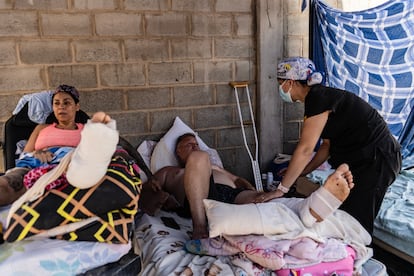
Faced with helplessness, a final year medical student, who arrived from Barquisimeto the first few days to help, set up an improvised clinic “with a blanket and two tarps tied to a tree” near the McDonald’s abandoned after the earthquake. One of his first patients was a police officer with a low blood pressure. “We stabilized it and I took the opportunity to ask him to allow the burger restaurant to work in better conditions,” he says at the door of the establishment, cordoned off with yellow police tape. The agreement was that the doctors would enter and the agents would be in charge of protecting them against robberies or assaults, which are beginning to be common in the most critical areas. On Saturday they managed to enter and the next day, after cleaning the rubble, they set up the new spaces: the operating room, where they treated the woman who had just given birth, in the dining room on the first floor; the pharmacy near the bar where the hamburgers were served and the first floor, the rest area with threadbare mattresses where the doctors and nurses sleep.
The relationship with the police is not easy. The student, who acts as a liaison with them, says that he only trusts “the bosses.” “The rest of the rank-and-file agents try to take advantage of the tragedy,” he says. In the dining area, doctors have hung bags of IVs and vitamins tied to the ceiling with bandages. With a line injected into his right arm, officer Nelson Guerrero, a plump 52-year-old man, explains that he has asked them to please give him insulin because he has only one kidney after a traffic accident. “We are here to not accept people’s shamelessness, so that no one does what they shouldn’t,” he says while the dropper delivers the insulin and sweat falls down his forehead.
Strain
Inside the hospitalized burger restaurant there is more tension than usual. They have recently been warned that the building next door, a gigantic pastel-colored block of more than 100 apartments that still stands, is about to collapse permanently. It is one of the public works constructions that Chavismo built for the most needy population, the Housing Mission project. The neighbors remember that when former President Hugo Chávez came to inaugurate it, more than two decades ago, he quoted a phrase from his great reference. During reconstruction efforts after a strong earthquake that hit Caracas in 1812, Simón Bolivar said: “If nature opposes us, we will fight against it and make it obey us!” Chávez repeated that messianic harangue after the landslide that devastated this same city in 1999, the first tragedy that Chavismo had to face as soon as it came to power. “It seems like we are cursed,” says one of the neighbors, his face covered with a T-shirt to protect himself from the sun and the smell of rot.
The Government of Delcy Rodríguez, under US tutelage since the capture of President Nicolás Maduro in January, He also experiences his first great test. The discontent of the population, increasingly at its limit, grows day by day. With thousands of armed soldiers and police deployed in the area, the risk of a social outbreak is a latent threat with unpredictable consequences. “We have no news from the Government, here of course, they are not supporting us,” says Dr. Miguel Romero, the surgeon who is in charge of the field hospital, although they distribute the management in shifts when it is their turn to go out to provide care in the field. Romero, 34 years old, is doing a doctorate in clinical neuropsychology between Germany and Spain. He arrived the day before the earthquake to visit his family in Coro, a rural city on the coast. After more than 10 hours by bus, he barely sleeps a couple of hours a day since arriving at ground zero.
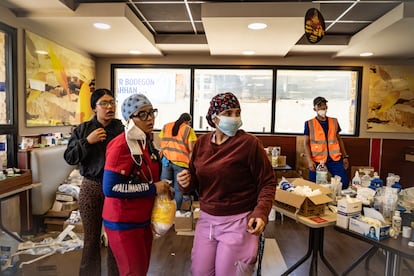
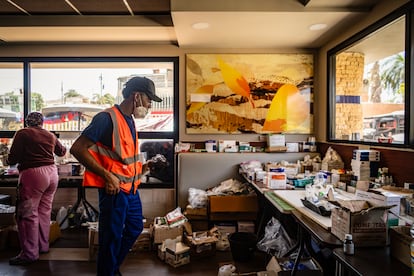
The McDonald’s pharmacy is well stocked, doctors say. Intravenous painkillers, surgical supplies, anxiolytics and even veterinary medications, to care for pets in the parking area, where until a few days ago customers drove by to pick up their Big Macs. The upstairs also hosts groups of international rescuers who have nowhere to spend the night. There are more than 2,300 professionals who have arrived from Mexico, China, Spain or Qatar. Monday night was particularly complicated. It rained in La Guaira for the first time this week, something that everyone expected since it was the summer season. The sky had been kind until now. Water and mud complicate everything even more. But Dr. Ramírez, about to finish his studies in neuroscience, keeps the faith: “I trust in strength, resilience and stoicism of a people mobilized and clinging to life.”