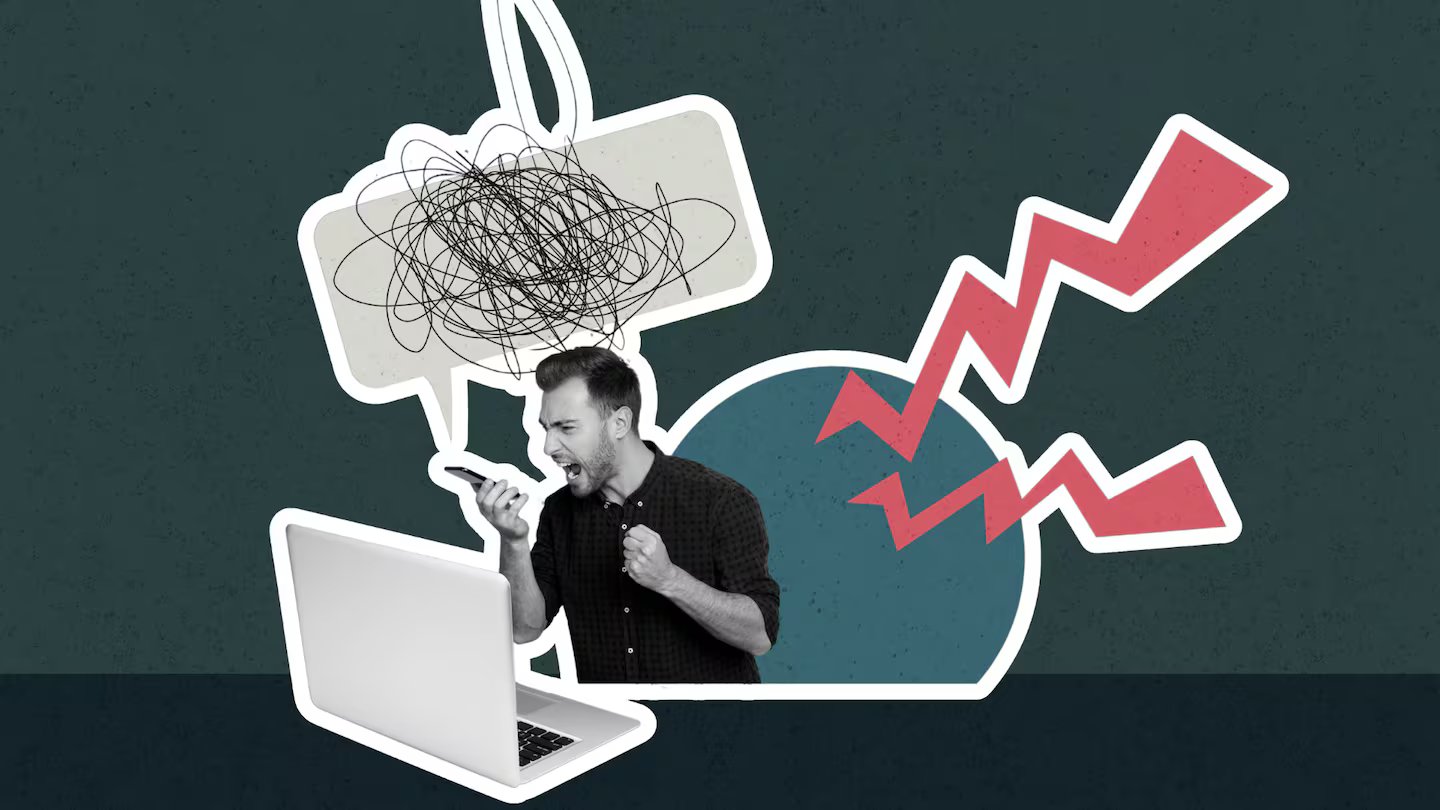
This is not your imagination, it is something that happens to us every day since we open our cell phone while we try to open our eyes to beat sleep and for a moment without realizing it, minutes, hours or even an entire day have already passed glued to a screen.
In that infinite flow of information, something begins to wear away… the ability to think calmly and only the intoxication and cognitive fatigue.
Jeimy Agudelo, psychologist at the Hikma Clinic and part of the MediSmart medical network, explains to us in detail what these terms refer to, why they are often confused, how they have changed our lives and why understanding their differences is key to taking care of mental health in today’s digital age.
What you should know:
- Excess information that the brain cannot process causes mental fatigue and poor concentration.
- Reduces sleep and short-term memory.
- You must use rest and disconnection routines.
The poisoning information occurs when the brain receives more stimuli than it can efficiently organize. It is not only about the volume of content, but also about the speed with which it arrives, the variety of topics and the absence of pauses between one stimulus and another.
Consequently, it appears cognitive fatiguea state of mental exhaustion that many people describe as being exhausted without having done anything physical, lack of focus, or tired without having made physical effort.
What is the difference between both?
For Agudelo, many people tend to confuse them, but intoxication and cognitive fatigue they are not the same:
- Information intoxication: excess of external information.
- Cognitive fatigue: internal response of the brain to that overload.
“Intoxication is the excess of information we receive, and cognitive fatigue is what we feel as a result of that. That is, one has to do with what is happening outside and the other has to do with how our brain experiences it,” said the psychologist.
Nowadays, people are more exposed to information, but not necessarily quality information since they often consume large amounts of content quickly, without really processing it what can generate a feeling of being up to date, even if it does not always imply understanding or integrate what they see.
Why do we feel the need to constantly consume information?
According to the psychologist, there are multiple factors since, on the one hand, we tend to think that having more information gives us a greater feeling of control, adding to this the fear of being left out of events and finally, the brain is attracted to the new.
“The brain gets hooked on novelty, because each new thing generates a small reward, so it becomes an automatic habit,” said Agudelo.
Even the networks are designed so that consumption does not stop quickly, the problem is that there are no real breaksthat is why the brain cannot process what it sees, which generates mental saturation in people of all ages.
Does multitasking make mental overstimulation worse?
“Yes, because in reality the brain does not do several things at the same time, what it does is change from one to another quickly and that constant change is very tiring. In the end, there is more exhaustion and less concentration,” explained the specialist.
Although multitasking is perceived as a productive skill, in reality the brain does not multitask. This constant change of focus reduces concentration, increases errors and accelerates mental exhaustion.
The algorithms of digital platforms They feed on user behavior to show highly personalized content. This increases the time of use, but also intensifies overexposure to constant stimuli.
According to Agudelo, the impact of intoxication and cognitive fatigue manifests itself at different levels:
- Difficulty concentrating.
- Feeling of saturated or blocked mind.
- Decreased short-term memory.
- Sleep problems, especially due to nighttime screen use.
- Making more impulsive or superficial decisions.
“The brain becomes saturated, it is difficult to concentrate, think clearly and maintain attention. It is as if everything was full and there was no space to process more,” explained the expert.

Agudelo provides some signs for people to understand when they have intoxication and cognitive fatigue:
- Check your cell phone automatically.
- Feeling of constant mental saturation.
- Irritability or low tolerance for frustration.
- Difficulty sustaining attention.
- Sensation of permanent mental noise.
“Today the problem is not that there is a lack of information, it is that we are not giving ourselves permission to stop and a mind that does not rest does not think better, it only reacts faster and worse,” Agudelo explained.
Intoxication and cognitive fatigue are not isolated individual problems, but rather the reflection of a hyperconnected culture that does not stop, which is why the psychologist recommends Establish disconnection times, take conscious breaks during the day, actively choose the content you consume, reduce multitasking and prioritize one activity at a time.