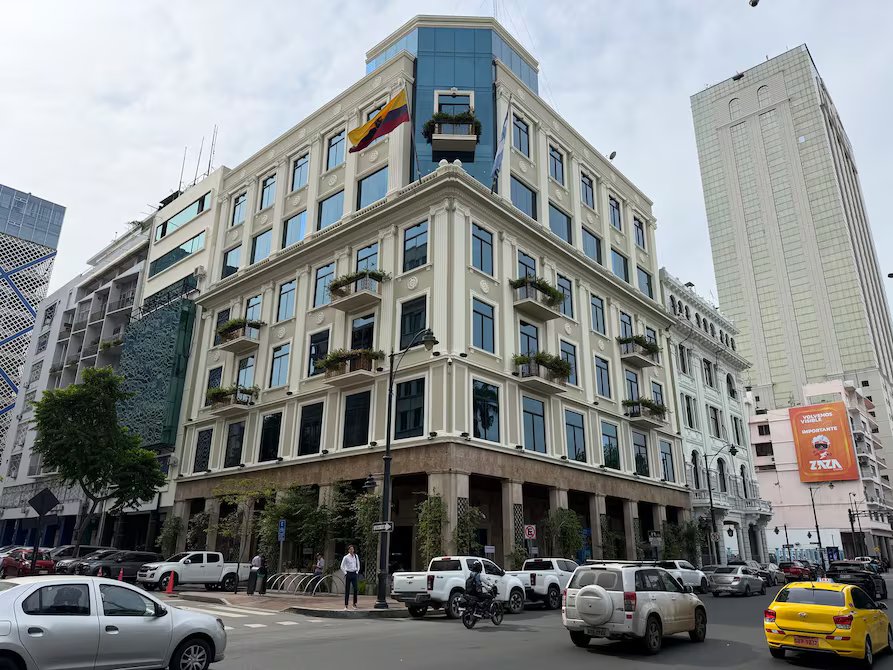
The session called for this Thursday April 16 in it Provincial Council of Guayas It will be decisive not only to fill the vacancy in the Vice Prefecture, but to define who will assume leadership of the province until 2027. After the resignation of Vice Prefect Carlos Serrano and with the announced departure of Prefect Marcela Aguiñaga for next May 14, the organization must make a decision that will have immediate effects on the provincial power structure.
Beyond the polarization of political forces in the Provincial Council, analysts agree on two key points: the election will depend on political agreements within the organization, which could have been taking place before Aguiñaga’s shortlist was known, and in which the profile of the chosen one will be decisive, since he will not only assume the Vice Prefecture, but will also lead, in less than a month, a Prefecture with works in progress and political tensions.
The Provincial Council of Guayas is made up of the prefect, the mayors of the cantons of the province and representatives of the rural parish councils, who have a say in the decisions. With the departure of Serrano, the Vice Prefecture becomes vacant, which activates the mechanism provided for in the Organic Code of Territorial Organization (Cootad)but for which no specific deadlines are defined.

The rule establishes that the Council must elect the new vice prefect of a triple presented by the prefect and, furthermore, that the person designated must be a external person to the organism itself. That is, none of the mayors or parish representatives can be elected.
This element introduces a peculiarity in the process: whoever is designated will not come to office by popular electionbut by decision of the Council. And even more, he will become prefect in a few weeks, when Aguiñaga formalizes his resignation.
To date, the triple which Aguiñaga must send. However, several names are already circulating in the political sphere, although without official confirmation.
The procedure is clear: once the shortlist is presented, the Council meets, names are moved and it is submitted to vote until a majority is reached. The candidate who obtains the necessary votes will be appointed vice prefect.
In this case, the decision has greater weight, since the chosen one will assume the Prefecture from the May 15 and must complete the period until 2027. Subsequently, the Council must meet again to appoint a new vice-prefect, respecting the principle of gender parity.
For the political analyst Hector MuñozGuayas is getting ready to live a unprecedented fact in the political history of the country, since when the new prefect takes office and elects a vice-prefect, the province will have, until the end of the period, two acting authorities who They were not elected by popular votewhich for him shows an issue that must be reviewed within Cootad.
Likewise, the context in which both elections will take place is marked by a fragmented political composition within the Provincial Council. The mayoralties of Guayas are divided between different political forces, mainly the Citizen Revolution and the Social Christian Party, as well as local movements and other organizations. This scenario prevents a single force from having absolute control of the vote.
In practice, this means that any decision will require agreements between blocks. The mayors, who constitute the majority of the Council, will have a determining role in the election.
However, the reading on the real weight of these forces is not unanimous. For Muñoz, the correlation of forces Within the Council it will be a key factor, as will the profiles of the shortlist be accepted by all the organizations that make up the organization.
From their perspective, the process will be marked by intense negotiations in the days prior to the session, with the aim of reaching consensus that allows an appointment without conflicts.
“The logical thing would be that there is practically unanimity in the name they are going to choose, taking into account the importance that Guayas represents,” he noted.
Muñoz warns that the worst scenario would be not reaching the necessary votes, which could generate a political vacuum in the province. For this reason, he considers that the forces represented in the Council must give in and find a name that is acceptable to all.
Furthermore, it highlights a particularity of the process: the new prefect will not be elected by popular votebut by the advisors, which introduces an element of political legitimacy which will depend on the consensus reached.
In contrast, the academic Andrea Endara suggests that the direct influence of the political blocks on the shortlist is not as decisive as one might think.
From its analysis, the formation of the shortlist depends exclusively on the prefectso political forces do not directly influence this initial stage.
“I don’t think they are comparable or that they can be directly influencing who is going to be or who is going to make up that triple”he explained.
For Endara, the focus should be on candidate profilemore than in its political alignment and emphasizes that the profile must be linked to the territory and, in particular, to the rural areawhich is where the powers of the Prefecture are concentrated.
“It has to be a person who has a connection and a strong relationship with the rural part”, he noted.
Furthermore, it considers that a combination of technical and political capabilities: experience in construction management, knowledge of the territory and negotiation skills.
The election of a vice prefect is not a new issue for Guayas. In 2020after the death of the then prefect Carlos Luis MoralesVice Prefect Susana González assumed the Prefecture.
Subsequently, the Provincial Council elected Jose Yunez as vice prefect, from a shortlist and with unanimous vote.
This background shows that, although the process can be resolved through broad agreementsit also depends on political context of the moment, according to experts.
Just hours before the session, the uncertainty revolves around the names that the triple that the prefect will present and the ability of the councilors to build consensus, taking into account that in less than a month they will be summoned again.
(YO)