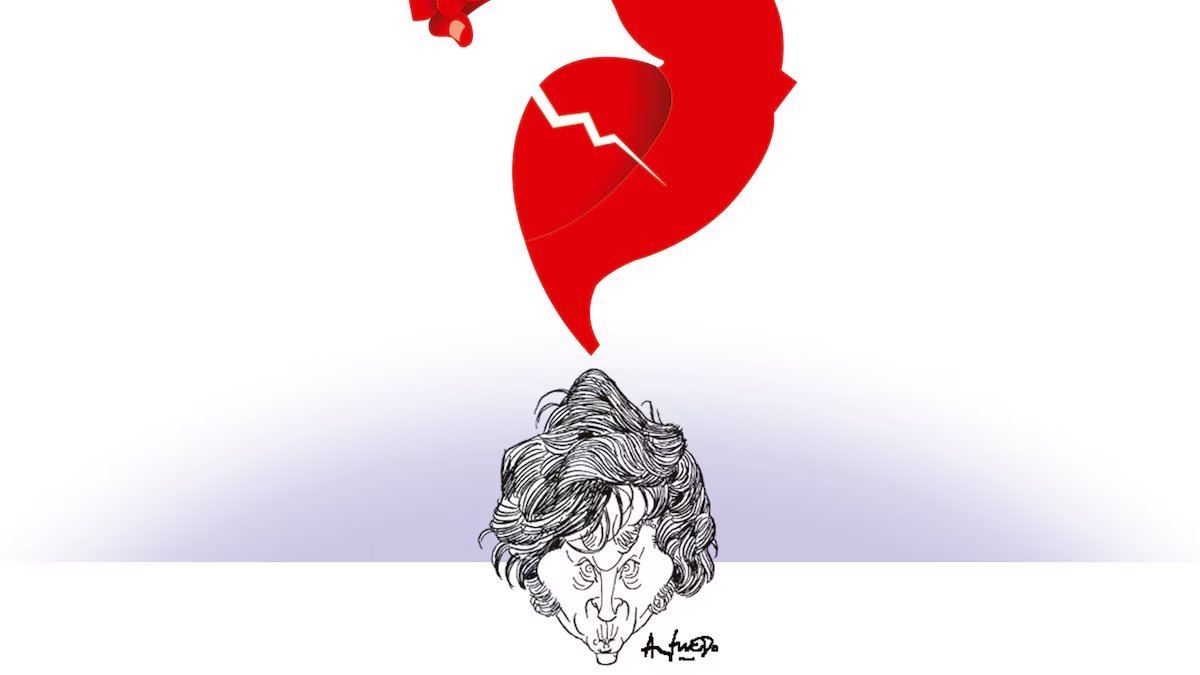
There is a central question that dominates the Argentine situation: Is Javier Milei consolidating or weakening? The question takes into account the local front and also the global horizon. There are data that raise doubt; There are data that dispel it: in that unstable balance of opposing interpretations the day to day and the future of the libertarian government is at stake. But there is a conclusion that, for the moment, works in the Government’s favor: precisely, that the doubt remains and there is still no way to clear up the mystery. Argentina is far from a general crisis and undisputed that corners the exhausted Government against the ropes, despite the daily waves.
The winds that blow strong from the Adorni case and of $POUND and from a set of macroeconomic indicators they are not enough to turn the Government’s ship around. The present does record fissures in support for the ruling party in public perception. Fruit of the pure present with the possibility of future correction? The question is whether this perception is only temporary or will be reversed in the coming months, to last until the 2027 presidential elections.
Yesterday, Luis Caputo anticipated the inflation figure that will be known today: according to the minister, it would exceed the 3 percent. He did it with one objective, to control the political-economic interpretation of the rise in inflation. He lowered the price of the March indicator and sought create expectation forward: the near, or medium, economic future, as the exit door for the Government. “Since April, a process of disinflation and growth has been taking place. The best months are coming,” he assured.
Generations of Argentines are accumulating who carry the history of the macro and microeconomic debacle in their DNA: confronted against the collective memory, the current panorama does not fit into that historical series of Argentine anguish, at least for the moment. There is no 2001 model crisis, with a mobilized street and political anarchy; nor ’89 model or Massa 2023, with rampant inflation determined to become at risk of hyper or directly hyper; There is also no opposition so organized as to organize the street.
There is no definitive and absolute answer about the progress of the economy, neither for nor against: the clear conclusions are more the result of political logic than of the evidence offered by reality.
The hardline opposition sees chaos, and in some cases, they also want it. “We have an immense task. I think times are accelerating,” he said. Axel Kicillof at the launch of the university leg of Right to the Future at the Faculty of Exact Sciences of the UBA, last Thursday. The ruling party sees the opposite: an Argentina that consolidates its foundations and moves forward. Now, in addition, the Government is beginning to make efforts, until now unknown, to recognize difficulties and, at the same time, convince of their ability to change their course.
Yesterday, Caputo’s statements were in that direction: for the head of the economic team, next month will show recovery of the downward inflation path. In the Government, there are high expectations. On the one hand, with the price of gasoline tamed through YPF, they assure that they will control the external shock of the war in the Strait of Hormuz. On the other hand, March and its classic seasonality will be left behind. And the central thing for the economic team: that the accumulation of reservesgetting rid of pesos and buying dollars, is not going to prices, neither the dollar nor the products. The supply of dollars from export sectors such as agriculture and energy offset the official demand for the dollar: a new exchange rate and anti-inflationary anchor for the Government. For the opposition, however, this process sets the dollar even further behind.
Strong market players do more independent analysis: when you have silver plunged into an emerging market Like Argentina, it is best to be as rational as possible. One of them, from Manhattan, where he follows Argentine investments, draws distinctions. “Technically, Mingo (by Domingo Cavallo) is not right: this is not stagflation. An economy growing at 4.4 percent is not in stagflation by any means. The Government is right when it bothers with that definition,” he says. The Argentine of the markets is not an unconditional supporter of the Government: he also integrates the dark side of the moon into his analysis. But he recognizes its achievements that he considers unquestionable: fiscal surplus, GDP growth, order in the streets, minority governability, political decision for change. “Being here is a miracle”he emphasizes. It refers to the current panorama, with its good and bad indicators.
Where is your main concern? Not because of country risk or inflation. Yes on two other sides. First, because of monetary policy: there you see “catastrophic errors.” “You question one variable and they tell you: you don’t understand anything, you have to look at the other. You look at the other and they tell you: you missed this variable. And so on all the time. There is no clarity in monetary policy”he proposes. The sky-high interest rate in 2025 was the symptom of those errors. The drop in rates in recent weeks would indicate a correction in that direction.
The other concern is in the level of activity. The question that the investor puts on the table is: When does the transition begin to be left behind, with all the political costs it has? In the eyes of the Argentine from Manhattan, the process of creative destruction to overturn the logic of the Argentine productive matrix is a bitter pill that is impossible to avoid. “Trying to cushion it is going to delay the process more”he warns.
Is a global investor worried about the $LIBRA case or the Adorni case? “We’re following him. What are they doing?!”he says to acknowledge his concern. From the globality of the markets, the first reaction that arises is disbelief, which translates into: how can it be that a Government makes such a mistake. Of particular concern is that these complaints take away from the Government the capacity for political maneuver, margins of governabilityand that this affects the stabilization process of the economy. Moral purity does not enter into his calculations: he accepts it as a lost battle in Argentine politics.
That coin in the air of the economy that does not end up falling on one side or the other of perception imposes another key question at this moment. It is about the issue of the speed of epochal changes. How fast is the world changing? At what speed is Argentina changing? The acceleration of everything – of the political transformation, of the rise and fall of the global right, of the recovery of a less extreme vision of politics, of the geopolitical reordering, of the change in the economic matrix – as the dynamics of the present. Did Argentina also press the accelerator and Is the Milei that came to screw up the speed of structural transformation in Argentina running out of gas?
On the one hand, 2026 started with unfavorable polls for Milei. Is the majority new social subject synthesized in “Milei’s repentants”? Or is it the optical illusion What is the opposition manufactured? Surveys continue to emerge that highlight a decline in support for the Government and its policies.
One of the most recent surveys confirms what others have been publishing. It is the Third Report of the Psychosocial and Economic Thermometer of the Faculty of Psychology of the UBA. Uncertainty prevails over the confidence and optimism of previous months. 46 percent say it is worse and 36 percent say it is better. It is the first time that the balance on well-being is negative. The main factor is the economy: For 83 percent, financial problems impact their mental health the most.
For the hard opposition of Kirchnerism and the left and an opposition in the process of hardening, such as that of Pichetto, Monzó and Massot, “Milei’s repentants” are a rapidly growing political subject. Your goal is to represent them. For a political class that governed against the macroeconomic rationality that is producing some results, although not all, it is a difficult task to gain that credibility.
What is clear is that the symbolic power of Milei 2024, recently landed in power, was left behind. The most powerful mileist message and vision was far away: today the speech he gave at the Milken Institute in May 2024 would be impossible. At that time, he deregulated the word politics and planted the Argentine case as part of a mix that integrated a futuristic social vision, an evolutionary theory of the human species and the heroic place of the adventurous businessman as the finished form of that evolutionary path for everyone. A kind of overcoming of social justice without the “moralistic” alibi and with benefits for the poor, and not just the rich. Two years of management changed everything: his own backpack sets the prosaic limits of reality for the Government.
Now every message is encoded in storm pilot mode: words or silences fall under the strategy of governing in stormy waters. A president who insults everyone on many issues calls for silence with the Adorni case. And between last Thursday and last Sunday, Milei saw the need to replace Adorni as spokesperson. In two key posts, he acknowledged the problems with his economic plan while again highlighting his achievements.
Mileist management also faces a planetary challenge. The global scenario is never anecdotal for the progress of an Argentine government, but in the case of Milei, that weight is accentuated. The mileist identity is completed in its place in the world, as part of a global alliance: Milei synthesizes it like few others and at the same time, builds meaning in that dotted line that goes from Trump to Orbanamong others.
That alliance began to find a limit: that of the popular vote. After visiting Orban as a brother leader in the same global crusade, a shocking majority of votes left milleist support sidelined. The Hungarian lost an election under his own rules, made to win: hence his defeat is even more resounding. A symptom that Milei should not miss: that in democratic systems, even under extreme pressure from an illiberal leader, hegemony is never eternal.