April 14, 2026 – 01:00
While managing G. 4.7 billion of public and IPS money, Ueno Bank – linked to former associates of President Santiago Peña – skyrocketed its deferred charges from G. 224,000 million to G. 800,432 million in just one year. Through accounting engineering endorsed by the Central Bank of Paraguay (BCP), the entity had already managed to hide and pay in installments for 20 years the “costs” required by the merger with Visión Banco.
While the regulations of the Central Bank of Paraguay (BCP) usually establish more prudent terms to amortize operating costs, Ueno Banklinked to Grupo Vázquez SAE, chaired by Federico Miguel Vázquez, achieved an unprecedented regulatory exception after the absorption of Visión Banco in 2024. This flexibility allowed him to “kick off” the transition costs over 20 years, a benefit that will help him not “punish” its current profits with the heavy burden of the deteriorated portfolio of the absorbed entity, which represented G. 2.5 billion.
Read more: Ueno leads public fund raising, but earns more with “rentals” and “projects”
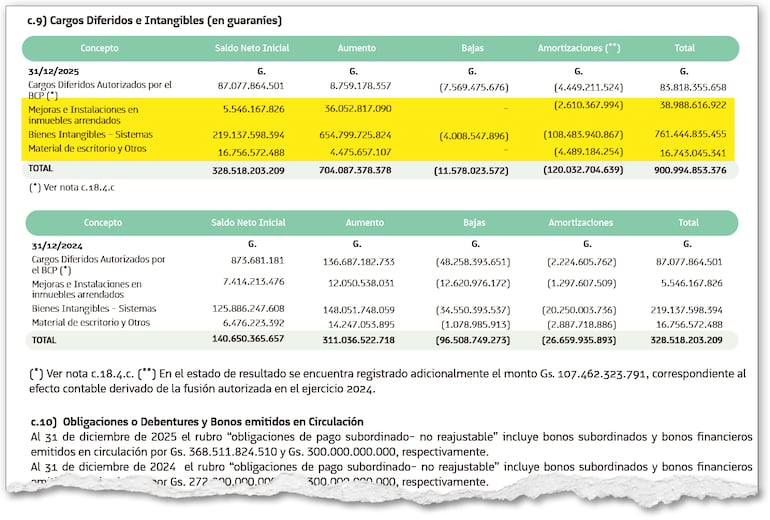
At the end of fiscal year 2024, the annual “fee” for these deferred charges was G. 87,077 million. However, at the end of fiscal year 2025, the bank recorded an alarming jump in other items that, under normal conditions, should be direct expenses, but which appear here “protected” under the figure of assets to be amortized.
Disguised expenses?
The most drastic increase occurred in the so-called intangible assets (systems), which rose from G. 219,137 million to G. 761,444 million in just one year. While the bank could argue that this is “technology investment,” the magnitude of the jump (more than G. 540,000 additional million) suggests that operating costs are being capitalized to avoid showing losses on the balance sheet.
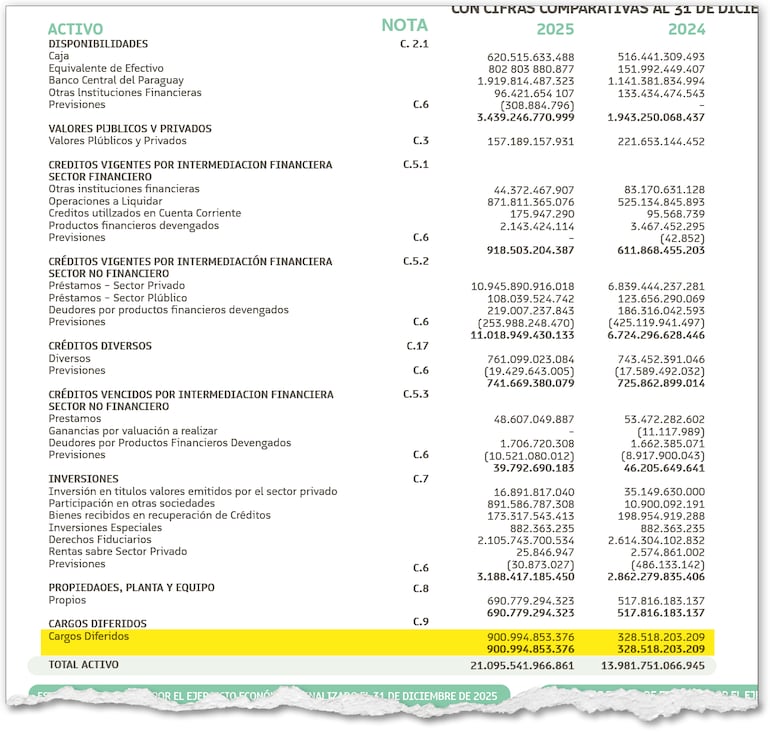
Added to this is the contradiction in the area of improvements in leased properties, where expenses went from G. 5,546 million to G. 38,988 million. It is financially inconsistent for an entity that attributes a large part of its profits to income from “rentals” -acting as owner- at the same time record record expenses on improvements to premises that do not belong to it.
According to the same Ueno balance sheets, in 2025 the “rentals” item left it with profits of G. 180,000 million, while another quite particular item such as “projects” G. 200,400 million. In total, for other various profits, the bank says it won G. 497,944 million.
A “paper” solvency
This financial engineering, even if it has the approval of the regulatory entity, dilutes the real “solvency” of the entity that today guards the state savings and the Social Security Institute (IPS). In accounting terms, the bank appears solid because it records these G. 800,000 million as “goods”, but in reality they are already executed expenses that have no resale value.
If the bank were to face an immediate need for liquidity, these intangible assets cannot be converted into cash to return money to depositors.
Read more: Public funds in ueno skyrocketed 4,600% in 28 months of Peña’s administration
The “solvency” of Ueno, whose main shareholders were business partners of President Santiago Peña until April 2025 through Ueno Holding Saecadepends today, to a large extent, of the persistence of this exceptional 20-year permit; an accounting shield that is unmatched by any other entity in the Paraguayan financial system.