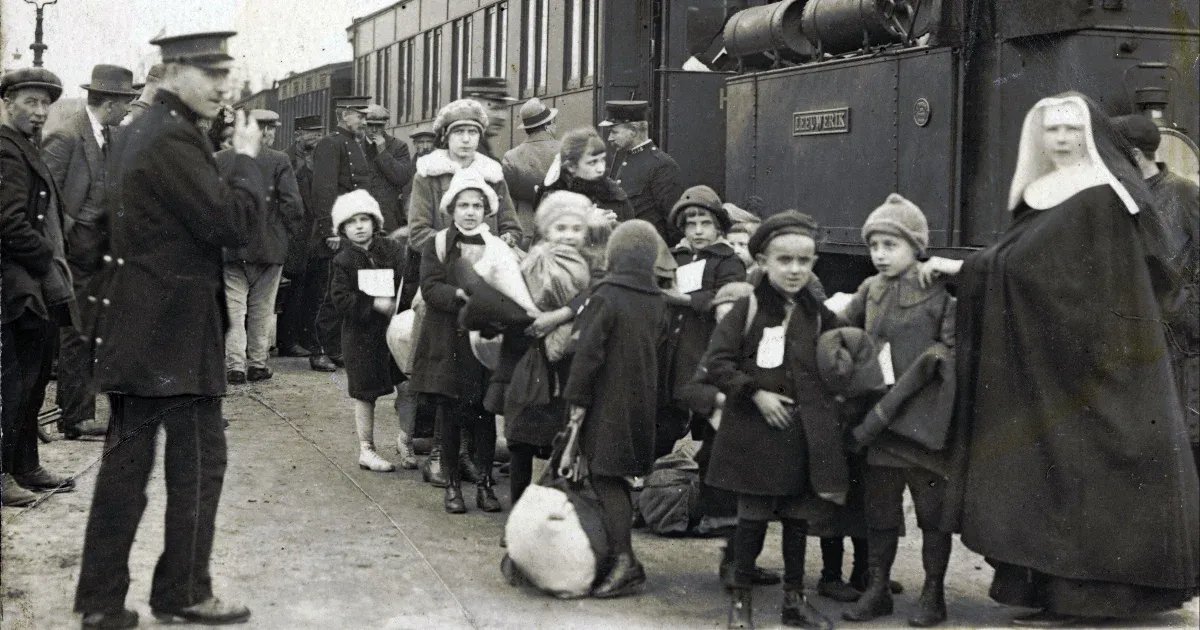
Most Hungarian newspapers reported a hundred years ago that on April 24, 1926, the hundredth children’s train returned home from Belgium. After traveling 1,350 kilometers, the train entered the Keleti railway station from Antwerp with six hundred children at ten o’clock in the morning. In the Belgian metropolis, the children who enjoyed the country’s hospitality were bid farewell in a solemn and intimate setting.
One of the priests at the event drew a parallel from the 11th century when he saw the humanitarian aid: he recalled that at that time many people from the Liège area headed towards the Carpathian basin in the hope of a better life. And now Belgium has helped Hungarian children with a difficult fate.
“Canon Jansen remembered Hungary’s great historical task, when it was the bulwark of the West and Christianity against the Turkish threat from the East. He raised his glass to a better future and Hungary’s resurrection,” Pesti Hírlap wrote in its on-site coverage. Dezső Kosztolányi this action piqued his interest. “Children are wonderful statesmen. I recommend that people try to make friends this way. Adults should not meet.”
The name children’s train dates back to 1920 and covered an exemplary initiative. With state support, the National Children’s Protection League has set itself the goal of helping the children who suffered a lot in the First World War with this charity action.
The plan was that the traumatized, in many cases half-orphaned, children with a difficult fate could not live in musty basement apartments or mass hostels, but in cultured conditions, and not least to be able to eat every day. In post-war deprivation, it often happened that a parent chose the children’s train because he could not give his child adequate food for days. And Dutch families agreed to put one plate more on the table.
“Pale, thin, thin human seedlings were taken beyond the Dutch, Swiss, and later Belgian borders, from where red-juicy, powerful little Hungarians returned over time”
– the newspaper Szózat enthusiastically and sensitively presented the practical importance of the program.
The League was founded in 1906, and its leaders constantly sought contact with the Netherlands. The Protestant religious thread has been present between the two countries for centuries. Lutheran bishop Sándor Raffay was not only a member, but also the engine of this action. While the Austro-Hungarian Monarchy was considered a wealthy country in the years before the war, the Netherlands, despite its colonies, was not so prosperous at the time. They also thought of Switzerland, Sweden, and Great Britain as host countries, since they were not affected by the destruction of the war. Belgium, which was also suffering from the trials of the war, offered a helping hand to Hungarian children from 1923.
Some started traveling at the age of three, while others got tickets for the train much older, in their late teens. The first trip took place on February 8, 1920, the wagons rolled out of Keleti with six hundred children, many of whom did not speak German. The Dutch quickly realized that since children learn very quickly, it was unnecessary to impose a language proficiency requirement, so they did not do so.
The children spent an average of two months outside, and then another train left for them, which was also packed to the brim in Budapest, so they took turns and the trains did not have to turn around empty. It happened that some of the teenagers stayed outside in the hope of a better life, some were wanted by the families outside, even though this was an unknown procedure at the time. According to the latest research ten percent of the children did not return to their homeland. In some cases, it happened that after several years of being abroad, the biological family asked for the child to return home, because they were in such a financial situation that they could provide for them. By the time he returned home, he had forgotten Hungarian and had to learn his mother tongue again.
During the ten-year program, which was completely completed in 1930, approximately sixty thousand children benefited from the support of foster parents, in many cases the good relationship was maintained for decades, abuse was negligible when someone was pushed into the ranks of servants. After the Second World War, for similar reasons, this initiative came to life again, but it ceased in 1948.