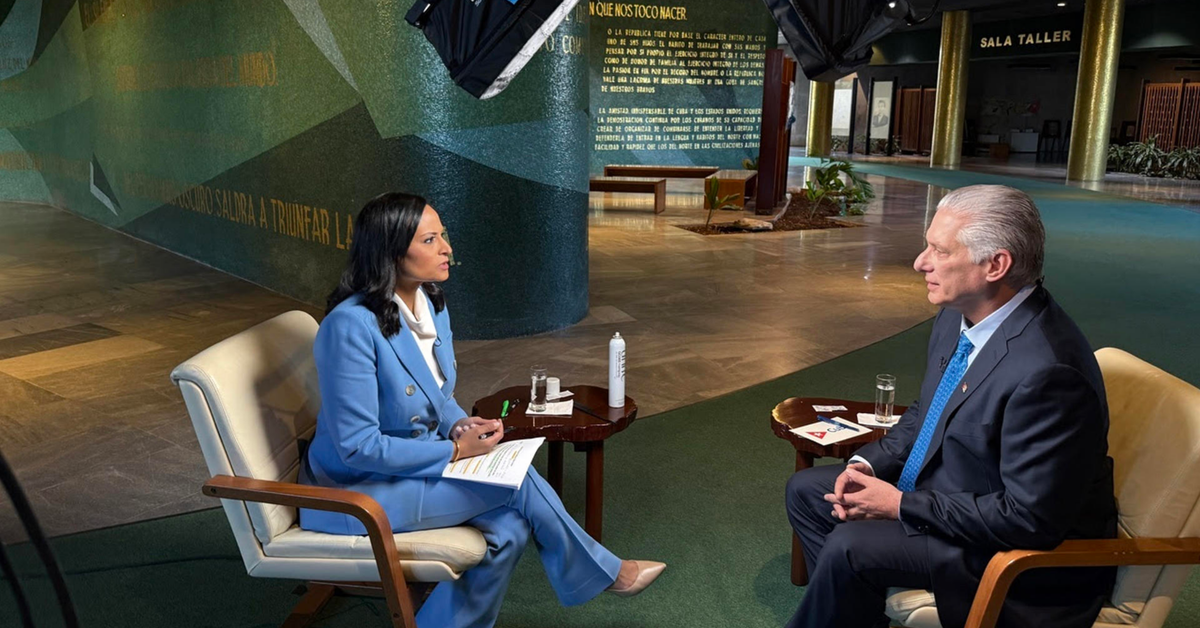
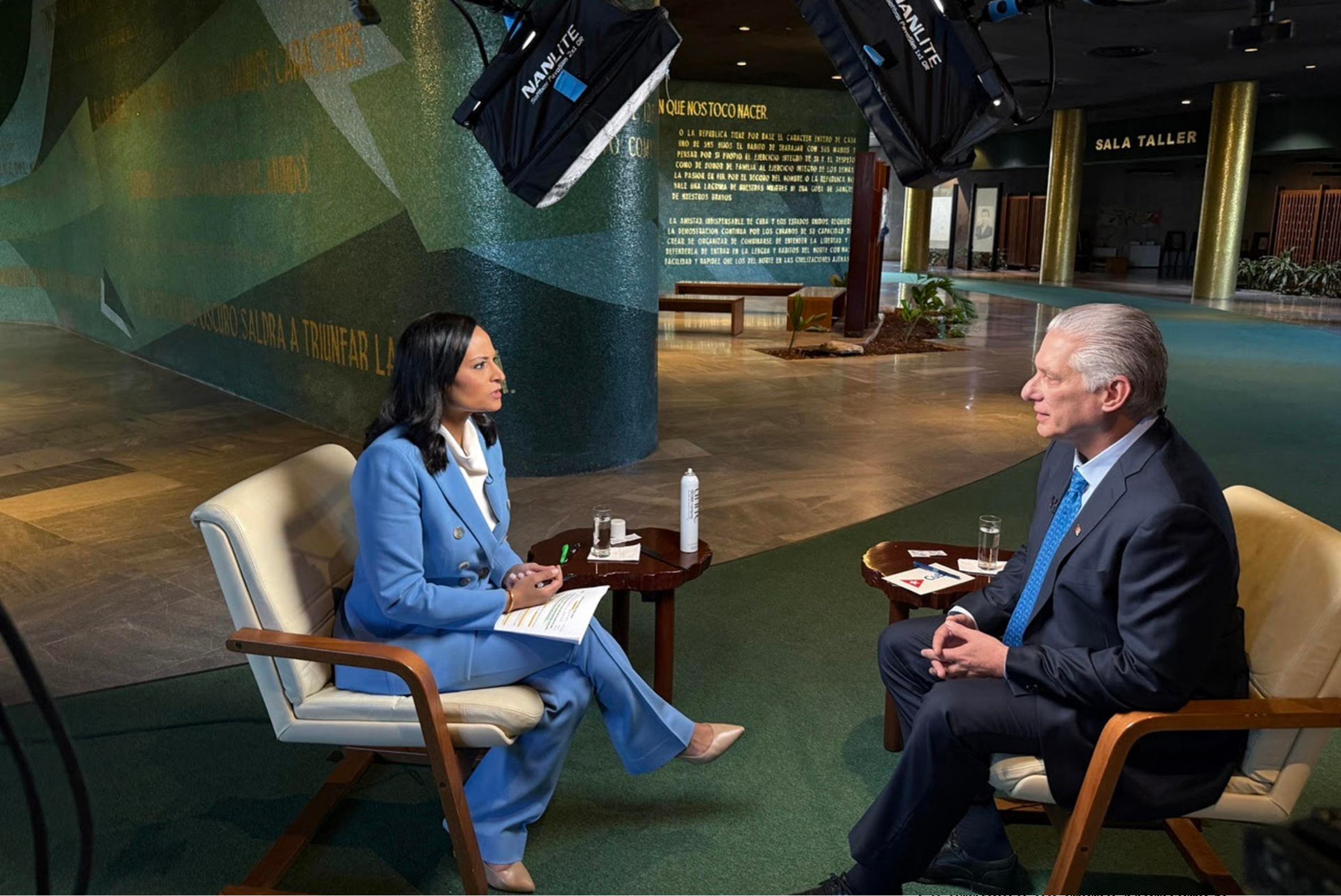
Madrid/The American network NBC published this Sunday the full interview to the Cuban ruler Miguel Díaz-Canel, hosted by journalist Kristen Welker in the program Meet the Press.
Unaccustomed to facing the foreign press – until now he has moved almost exclusively between official media or international interlocutors sympathetic to the regime – Díaz-Canel responded harshly and took refuge in the most worn-out repertoire of Cuban power. For more than 50 minutes he did not assume a single political responsibility for the deterioration of the country. On the contrary, he defended the continuity of the system, rejected any conditioning from Washington and presented himself as part of a “collegiate leadership” even willing to “give his life for the Revolution.”
In the face of Donald Trump’s threats, Díaz-Canel also implies that the aggressive language against Cuba has not only come from the US president, but also from other members of his Administration, in a barely veiled allusion to Marco Rubio, whom he avoids mentioning by name in that section of the interview. Instead of taking advantage of the space to reduce tensions or outline a political solution, the president once again settles into the terrain of resistance, the square under siege and the nation permanently on guard. A serious ruler would have talked about de-escalation, international legality and protection of civilians. Díaz-Canel, on the other hand, preferred the liturgy of the martyr and the use of the population as a rearguard for the doctrine of “war of all the people.”
In the face of Donald Trump’s threats, Díaz-Canel also implies that the aggressive language against Cuba has not only come from the US president.
The Cuban president avoids drawing parallels between Cuba and other countries and takes refuge in the historical uniqueness of the Island, but this caution fails to erase a recent uncomfortable fact. The doctrine of the “civil-military union,” which Chavismo copied from Castroism, has already shown its most resounding failure in Caracas.
In the section dedicated to fuel, Díaz-Canel admits, perhaps more clearly than at any other time in the interview, the magnitude of Cuban energy precariousness. Recognize that the newly arrived Russian ship “It will only cover a third of Cuba’s monthly oil needs,” that this crude oil must still be refined and distributed, and that a good part will be used to recover 1,200 megawatts out of service for four months. From there it tries to wrap the Island’s dependence on Russia in a language of resistance and sovereignty, but what remains is the confession of a country that cannot sustain its economy or its electrical system without immediate external assistance.
When the journalist asks him if he assumes any responsibility for “the pain that Cubans are experiencing,” Díaz-Canel does not offer a single concrete admission about mismanagement, economic design errors, state inefficiency or internal obstacles. It limits itself to returning the question: “What is the main cause of this suffering?” His answer is elusive: “It is not the fault of the Cuban Government.” With that statement he suddenly cancels any serious examination of the role of the State in the electrical collapse, food shortages, lack of medicine or mass emigration.
His evasiveness is even more evident when addressing the visible poverty in Havana, the 20-hour blackouts or the departure of hundreds of thousands of Cubans. It recognizes that “our people are experiencing very difficult conditions every day,” but avoids connecting that suffering with a centralized, unproductive and politically closed model. He prefers to describe the population as a resistant subject. “The Cuban people feel frustrated,” yes, but “the majority of the Cuban people do not blame the Cuban Government.” The statement contradicts what can be seen on social networks and even in the streets, where more and more citizens openly reject not only his management, but also the power structure that supports it.
When NBC lists some of the demands that Washington usually places on the table – release of political prisoners, multi-party elections, independent unions and a free press – Díaz-Canel responds with a mixture of denial and contempt. First, he assures that “no one” has made these demands to him. He then makes it clear that, in any case, the Cuban political system and the “constitutional order” are not subject to negotiation.
The most revealing comes when he reduces democracy, human rights, freedom of the press and union autonomy to a simple “paraphernalia” of manipulated concepts loaded with “prejudices.” That is, it does not refute the accusations, it does not offer evidence and it does not go into the substance of the matter. He limits himself to discrediting in advance the language with which he is questioned. His final statement – “we don’t have time now”, “it would take us a long time to discuss it” – finishes portraying the maneuver.
NBC insists, mentions Maykel ‘Osorbo’ and places those imprisoned for political reasons at more than 1,200. “It’s a big lie,” responds the president
NBC insists, mentions Maykel Osorbo and places those imprisoned for political reasons at more than 1,200. “It’s a big lie,” responds the president. According to their version, in Cuba protest is not punished, but rather vandalism and subversion encouraged from abroad. But it is enough to review the files, accusations and sentences imposed on protesters, artists, opponents and activists one by one to verify that the person who falsifies reality is Díaz-Canel himself.
In the diplomatic field, the president is open to negotiating with the United States, but under one absolute condition: that “our political system” or “our constitutional order” is not touched. He assures that dialogue and agreements “are possible, but they are difficult,” and lists areas of cooperation such as migration, drug trafficking, terrorism or investments.
One of the most revealing moments comes at the end. When asked if he would be willing to resign to “save Cuba,” Díaz-Canel responds, irritated, with a phrase that summarizes the essence of the entire interview: “The concept of revolutionaries abandoning and resigning is not part of our vocabulary.”