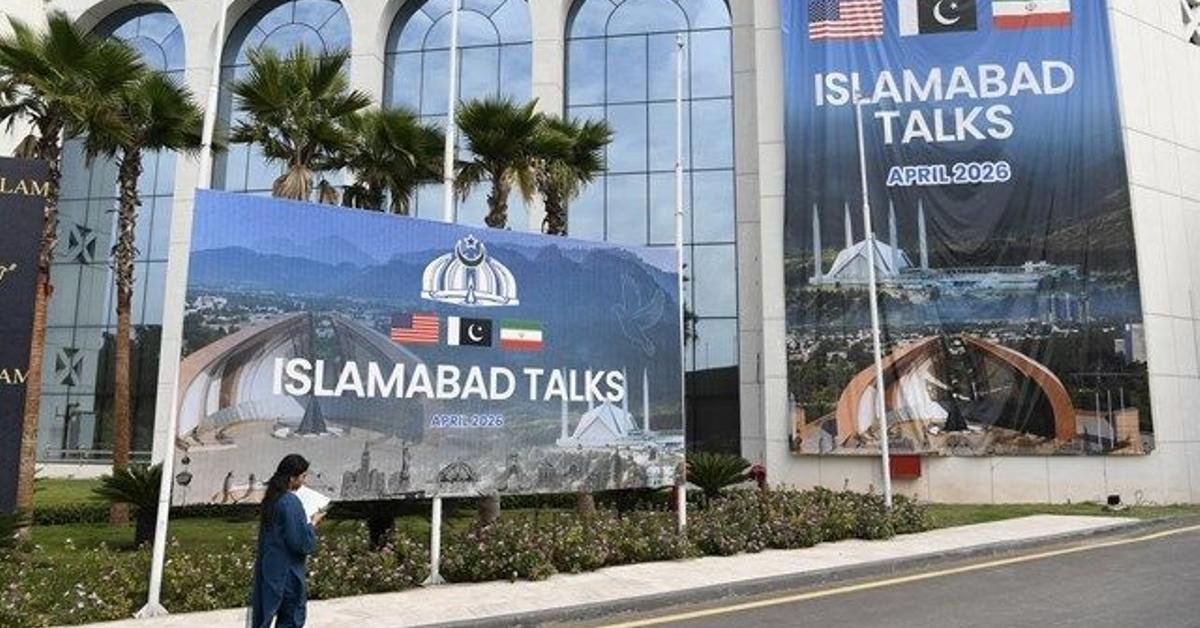
Islamabad/The United States and Iran closed 21 hours of negotiations this Sunday in Islamabad without reaching an agreement, but left the door open to new talks. The meeting, held with the mediation of Pakistan, was the first direct high-level contact between both countries in almost half a century and ended without decisive progress on the issues that weigh most on the table: the Iranian nuclear program, control of the Strait of Hormuz and the real scope of the truce in the midst of the offensive that began on February 28.
The delegations left the Pakistani capital early in the morning. On the American side, Vice President JD Vance appeared briefly before the press to present the result as a relevant, although insufficient, step. He spoke of “substantial conversations,” avoided giving details and assured that Washington left on the table a proposal that he defined as its “best and last offer.”
There was, however, no announcement of a pact. Nor a public roadmap for a new round. The message was rather that of a dialogue that is not completely broken, but that remains trapped in its underlying differences.
According to several sources cited by Iranian and Pakistani media, during the long hours of talks there was an exchange of texts and partial understandings on some points. Still, at least “two or three” major disagreements persisted. In practice, these disagreements were enough to block a final document.
Tehran defends its right to maintain a nuclear program for civilian purposes and considers that the demand for “zero enrichment” is equivalent to dismantling a strategic part of its sovereignty
The main shock continues to be the nuclear one. Washington maintains as a red line that Iran renounces not only making an atomic weapon, but also retaining the technical capacity that would allow it to do so quickly. Vance pressed that point, noting that the United States needs “a firm commitment” that Tehran will not pursue a nuclear weapon “either now or in the long term.”
Iran rejects that demand in the terms proposed by the White House. Tehran defends its right to maintain a nuclear program for civilian purposes and considers that the demand for “zero enrichment” is equivalent, in practice, to dismantling a strategic part of its sovereignty. Furthermore, it continues to demand the lifting of sanctions as an essential condition for any lasting settlement.
The pulse is not new. At the beginning of 2026, indirect contacts had been resumed in Oman and Geneva to try to put the nuclear issue back on track, but the offensive launched on February 28 by the United States and Israel against Iranian territory interrupted that process and once again hardened positions.
The second critical point was the Strait of Hormuz, one of the most sensitive shipping routes on the planet. An essential part of the world oil trade passes through there and its control has become a political and military asset for Iran. Although Washington avoided making a public statement on this point at the end of the meeting, it was made clear from the Iranian environment that the disagreement persists.
There will be no changes in the situation in the Strait of Hormuz as long as the United States does not accept a “reasonable” agreement
A source cited by the Mehr agency summarized Tehran’s position with a blunt phrase: there will be no changes in the situation in the strait as long as the United States does not accept a “reasonable” agreement. In other words, Iran is not willing to offer a full and unconditional reopening of that sea route without obtaining clear compensation.
For now, the Islamic Republic maintains a limited safe passage protocol for two weeks, conditional on direct coordination with its Armed Forces and compliance with the truce by the other party. Washington aspires to a more stable, commercial and unrestricted reopening. Between both positions there is still a distance that is difficult to bridge.
Added to these disagreements was another element that complicates any negotiation: the regional scope of the crisis. While the delegations spoke in Islamabad, Israeli military actions in Lebanon continued. Iran claims that any understanding with the United States must include guarantees on Israel’s actions, especially in southern Lebanon and in Beirut. Washington, on the other hand, maintains that the two-week ceasefire only covers the direct confrontation with Iran and does not tie Tel Aviv’s hands on other fronts.
The economic dispute also remains open. Iran wants the lifting of sanctions and the return of frozen assets as part of an eventual agreement. The United States ties any financial relief to prior acceptance of its nuclear demands. It is a clash of sequence: Tehran asks for concrete measures before signing; Washington demands the signature before easing pressure.
Pakistan, which acted as a mediator, tried to reduce the feeling of total failure. Foreign Minister Ishaq Dar asked the parties to respect the two-week truce and made it clear that his country will remain available to facilitate future contacts. That was, perhaps, the only point shared by everyone at the close of the meeting: no one considered the dialogue dead.