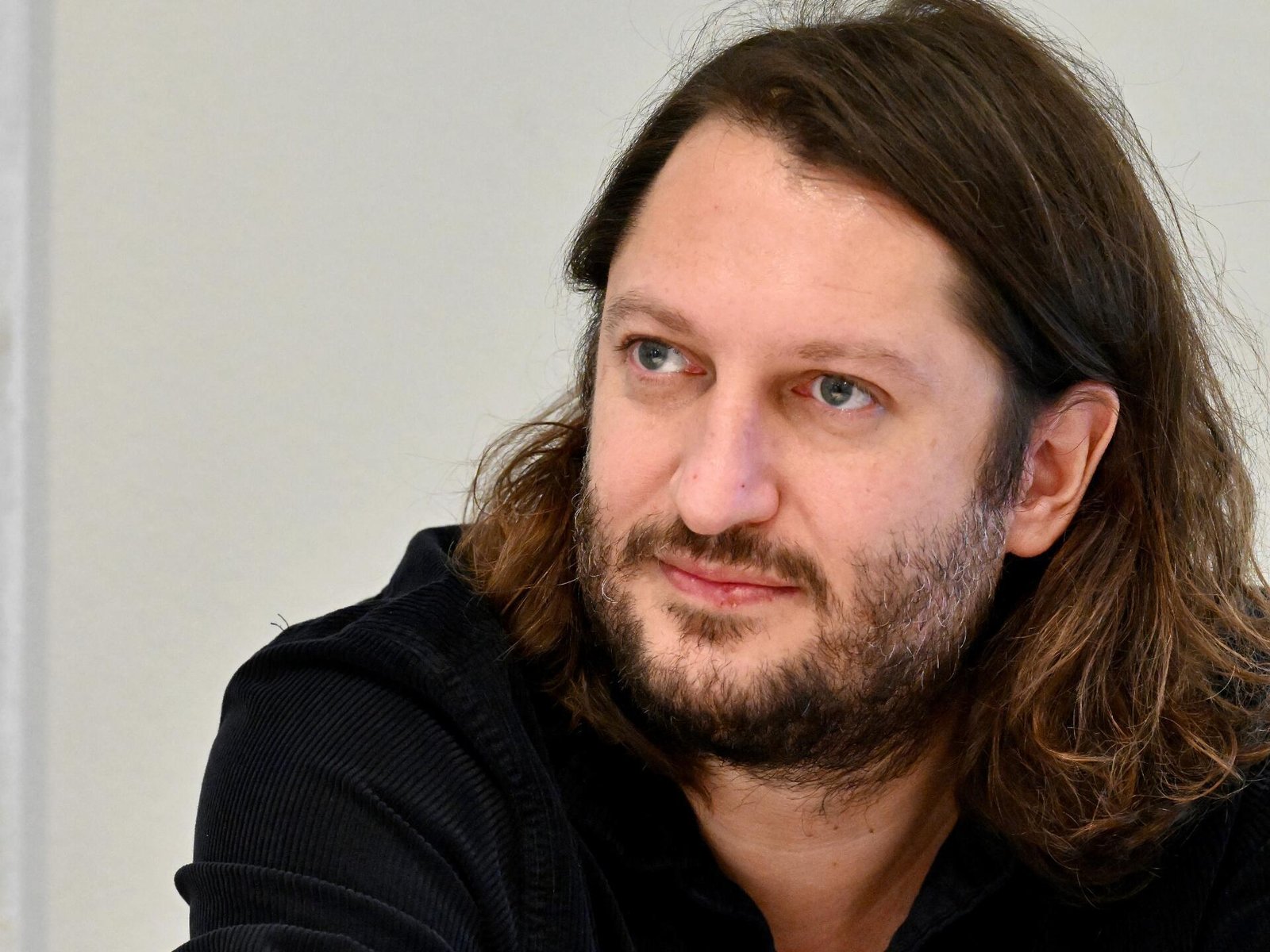
Ian De Toffoli will receive the “Prix Servais” 2026, worth 7,500 euros, for his book “Lea or the theory of complex systems” (2025, Actes-Sud-Verlag). The “Fondation Servais” announced this in a press release on Monday. De Toffoli’s work prevailed against four other authors. Also in the running were Tullio Forgiarini (“Vandalium”editions guy binsfeld), Guy Helminger (“Buildings for latitudes”Elif Verlag), Nico Helminger (“Dude against Hunneg”editions guy binsfeld) and Amélie Vrla (“Enfanter une étoile qui danse”Hydre Editions).
“I was at a loss for words,” says Ian De Toffoli in an interview with daily newspaper about his winnings. He said so little in the conversation with the jury that he contacted them again after the phone call – to make it clear that he was not “underwhelmed”, but simply speechless. “Authors are on their own, and this work involves a lot of anxiety,” says De Toffoli. You constantly ask yourself whether things are going in the right direction and whether what you are writing makes sense.
The fact that this work has now been officially recognized means a special fulfillment for him. “This kind of appreciation is not without its benefits,” says De Toffoli. “Of course you can surround yourself with friends who give you regular feedback – but this is official.”
In addition, such a price creates more visibility. His book was published a year ago. In a fast-moving market, such an award could give a plant new impetus. “Visibility for the current work is the most important thing,” says De Toffoli. Especially in Luxembourg, because there is not enough talk about authors here.
What is it about?
“Léa ou la théorie des systèmes complexes” examines the interconnections between the oil industry, economic structures and the climate fight. On the one hand, the author outlines the true history of Koch Industries. This is at the head of a widespread multinational oil company that dominates politics and establishes an ideology of exploitation. On the other hand, he describes the radicalization of the fictional Luxembourger Léa. The young woman is calling for a radical rethink in view of the climate crisis. The presence of Koch Industries in Luxembourg ignites their anger at the system, which leads them to carry out an attack. How does De Toffoli tell this story? Using elements from family legends, documentary writings, ancient theater and poetry.
The jury praised De Toffoli’s “strong narrative and stylistic choices” and described the work as a “contemporary epic” that combines elements of documentary film, theater, novel, poetry and oral storytelling. The text is based on De Toffoli’s research into capitalist power structures and the current challenges of political ecology. The jury also emphasizes the tension of the discourses, the changes in perspective and the change between poetic and sober style. The author draws on an ancient literary tradition by showing characters “who embody the ambivalence of human aspirations and allow incompatible life paths to coexist in the same fictional space.”
The works nominated for this year’s Servais Prize showed a wide variety of genres: De Toffoli and Forgiarini’s works are plays, the Helminger brothers entered the ring with a volume of poetry (Guy Helminger) and a collection of poetic texts (Nico Helminger). Only Amélie Vrla – the only woman in the group – came forward with a novel. The jury consisted of Sébastian Thiltges (chair), Fabienne Gilbertz, Danielle Igniti, Ludivine Jehin, Henning Marmulla, Diane Neises, Jérôme Netgen, Aimée Schultz and Tamara Sondag. (read)
To the Prix Servais
The Prix Servais has been awarded since 1992 and is worth 7,500 euros. It is named after the Luxembourg writer and politician Emmanuel Servais, who, among other things, took part in drafting the Luxembourg constitution in the 19th century. In addition to the Prix Batty Weber, which is awarded every three years for an author’s complete work, the Prix Servais is considered Luxembourg’s most important literary prize. The first prize winner was Roger Manderscheid (“De Parrot to Käschtebam”, Editions Phi). The first woman to accept the Prix Servais was Margret Steckel (“The Last from Bayrisch Platz”, Editions Phi). Last year the prize went to Anne-Marie Reuter for her debut novel “M for Amnesia” (Black Fountain Press). (ispi)