Thursday, May 7, 2026
    The GeoStrategic Consensus
    No Result
    View All Result
    • Login
    • HOME
    • AMERICAS
      • Argentina
      • Brazil
      • Canada
      • Chile
      • Colombia
      • Costa Rica
      • Cuba
      • Dominican Republic
      • Ecuador
      • El Salvador
      • Greenland
      • Guatemala
      • Honduras
      • Mexico
      • Nicaragua
      • Panama
      • Paraguay
      • Peru
      • United States
      • Uruguay
      • Venezuela
    • ASIA-PACIFIC
      • Australia
      • Brunei Darussalam
      • Cambodia
      • China
      • Federated States of Micronesia
      • Fiji
      • Indonesia
      • Japan
      • Kiribati
      • Laos
      • Malaysia
      • Marshall Islands
      • Mongolia
      • Myanmar
      • Nauru
      • New Zealand
      • North Korea
      • Palau
      • Papua New Guinea
      • Philippines
      • Samoa
      • Singapore
      • Solomon Islands
      • South Korea
      • Taiwan
      • Thailand
      • Timor-Leste
      • Tonga
      • Tuvalu
      • Vanuatu
      • Vietnam
    • CARICOM
      • CARICOM – Non-English
        • Haiti
        • Suriname
      • CARICOM Associates
        • Anguilla
        • Bermuda
        • British-Virgin-Islands
        • Cayman-Islands
        • Curacao
        • Turks-and-Caicos
      • CARICOM English
        • Antigua and Barbuda
        • Barbados
        • Belize
        • Dominica
        • Grenada
        • Guyana
        • Jamaica
        • Montserrat
        • Saint Kitts and Nevis
        • Saint Lucia
        • Saint Vincent and the Grenadines
        • The Bahamas
        • Trinidad and Tobago
    • EURASIA
      • Armenia
      • Azerbaijan
      • Balarus
      • Georgia
      • Kazakhstan
      • Kyrgyzstan
      • Moldova
      • Russia
      • Tajikistan
      • Turkmenistan
      • Ukraine
      • Uzbekistan
    • EUROPE
      • Albania
      • Andorra
      • Austria
      • Bosnia and Herzegovina
      • Bulgaria
      • Croatia
      • Cyprus
      • Czech Republic
      • Denmark
      • Estonia
      • Finland
      • France
      • Germany
      • Greece
      • Holy See
      • Hungary
      • Iceland
      • Ireland
      • Italy
      • Kosovo
      • Latvia
      • Liechtenstein
      • Lithuania
      • Luxembourg
      • Malta
      • Monaco
      • Montenegro
      • Netherlands
      • North Macedonia
      • Norway
      • Poland
      • Portugal
      • Romania
      • San Marino
      • Serbia
      • Slovakia
      • Slovenia
      • Spain
      • Sweden
      • Switzerland
      • United Kingdom
    • MIDDLE EAST AND NORTH AFRICA
      • Algeria
      • Bahrain
      • Egypt
      • Iran
      • Iraq
      • Israel
      • Jordan
      • Kuwait
      • Lebanon
      • Lybia
      • Morocco
      • Oman
      • Palestinian Territories
      • Qatar
      • Saudi Arabia
      • Syria
      • Tunisia
      • Turkey
      • United Arab Emirates
      • Western Sahara
      • Yemen
    • SOUTH ASIA
      • Afghanistan
      • Bangladesh
      • Bhutan
      • India
      • Maldives
      • Nepal
      • Pakistan
      • Sri Lanka
    • SUB-SAHARAN AFRICA
      • Angola
      • Benin
      • Botswana
      • Burkina Faso
      • Burundi
      • Cabo Verde
      • Cameroon
      • Central African Republic
      • Chad
      • Comoros
      • Cote d’Ivoire
      • Democratic Republic of the Congo
      • Djibouti
      • Equatorial Guinea
      • Eritrea
      • Eswatini
      • Ethiopia
      • Gabon
      • Gambia
      • Ghana
      • Guinea
      • Guinea Bissau
      • Kenya
      • Lesotho
      • Liberia
      • Madagascar
      • Malawi
      • Mali
      • Mauritania
      • Mauritius
      • Mozambique
      • Namibia
      • Niger
      • Nigeria
      • Republic of the Congo
      • Rwanda
      • Sao Tome and Principe
      • Senegal
      • Seychelles
      • Sierra Leone
      • Somalia
      • South Africa
      • South Sudan
      • Sudan
      • Tanzania
      • Togo
      • Uganda
      • Zambia
      • Zimbabwe
    • HOME
    • AMERICAS
      • Argentina
      • Brazil
      • Canada
      • Chile
      • Colombia
      • Costa Rica
      • Cuba
      • Dominican Republic
      • Ecuador
      • El Salvador
      • Greenland
      • Guatemala
      • Honduras
      • Mexico
      • Nicaragua
      • Panama
      • Paraguay
      • Peru
      • United States
      • Uruguay
      • Venezuela
    • ASIA-PACIFIC
      • Australia
      • Brunei Darussalam
      • Cambodia
      • China
      • Federated States of Micronesia
      • Fiji
      • Indonesia
      • Japan
      • Kiribati
      • Laos
      • Malaysia
      • Marshall Islands
      • Mongolia
      • Myanmar
      • Nauru
      • New Zealand
      • North Korea
      • Palau
      • Papua New Guinea
      • Philippines
      • Samoa
      • Singapore
      • Solomon Islands
      • South Korea
      • Taiwan
      • Thailand
      • Timor-Leste
      • Tonga
      • Tuvalu
      • Vanuatu
      • Vietnam
    • CARICOM
      • CARICOM – Non-English
        • Haiti
        • Suriname
      • CARICOM Associates
        • Anguilla
        • Bermuda
        • British-Virgin-Islands
        • Cayman-Islands
        • Curacao
        • Turks-and-Caicos
      • CARICOM English
        • Antigua and Barbuda
        • Barbados
        • Belize
        • Dominica
        • Grenada
        • Guyana
        • Jamaica
        • Montserrat
        • Saint Kitts and Nevis
        • Saint Lucia
        • Saint Vincent and the Grenadines
        • The Bahamas
        • Trinidad and Tobago
    • EURASIA
      • Armenia
      • Azerbaijan
      • Balarus
      • Georgia
      • Kazakhstan
      • Kyrgyzstan
      • Moldova
      • Russia
      • Tajikistan
      • Turkmenistan
      • Ukraine
      • Uzbekistan
    • EUROPE
      • Albania
      • Andorra
      • Austria
      • Bosnia and Herzegovina
      • Bulgaria
      • Croatia
      • Cyprus
      • Czech Republic
      • Denmark
      • Estonia
      • Finland
      • France
      • Germany
      • Greece
      • Holy See
      • Hungary
      • Iceland
      • Ireland
      • Italy
      • Kosovo
      • Latvia
      • Liechtenstein
      • Lithuania
      • Luxembourg
      • Malta
      • Monaco
      • Montenegro
      • Netherlands
      • North Macedonia
      • Norway
      • Poland
      • Portugal
      • Romania
      • San Marino
      • Serbia
      • Slovakia
      • Slovenia
      • Spain
      • Sweden
      • Switzerland
      • United Kingdom
    • MIDDLE EAST AND NORTH AFRICA
      • Algeria
      • Bahrain
      • Egypt
      • Iran
      • Iraq
      • Israel
      • Jordan
      • Kuwait
      • Lebanon
      • Lybia
      • Morocco
      • Oman
      • Palestinian Territories
      • Qatar
      • Saudi Arabia
      • Syria
      • Tunisia
      • Turkey
      • United Arab Emirates
      • Western Sahara
      • Yemen
    • SOUTH ASIA
      • Afghanistan
      • Bangladesh
      • Bhutan
      • India
      • Maldives
      • Nepal
      • Pakistan
      • Sri Lanka
    • SUB-SAHARAN AFRICA
      • Angola
      • Benin
      • Botswana
      • Burkina Faso
      • Burundi
      • Cabo Verde
      • Cameroon
      • Central African Republic
      • Chad
      • Comoros
      • Cote d’Ivoire
      • Democratic Republic of the Congo
      • Djibouti
      • Equatorial Guinea
      • Eritrea
      • Eswatini
      • Ethiopia
      • Gabon
      • Gambia
      • Ghana
      • Guinea
      • Guinea Bissau
      • Kenya
      • Lesotho
      • Liberia
      • Madagascar
      • Malawi
      • Mali
      • Mauritania
      • Mauritius
      • Mozambique
      • Namibia
      • Niger
      • Nigeria
      • Republic of the Congo
      • Rwanda
      • Sao Tome and Principe
      • Senegal
      • Seychelles
      • Sierra Leone
      • Somalia
      • South Africa
      • South Sudan
      • Sudan
      • Tanzania
      • Togo
      • Uganda
      • Zambia
      • Zimbabwe
    No Result
    View All Result
    Agentially
    No Result
    View All Result
    Home EUROPE Hungary

    Telex: The war that cannot be won, only ended

    The Analyst by The Analyst
    May 7, 2026
    in Hungary
    Telex: The war that cannot be won, only ended


    Moscow has already lost the war in a strategic sense. He has to face this sooner or later, so that in the meantime he can sell the conflict as a success at home. That is, you need to make the best possible deal. Time has worked for them so far, but not now: sanctions are tightening, the economic burden is increasing, drone technology is developing rapidly, while there is no breakthrough on the front line.

    READ ALSO

    Péter Magyar Appoints Brother-in-Law as Justice Minister despite Pledging to Fight Nepotism

    Telex: The Fidesz EP faction initiates the termination of the proceedings against Hungary for violating the EU’s core values

    Finnish President Alexander Stubb is one of the most underrated European leaders of our time, but at the same time the most influential in the background. Stubb can simultaneously find a voice with the President of the United States on the golf course and unite the countries of the “coalition of the ready to act” in suits reminiscent of immaculate frigate captains.

    It is worth listening to his statements, because he shows the direction of Europe. In this interview also draws this big picture: it takes one by one what the Russian goal was and what they actually achieved.

    According to Sun Tzu, speed is the essence of war. It is now a consensus opinion that Moscow was preparing for a blitzkrieg: it wanted to occupy Ukraine in the same way it did Crimea, or as the United States carried out Operation Absolute Resolve in Venezuela this year. Compared to this, the war has been going on for the fourth year, Russian capabilities have substantially depreciated, and all this highlights the serious corruption in the system.

    The goal of the Russian leadership was to block NATO’s eastern expansion. On the other hand, as a result of the war, the previously neutral Sweden and Finland also joined the alliance, so the common border increased by about 1,340 kilometers, and European NATO capabilities were significantly strengthened.

    It is also clear that Moscow wanted a divided and fragmented Europe. Compared to this, the “coalition of those ready for action” today shows greater unity than the European allies at any time in the last fifty years. Closely related to this is the fact that the Russian leadership hardly aimed for a new wave of European armaments. Despite this, partly due to the rhetorical pressure of Donald Trump and partly due to the war in Ukraine, European countries are increasing their defense spending to an unprecedented extent, which can reach up to 5 percent of GDP.

    As the Finnish president puts it: Russia lost this war, but obviously Ukraine did not win either. Below we examine how and why the conflict can be resolved.

    When quantity beats quality

    Due to the above, it was possible to read a lot about the soaring of the defense sector, which in Europe is really justified due to the ReArm Europe program: defense spending may even triple in the next six years. At the same time, the conflicts in Ukraine and the Middle East also show that the industry is changing and that legacy defense companies need to rethink their strategies.

    He clearly illustrates the problem to the CEO of Rheinmetall rushing out: “It’s done by Ukrainian housewives, they have 3D printers in their kitchens, and they make drone parts. It’s not innovation.” The tank manufacturer’s CEO did not have to wait long for the Ukrainian response: according to the Ukrainian side, these drones destroyed more than eleven thousand Russian tanks.

    The frustration is understandable: the new direction is fundamentally transforming the industry. The CEO is partly right, but what we are seeing on the Ukrainian front is real-time innovation, even if the price is tragic.

    According to on-site reports, battlefield experience will be integrated into the new developments in roughly two weeks. Ukraine and Russia, which relies on Iranian technology, are today one of the leaders in military innovation. We have already written a about the cost differences between missiles and drones and about the resulting asymmetry.

    The essence of this is not only that the production of an Iranian Shahed-136 drone costs an estimated 30-35 thousand dollars, compared to the cost of a Patriot interceptor missile of about 4 million dollars, but also that the former can be produced in the order of tens of thousands per month.

    In other words, for the price of a single Patriot, the United States could acquire more than a hundred LUCAS drones or even 1,500 Ukrainian Sting drones. According to a recent analysis by McKinsey, modern armed forces need both classic missiles and cheap, mass-produced drones, with the United States and Europe lagging behind in the latter area.

    Race against time

    At the end of January, Russia faced serious difficulties. As a result of the sanctions, the former customers did not welcome the shadow fleet with open arms, and the US Navy carried out several actions against the tankers. Not only did the quantity sold decrease, but they also had to give an increasingly large discount compared to the world market price Financial Times according to

    However, the conflict in the Middle East brought a temporary twist: in order to ease tensions related to the physical energy market, the United States relaxed sanctions and, for example, allowed India to buy from the sanctioned stocks. The Russians were thus able to sell a larger volume at a higher price, which temporarily relieved the budget, which was in a very bad state.

    But the key question is whether tougher sanctions will return once the Middle East conflict ends.

    Matt Gertken, senior geopolitical strategist at BCA Research, made a vivid analogy: he compared Russian losses to American losses in the Vietnam War. In the public mind, the Vietnam War is synonymous with total failure and huge loss, yet if we look at the number of deaths in relation to the working-age population, we can see that in the case of the USA it was 0.05 percent in eight years, while in Russia it reached 0.38 percent in the first four years. The annual average cost per GDP was 1.35 percent in the case of the USA, while it was 19.5 percent in the case of Russia.

    Historically, casualties alone rarely force Moscow into a ceasefire. On the other hand, the long-term military economic burden of nearly 20 percent indicates a trajectory that is difficult to sustain. This was confirmed by the head of Swedish military intelligence, Thomas Nilsson in a recent interview.

    The front line is essentially frozen: less than one percent of the territory of Ukraine has been captured in the last thousand days. At this rate, the complete occupation of Donetsk would take four years, but the Russian economy does not have that much time. The issue of the ceasefire is more about timing. For a long time, the Russian hinterland felt less of the effects of the war, but with the development of drone technology, the energy infrastructure is increasingly being attacked.

    In the meantime, the European allies have approved a loan package of around 90 billion euros for Ukraine, which will also ensure financing in the longer term. That particular cube seems to be turning, time is increasingly working for Ukraine. We put these dynamic processes on the static diagram below. Not with the aim of giving a precise estimate of the end of the conflict, but to visualize the essence of the decision dilemma.
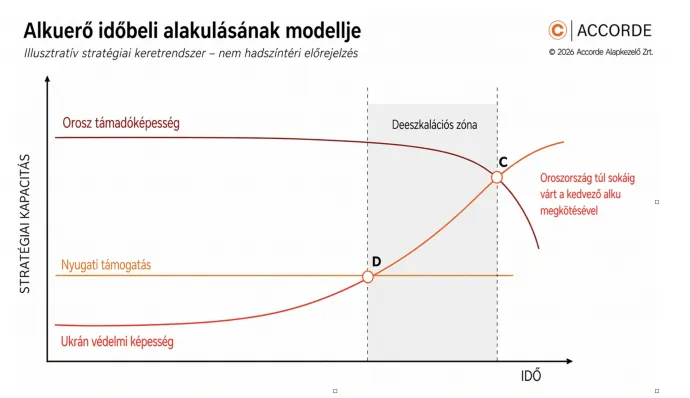
    The figure shows that Ukrainian defense capabilities start from a low level and dynamically strengthen over time. In the beginning, as a result of the United States and then the subsequent Western European support, the scissors gradually narrowed compared to the Russian offensive capabilities. In reality, Western subsidies are not as static as the figure suggests, as it is clear that both the technological and the financing background are permanently secured.

    Although both sides are at the forefront of drone technology innovation, overall, this still exponentially strengthens the Ukrainians’ defense and depth-of-field strike capabilities.

    The Russian offensive capability is still stable at the beginning of the figure, and then begins to decrease at point D (“drone strike”), partly because they are moving very slowly on the front line. The rate of decline accelerates after point C (“collapse”): this is the stage when Ukrainian drone attacks already cause lasting damage in the hinterland. As a result, the Russians increasingly focus on defense, which leads to a further, significant decrease in offensive capability.

    It is important to note that, as the examples in the Middle East show, it is almost impossible to permanently protect the oil industry infrastructure if it is hit by hundreds of drone attacks per day. This is especially true in the European areas of Russia, where these facilities are densely located close to each other.

    In my opinion, it is in Moscow’s interest to conclude a ceasefire that is as favorable to it as possible for years in the de-escalation zone between points D and C, before it completely loses narrative control. We are already in this zone now.

    One of the key elements of Donald Trump’s campaign was ending the war. Approaching the midterm elections, especially after a potential Middle East ceasefire, this could become a priority again. Moscow must take advantage of this window of time, after the elections the American political focus can easily shift. We cannot know how the unpredictable president decides, but neither do they in Moscow.

    We may be wrong and the conflict will drag on. In any case, the market currently does not put a price on peace: just look at the price of long-term, dollar-denominated Ukrainian bonds. From an investment point of view, the situation is asymmetric and is shifting more and more in this direction over time.


    Source link

    Related Posts

    Péter Magyar Appoints Brother-in-Law as Justice Minister despite Pledging to Fight Nepotism
    Hungary

    Péter Magyar Appoints Brother-in-Law as Justice Minister despite Pledging to Fight Nepotism

    May 7, 2026
    Telex: The Fidesz EP faction initiates the termination of the proceedings against Hungary for violating the EU’s core values
    Hungary

    Telex: The Fidesz EP faction initiates the termination of the proceedings against Hungary for violating the EU’s core values

    May 7, 2026
    Budapest and Lake Balaton Shine in Polish Travel Magazine Feature
    Hungary

    Budapest and Lake Balaton Shine in Polish Travel Magazine Feature

    May 7, 2026
    Telex: The secret life of the botanical garden
    Hungary

    Telex: The secret life of the botanical garden

    May 7, 2026
    Tableau Exhibition Marks the 130th Anniversary of the Opening of Hall of Art
    Hungary

    Tableau Exhibition Marks the 130th Anniversary of the Opening of Hall of Art

    May 7, 2026
    Clearest Indication Yet that Magyar Could Open Hungary’s Borders to Migrants
    Hungary

    Clearest Indication Yet that Magyar Could Open Hungary’s Borders to Migrants

    May 7, 2026
    Next Post

    Mistakes at the Met Gala It has nothing to do with fashion An analysis by Annina Metz

    POPULAR NEWS

    Justin Bieber fans flood Coachella festival for headlining show – Entertainment

    Justin Bieber fans flood Coachella festival for headlining show – Entertainment

    April 20, 2026

    Over 600 flee homes as Army, NPA clash in Negros Occidental

    April 21, 2026

    Ex-DPWH exec recalls P800-M ‘delivery’ to Zaldy Co 

    April 20, 2026

    Former PM Paluckas suspends party membership, to waive immunity over criminal probe

    April 24, 2026
    Pres. Ali challenges CARICOM to transform into health research powerhouse

    Pres. Ali challenges CARICOM to transform into health research powerhouse

    April 23, 2026

    EDITOR'S PICK

    REPORT: Wolves approaching humans in Jutland may have been ‘actively fed’

    REPORT: Wolves approaching humans in Jutland may have been ‘actively fed’

    May 5, 2026
    D. Nausėdienė spoke vaguely again: abroad she talked about soft power networking

    D. Nausėdienė spoke vaguely again: abroad she talked about soft power networking

    May 2, 2026
    Hewanorra International Airport control tower more than halfway complete

    Hewanorra International Airport control tower more than halfway complete

    April 23, 2026
    ADPD proposes higher minimum wage, rent control for those on low income

    ADPD proposes higher minimum wage, rent control for those on low income

    May 4, 2026

    Recent Posts

    • Infantino defends the prices of tickets for the 2026 World Cup – Al-Shorouk Online
    • Ségolène Royal visits journalist Christophe Gleize
    • When is marriage preferable to performing the Hajj obligation for young men? .. “The Fatwa” clarifies
    • Higher Education: Taking legal measures after a driver committed an indecent act in front of a girls’ college

      © 2026 Agentially - Navigating shifting sovereignties and global risk .

      Welcome Back!

      Login to your account below

      Forgotten Password?

      Retrieve your password

      Please enter your username or email address to reset your password.

      Log In
      No Result
      View All Result

        © 2026 Agentially - Navigating shifting sovereignties and global risk .

        This website uses cookies. By continuing to use this website you are giving consent to cookies being used. Visit our Privacy and Cookie Policy.