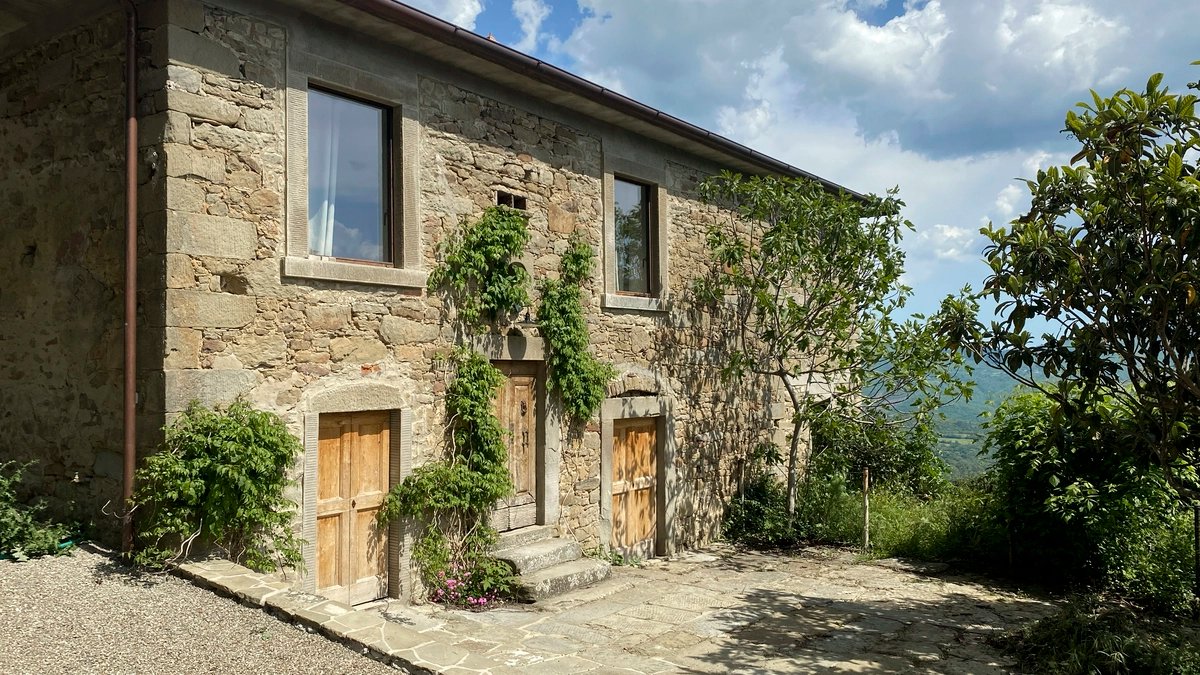
Senza Fine, the property of Thierry Grundman and Anne-Emmanuelle Thion, is located in the heart of a valley in Tuscany that has long been a nature reserve. “Nothing has been built here since the 19th century. The houses in this region were designed so that people could live self-sufficiently in the winter months when the valley was covered in snow,” says Grundman.
“There is a bread oven and the animals were housed in the rooms on the ground floor, called ‘cantina’.” They helped warm the living area, and supplies of wood and locally produced supplies – jars of pickled fruits and vegetables, olive oil and wine – were also stored here.
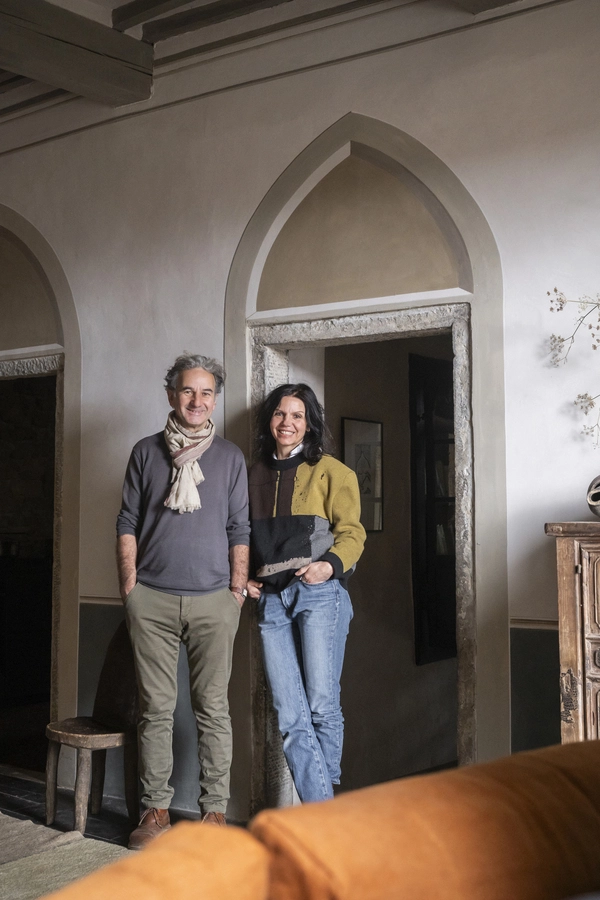
Enthusiastic owners: Thierry Grundman and Anne Emmanuelle Thion.
Anne Emmanuelle Thon
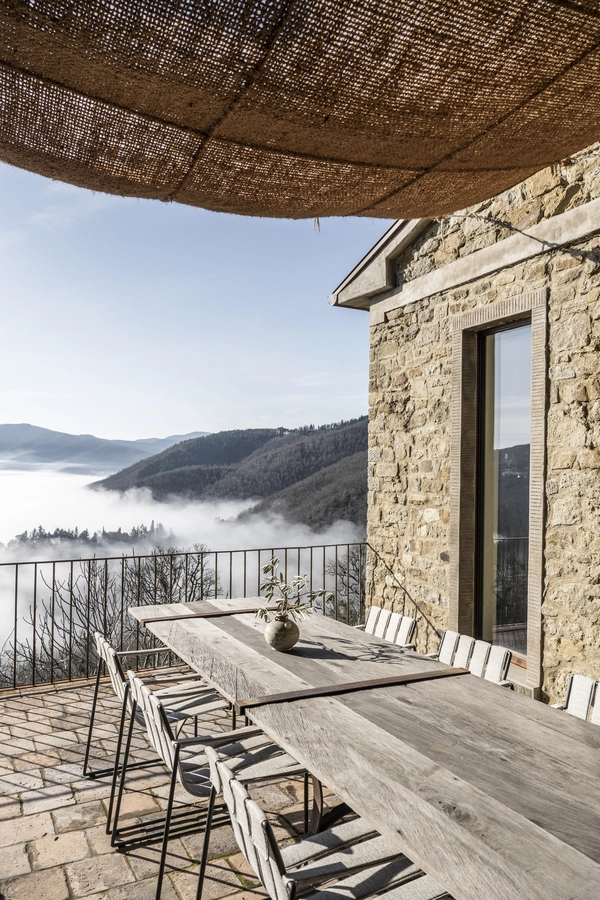
Covered in fog: a view of Tuscany. The valley has long been protected.
Anne Emmanuelle Thon
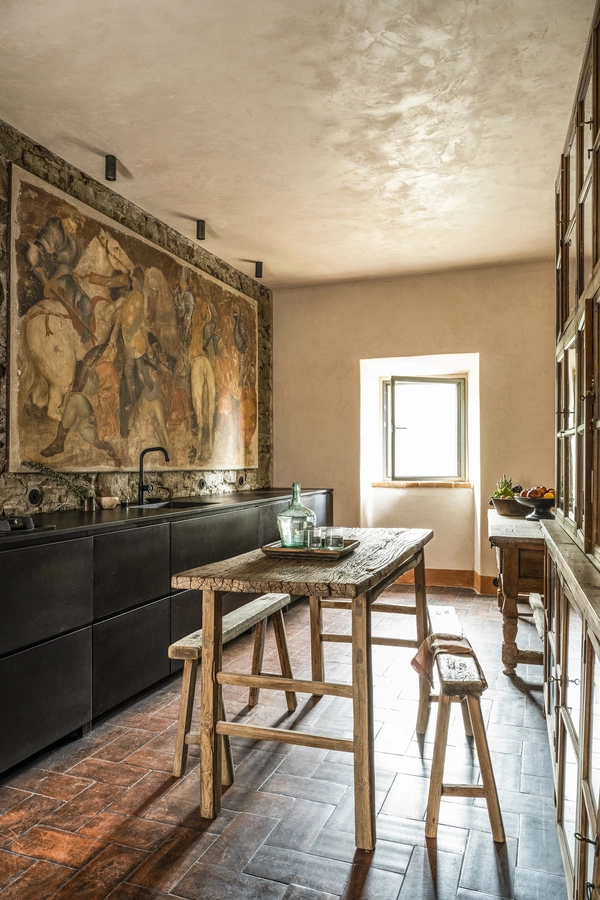
Rich in contrast: The kitchen is brand new and made of patinated steel.
Anne Emmanuelle Thon
The 300 square meter stone house of the antique lover, whose passion for travel brought him to this desolate part of Tuscany, dates back to the 18th century and is divided into three levels. There is the ground floor, which now houses, among other things, a billiards room, a music room, an office and a cellar.
Above this is the living area with kitchen, dining room, living room, terrace, master bedroom and three small bedrooms, each with its own bathroom. And the couple accommodates their guests on the upper floor with three bedrooms and a bathroom.
The complex renovation took a few months and only natural materials were used: local or reused wood, old terracotta tiles, stones, lime, wood wool for insulation, linen for bed linen and curtains. “I came up with everything myself and then called in an architect for the building permit, which was over 100 pages long,” says Grundman.

Entertaining: There is now enough space on the ground floor for billiards and music. Anne Emmanuelle Thon
The partially collapsed attic was restored, three bedrooms and a bathroom were installed, and an extension on the terrace was removed to restore the original floor plan. “We added a staircase in the dining room and removed a partition wall for the 350-square-foot master bedroom.” All aluminum window frames were replaced with narrow Corten steel window frames. The installation of a pellet central heating system made sense because the heating material is produced in the valley itself.

Harmonious: Modern staircase (and lamp) between old stone walls. Anne Emmanuelle Thon
The modern kitchen made of patinated steel creates an interesting contrast to the old stone walls. Here, too, the art lies in the details: “All the walls were whitewashed, a decor made of pigmented lime was created in the living room, the terracotta tiles were given a dark patina and the existing doors were replaced with oak doors,” says Grundman. In addition, the plaster on the stone walls was removed, and where floors needed to be replaced, old terracotta tiles and stone slabs were used.
»We automatically slow down here.«
Thierry Grundman
The roof also had to be completely renovated, “but no additions were made because we wanted to retain the original layout of the house.” In general, sustainable development was the focus. “The antique furniture and objects are all unique,” says Grundman, “they harmonize surprisingly perfectly with the Italian lights from the 1960s and 70s.”
Senza Fine is not only a home, shelter and refuge for its residents, but also a source of inspiration. The architecture that is open to the landscape, the dialogue between inside and outside and the Tuscan light promote a contemplative mindset.
And the surroundings, the mountains, the forest and the rhythm of the seasons dictate a different relationship to time: “Here we automatically slow down to observe and listen.” The house becomes a studio and observation station: “It encourages experimentation, looking for the essentials and making connections,” enthuses Grundman.

Generous: Senza Fine has an impressive 300 square meters of living space. Anne Emmanuelle Thon
The “traveling antique dealer,” as Grundman likes to describe himself, particularly loves the terrace: “The view from here is simply breathtaking.” And: You can still be a little self-sufficient today. Oil is produced in the olive grove, and porcini mushrooms and truffles grow in the forest.

Hand-picked: The antique furniture in the house is all unique. Anne Emmanuelle Thon
“Unfortunately, we still don’t have a vegetable garden. We’re just not there often or long enough to take care of it.” For both of them, living and working in Senza Fine means being inspired by the surroundings at every turn. Everything leads back to the essence, to nature, its sounds. “And it is in this inhabited silence that the most striking ideas often arise.”