The eastern entrance to Bratislava is probably the most inclining point of the D1 highway, which literally runs across Slovakia – it connects the east of the country with the west. However, the route through Trnava, Trenčín, Žilina and Prešov to the east of it is a test of patience for tens of thousands of drivers. Commuters from Senec and Trnava struggle daily on it near the capital. During the morning and afternoon rush hours, traffic jams for several kilometers are created.
“The original D1 solution in the section near Bratislava was no longer suitable in terms of capacity or technology for a long time. The highway was designed for significantly lower traffic intensities than what it actually serves today. At the same time, there were collisions between transit traffic and local connections – especially in the section between Zlatý Pieské and Triblavina. This caused frequent traffic jams and increased the risk of accidents,” explained Michal Feik, a transport expert.
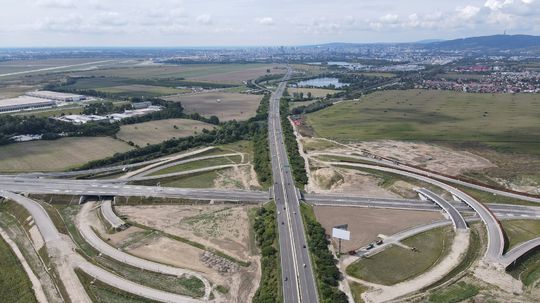
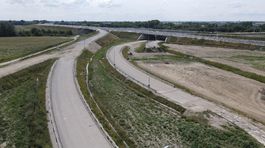
For this reason, the decision was made to dig up the section and expand it in its final form to eight lanes – four in the direction of Bratislava and another four from Senec and beyond. Officially, it is an extension from Bratislava to Triblavina before Pezinok, which also includes the connection of the D4 highway in the direction of Jarovce.
The work started in full in 2021. The goal was and still is to separate local traffic from transit and reduce queues. However, the project is in full operation, which significantly prolongs its implementation, and drivers have been feeling the restrictions for several years.
The project was originally expected to be completed faster, but in reality it was delayed mainly by the complex transshipment of networks and infrastructure, the coordination of a large number of bridges and branches of the D1×D4 intersection, but also temporary diversions of traffic, as well as the division into stages. To this, public procurements and ongoing modifications of the project were also added.
“Of course, the individual phases of the project did not go without restrictions, even though the entire organization of the construction was governed by the rule of minimal interference with live traffic. However, we thank motorists for their patience. Although the mechanisms have not left the construction yet, the impact of the construction on the traffic itself will be lower,” said the general director of the National Highway Company (NDS) Filip Macháček.
Although it was only a section of less than four kilometers in both directions, the work affected traffic up to Bratislava’s Prístavný most, where queues are common. Due to the fact that the construction is ongoing and will continue to be full of traffic, the overcrowded route has shown its limits to the drivers even more.
“The project is not yet completely finished, the completion of the four connecting branches between the D1 and D4 highways is still missing. The overall effect of this construction will be visible only after they are fully operational. However, the fact is that the first positive changes can already be seen, especially in the form of smoother passage and fewer critical situations. I personally very much welcome the ban on the transit of cargo truck traffic through the Port Bridge, which represents more than 2,000 trucks a day.” Feik recalled.
However, the stretch on D1, which was reconstructed to the greatest extent, has been open in both directions since the end of April this year. “Motorists are already driving on the reconstructed and expanded D1 also in the direction out of the capital, guided along the original body of the highway. The highway exit from Bratislava is thus fundamentally simpler, clearer, safer and more comfortable,” stated the NDS media communication.
They built a new highway
At first glance, it appears that this was only a minor modification, but a part of the highway, which is part of a much larger network, has been replaced. “Construction progress allowed us to open the original D1 stretch in the direction of Trnava even in the pre-holiday period. Although we say that it is a reconstructed D1, in reality the original highway was basically demolished and built anew,” said Minister of Transport Jozef Ráž (nom. Smer).
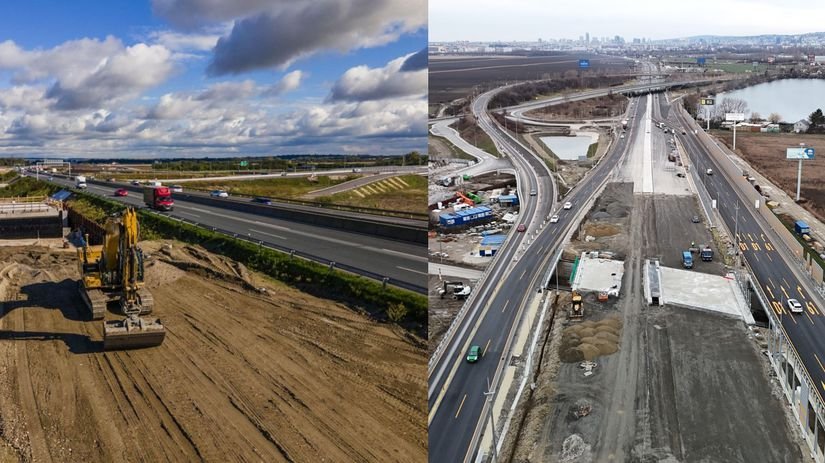
The process took place in such a way that not only the original asphalt was dismantled, but also new bridges were built. Since the highwaymen were not only reconstructing, but also widening the road with collectors in full operation, the work was all the more demanding. The goal was to expand the capacity of the highway, which could not handle the rush from satellite towns and villages, and at the same time to make the route clearer with additional, marshalling lanes.
The mentioned collectors were added along the main road, and their contribution is noticeable. They collect cars that are going to connect to the highway, or on the contrary, disconnect from it – by being separated for a long enough time, the main line is not blocked. Thus, drivers do not enter the fast lane directly on the highway, but first pass through the collector branches. The route has its own lane parallel to the highway.
This also increases safety, because they no longer have to zigzag and brake to fit in. Local traffic to and from work or school no longer blocks vehicles traveling along D1, leaving more capacity for transit.
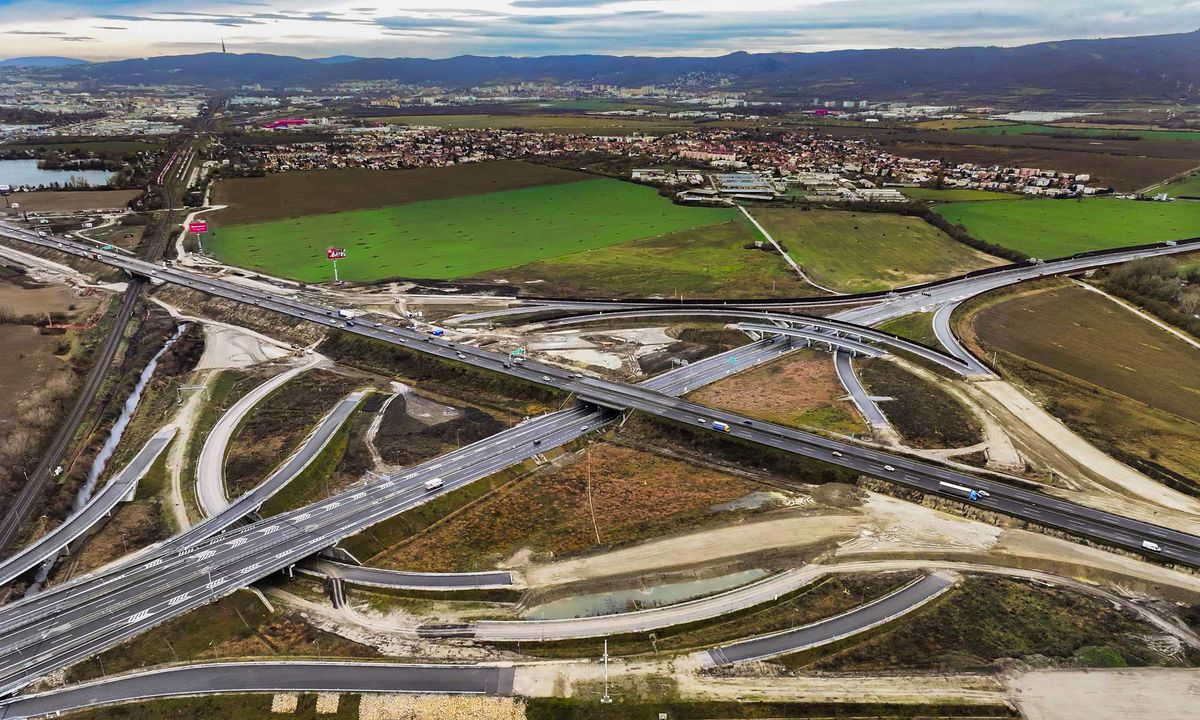 Photo: Michal Feik
D1xD4 construction view – March 2024. D1xD4 construction view – March 2024.
In addition, the works also included the reconstruction of intersections (especially near Vajnor and Zlaté Pišky), but the reconstruction of the bridge was also necessary – over the railway near Vajnor Lake. Added to this was the construction of a completely new intersection, the connection with D4. It belongs to one of the most complex constructions in the country in terms of its scope, as thanks to it traffic from the two highways D1 and D4 does not intertwine on one level. That would cause traffic jams and accidents.
Since several branches are gradually added to it, it can be branched off and directly connected to D4. Transit will thus be redirected outside the capital, as part of the traffic will no longer go through its “inside”. The pressure on exits within the city will also be reduced, so the traffic will calm down.
Although the D1 near Bratislava is open, the mentioned intersection D1×D4 is still being completed in stages – it needs a total of 18 bridges. Therefore, the full effect will only be felt after the completion of the entire project. The nearest Rača – Trnava branch is scheduled to open this month, which will improve the exit from Bratislava to the east and ease the traffic on the section near Zlaté Pieske and Vajnory.
At the same time, the D1×D4 junction near the north of Ivanka pri Dunaji is still being completed, where only half – four of the eight branches – are still working. At the end of April, the department of transport opened the exit from Senecká cesta, after the highwaymen finished the work on the bridge over the train.
“Motorists will now be able to get to the D1 highway without restrictions from the I/61 road near Vajnorské lake in the direction of Trnava. At the same time, the branch from D1 to D4 in the direction of Jarovce is also open again. The latest one is driving in a different way than the drivers were used to. It is already connected to the D1 highway via a new collector,” explained Feik. By June, the other arms should also be launched gradually, so that it is possible to travel between D1 and D4 in all directions without detours and delays.
D4 is basically the Bratislava bypass, a route around the capital. Its benefit is mainly the relief of Bratislava from transit traffic, which today often passes through the city or internal highway circuits (especially D1 and city radials). In addition, it connects not only the D1 highway in the north and east, but also expressways in the west to Austria and Jarovce or Hungary.

Although both highways are important in their own right, their connection through an intersection is fundamental, together they form one functional system. The most important part of the project, the D1×D4 intersection, connects transit going through the whole of Slovakia outside of Bratislava by moving heavy traffic from internal routes to the bypass – diverting trucks from the city, which reduces traffic jams. But at the same time, it is not only about the fact that it forms a closed semicircle of the city, but it will also improve the connection of the country with Austria and Hungary.
“The gradual commissioning of the individual branches means that the traffic flows are not yet operating in an optimal mode. Some directions are still run provisionally, which reduces the overall benefit of the project. After the completion of the remaining branches, the connection of the eastern part of Bratislava and its surroundings to the D1 highway will be improved, as well as the transit will be diverted to the D4. It will especially help motorists from Rača, Svätý Jura, Pezinok, but also from the township of Vajnora, Hrvatske Groba, Ivanky pri Dunaj or Bernolákova,” concluded Feik.
Although the extension of D1 brings significant relief to drivers, it is not a definitive solution to traffic problems. Experience from abroad shows that higher road capacity often attracts more cars and congestion returns. The long-term solution is therefore rather in the development of trains, which are more capable and reliable – because they do not stand in columns. Parking lots and transfer terminals will also be key, without which the traffic load will not be permanently reduced.