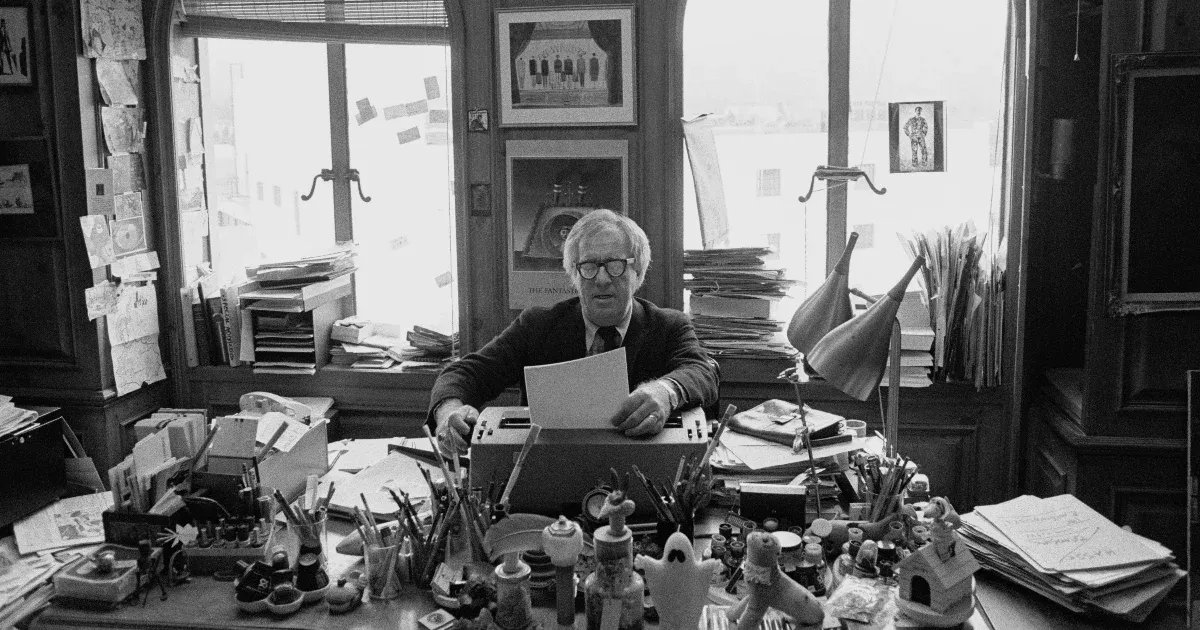
Bruce McAllister was passionate about the world of fiction and even tried to write short stories himself. When they came to the topic of literary symbols in an English class, the sixteen-year-old student from San Diego became frustrated with the teacher’s vague explanations. He thought that there must be clearer conclusions regarding the symbols placed in the works.
So the local library turned it over American literature of the 20th century volumes of his series, and then he sent a four-item questionnaire to 150 novelists of the time to titles hunted from newspapers and publishers. Weeks later, he would have been disappointed to learn that only about half of the respondents had returned their answers – except that among them were Jack Kerouac, Joseph Heller, Ray Bradbury, Isaac Asimov, John Updike, Norman Mailer and Iris Murdoch. This is how one of the most exciting writers’ surveys in the history of literature was born in 1963 from the small sample research of an American high school student: the Symbolism Research.
First question
With the first question, McAllister got straight to the point: “Do you deliberately and consciously use symbolism in your writing? If so, please tell me in what way you do this. Or do you feel that you use symbolism in your writing subconsciously?”
While Jack Kerouac settled the question with a resounding “No”, Isaac Asimov answered in more detail: “Consciously? Heavens, no way! Subconsciously? How could it be avoided?” Joseph Heller, on the other hand, wrote that he deliberately relies on symbolism, but not to the extent that many people think, and it is inevitable that things often take on additional meaning beyond the intended meaning. Ray Bradbury wrote that he never consciously uses these tools. “Consciousness defeats creative activity. It is better to let the subconscious do the work for us and get out of its way. The best symbolism is always unexpected and natural.” And John Updike declared that he had no method, because there is no method in fiction, and then poked a little at the letter writer: “You don’t seem to understand.”
Second question
The second question concerned hermeneutics: “Do readers infer symbols in your writing that aren’t intended? If so, what do you think of these types of inferences? (Funny? Annoying? etc.)”
“Both, depending on how busy I am,” Kerouac once again succinctly replied, while Joseph Heller says this often happens. “In many cases I have learned something about my own book because readers have seen many things in the book that I did not realize was there.”
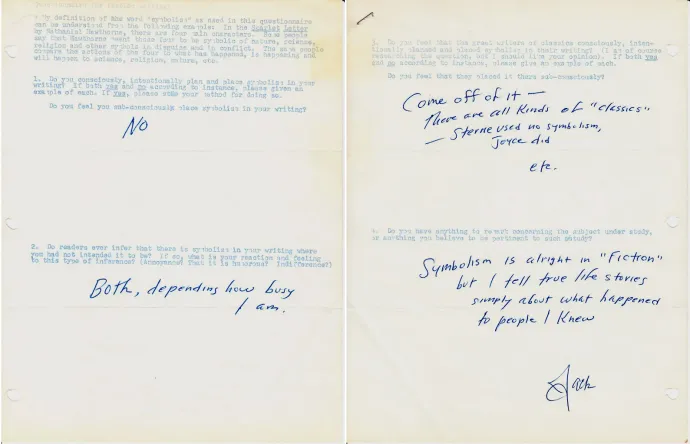
Letter from Jack Kerouac – Photo: Source: The Paris Review
Third question
In the third question, Bruce McAllister examined the working methods of the great predecessors: “Do you feel that the authors of the great classics consciously and deliberately placed symbols in their writings? Or did they use them subconsciously?”
Here, Ray Bradbury gave the answer backhand, writing, “You have to research this question for yourself.” John Updike believed that some used more symbols (Joyce, Dante), others less (Homer), but according to him “it is impossible to conceive of any significant narrative work without some symbolic dimension”. And the author of Catch 22, Joseph Heller, wrote: “I think the more sophisticated the writer, the less frequent the use of symbols, and the greater the effort to achieve the effects of symbolism in subtler ways.”
Fourth question
The young researcher intended the last item to be a kind of Other comments column. “Do you have anything else to note about the topic under investigation or anything that you think is important to write for the study?”
Kerouac took this issue most seriously: “Symbolism has its place in fiction. But I’m talking about true stories, simply what happened to people I knew.” Iris Murdoch wrote, “There is much more symbolism in ordinary life than some critics realize.” Fahrenheit 451 creator Ray Bradbury gave the teenager some fatherly advice. “If you want to be a fiction writer in the future, I don’t have much to say except to warn you not to take this all too seriously. If you want to be a critic, that’s a different story,” he wrote, adding that good symbols should be as natural and discreet as breathing.
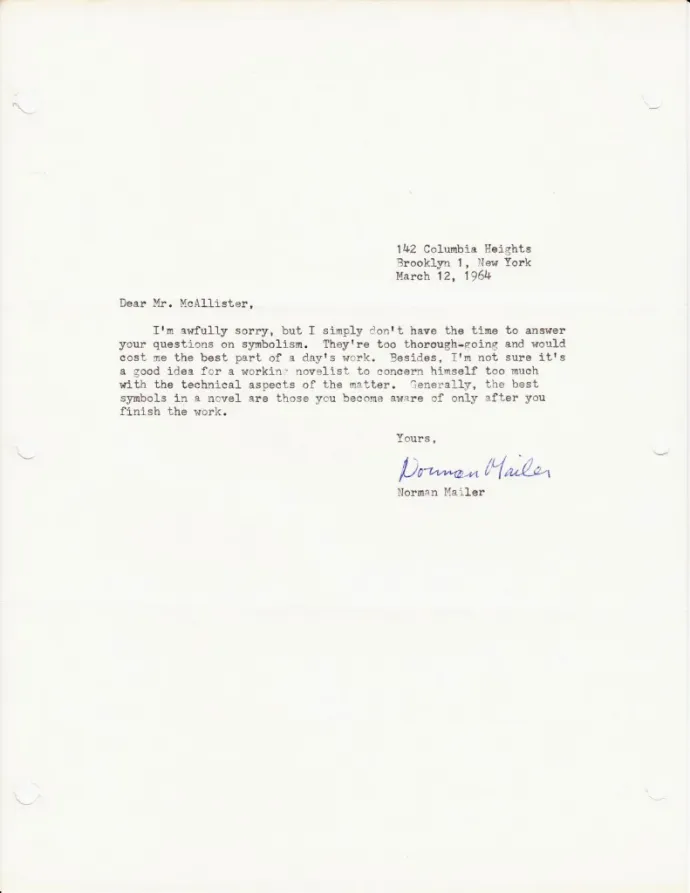
Letter from Norman Mailer – Source: The Paris Review
They were delighted
Even the star author of The Naked and the Dead, Norman Mailer, sent the boy a polite reply that a thorough answer would take time away from his valuable work time, but he still added that it might not be the best idea for an author to morph into the technical details of writing.
Some, on the other hand, invested quite a lot of energy in the education of the young colleague and provided him with a list of additional useful studies. But there were also several people who trained him. Pulitzer Prize winner MacKinlay Kantor, for example, called the boy’s method senseless and suggested that he should write research on the subject himself, rather than waiting for others to do the work for him.
Bruce McAllister is now almost eighty years old, and throughout his life several works of fantasy and science fiction have been published in various magazines and anthologies. He claims he never thought the writers would respond to him, so he and his English teacher were “thrilled”. To this day, he has not been able to decipher why such famous writers paid attention to a student who even used the word “precocious” incorrectly in his letter of introduction. Finally, he realized that the current of New Criticism was so focused on scholars and texts that they forgot to ask the writers about anything.
Of the seventy-five returned letters, sixty-five survived because McAllister lost ten during his high school years.
(Sources: Paris Review, Mental Floss, Wikipedia)