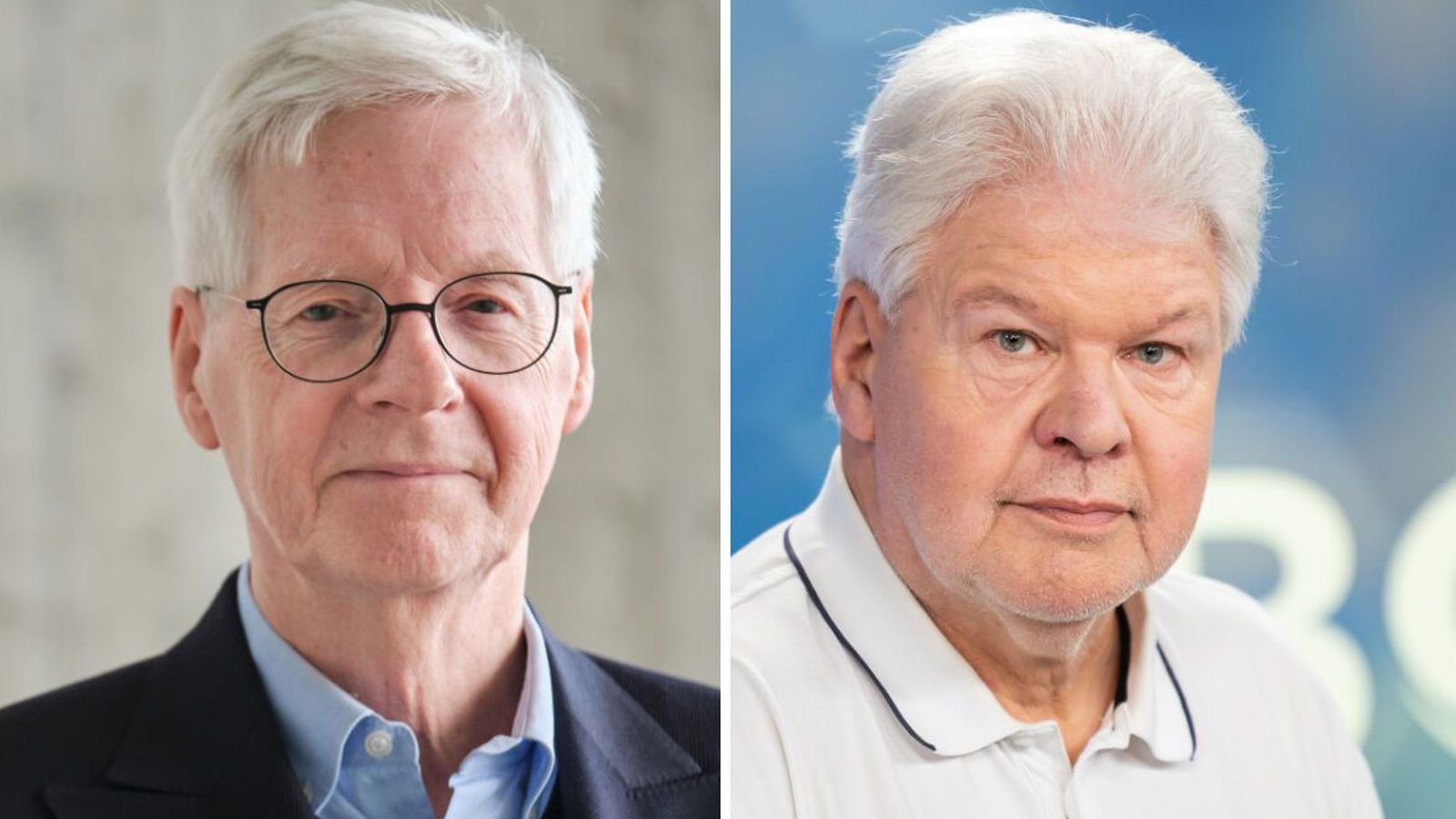
This is one of the things that appears in the podcast Korter i völlings hosted by Magnús Sigurbjörnsson and Péturs Ólafsson. There is probably nothing as big a fixture every single election night as Ólaf and Boga’s presence on the RÚV election TV screen, from where since 1978 they have brought the latest figures to the people until nightfall when they arrive.
Magnús and Pétur, Korter’s election managers, were interviewed on Sýnar’s evening news last night about the situation in Kópavogur before the local elections.
We are counting for a long time
In the episode, it is argued about the counting on election day and why there are no exit polls in Iceland like in the neighboring countries. Bogi and Ólafur say they think it is too expensive. Also, the tradition in Iceland is that numbers arrive in bits and pieces and not that they are counted in the constituency and numbers come in directly like in most of the neighboring countries.
“This delay here is for various reasons and it is the members of parliament who are fully responsible for it. First of all, the elections end at ten o’clock. When the electoral law was changed in 2021, the expert committee that had prepared the law proposed that the elections end at nine o’clock. The parliamentarians were not allowed to hear that mentioned and they changed it,” says Ólafur.
“She also suggested that it is permissible to count and start counting on election day, but now only the so-called sorting of votes is allowed on election day. There is no rational reason for that. So it should be possible to have counted the majority of the votes much, much earlier.”
Not counted in some places even though it is possible
The committee has also proposed changes to absentee voting and that it end a day earlier than the same day as the election, so that the counting of absentee votes could start earlier.
“The last point is that the experts also suggested in ’21 that it be counted in parliamentary elections in individual municipalities. But it was also not allowed to do that and in parliamentary elections, although it is allowed to have more than one counting place in each constituency, it has not been done. For example, in the North West, all the votes were counted in Borgarnes, naturally great experience with that, but it is naturally obvious that it is much more suitable to count at Borgarnes but also on Ísafjörður and also on Sauðárkrók and I just don’t understand why people just don’t do it.”
Why this conservatism towards change?
“Professor Ólafur has blamed the members of parliament for this and I think it is absolutely right. This is actually completely incomprehensible. For me, it would be enough to vote until eight o’clock. Of course, it should be allowed to start counting votes before the polling stations are closed,” says Bogi.
There’s no point in being up there in the studio until four in the morning?
“We have been up in the studio until nine o’clock the next morning. This is completely out of order and only in the last election when it is revealed in a discussion program at noon the day after that the chairman of the Progressive Party is in the parliament. There is naturally no trick to it being counted this way. This is just conservatism in the members of parliament and a way of crossing the fence,” says Bogi.
“I once heard that some of them did not understand what was proposed in the last changes and then they ran into it: No, we are not making any changes, just afraid of changes.”
The unequal weighting of votes stung
In the episode, Bogi also points out the unequal weight of votes between constituencies in the parliamentary elections. It has been a long time.
“I simply did not accept not having the same right to vote as people we see up here on Skaga across the bay. I lived in Seltjarnarnes for a long time and was there in Suðvesturkjördem, Reykjaneskjördem before that and Suðvesturkjördem and there the difference was that my friend Gísli Einarsson, Gísli skesse he had two votes for every one I had. Just imagine if the same applied in a presidential election. Would people accept that? Or a referendum?”
Bogi says he has never accepted this.
“If I was rich, I would have gone to court with the state a long time ago and lost it in the district, lost it in the National Court and lost it in the Supreme Court but won it in Strasbourg. That’s the point, because this is just a violation of human rights.”
Just need a simple majority for change
Bogi says he hopes it won’t be necessary, as his friend Ólafur sat on the committee for the revision of the electoral law. Ólafur is not correct in saying that 2/3 of the members of parliament are needed to approve such changes.
“This is because some provisions in the electoral system are bound by the constitution. For example, the number of members of parliament must be 63, the term of office must be four years, and that there are balancing seats that should ensure that the total number of parliamentary seats for parties is in accordance with their national affiliation.”
Bogi says that Ólaf has pointed out for many years that this has not been the case for many years. Ólafur says that it was not achieved until 1987, when changes were made that ensured that the parties got the right number of parliamentary seats. It was successful in all elections until 1999 when a new system was introduced, with six constituencies and nine balancing seats. In the elections since then, it has been possible to draw a balance between parties four times, but four times one party has won one member of parliament and a lot. In 2016, the Independence Party got one too many MPs and as a result was able to form a government with Bjartri fúmdaði and Viðreisn.
“However, some provisions are in the constitution, others are in the election law, and some of those items require, in order to change them in the election law, 2/3 of the votes are needed. This applies, for example, to the fact that if people are going to move away from the D’Hondt rule, the arithmetic rule for how seats are calculated, then 2/3 is needed. However, the number of compensatory seats, which are currently nine, can be changed, the number of compensators can be increased up to 27 with a simple majority. It is also possible to change the number of MPs in each constituency and achieve almost full parity between the constituencies with a simple majority. So, in fact, it is possible to make very radical changes between the constituencies with a simple majority in the parliament. it is completely clear there.”