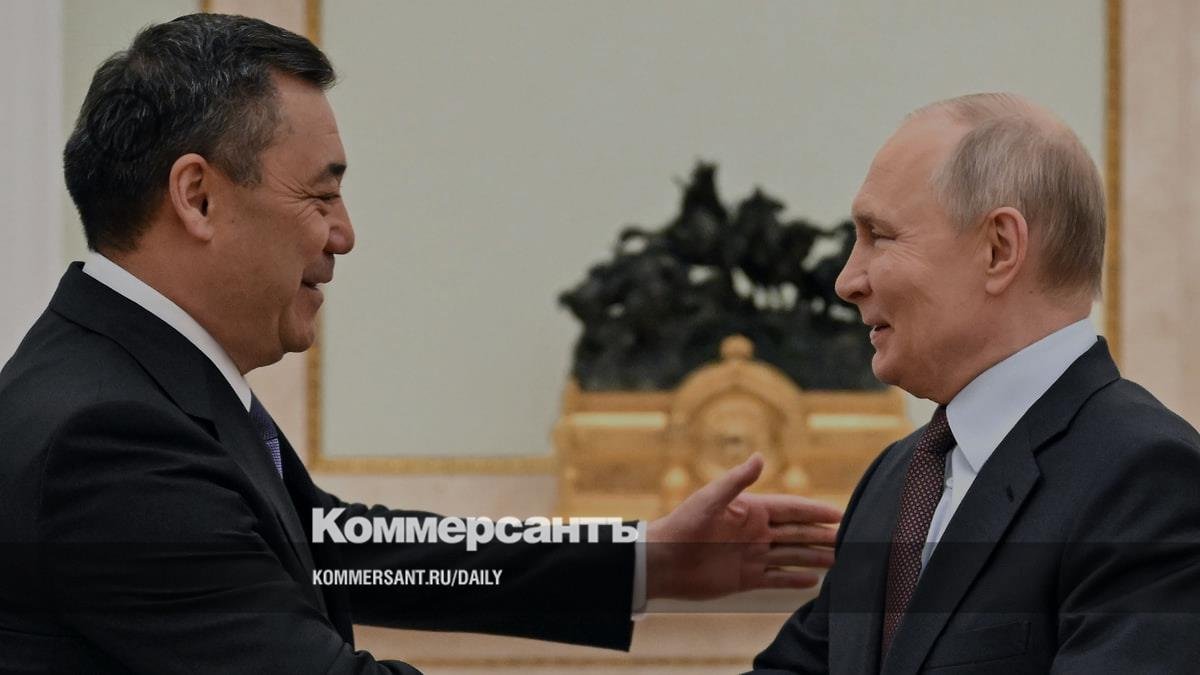
On April 23, Russian President Vladimir Putin held a meeting with members of the Russian government and received the President of Kyrgyzstan Sadyr Japarov on a working visit. Kommersant special correspondent Andrey Kolesnikov notes that closer interaction between law enforcement agencies and civilians is being prepared, but still, it seems, not in a tragic sense. Just like “accepted.”
On this day, the president’s schedule included two big events: a meeting with members of the government in video conferencing mode and negotiations with the President of Kyrgyzstan Sadyr Japarov. Moreover, it was assumed that negotiations would take place first, and then a meeting. Around three in the afternoon it turned out that government colleagues were first in line. Everything could have changed again, and more than once, but in the end it remained exactly that way.
First, Minister of Justice Konstantin Chuychenko shared with his colleagues free legal assistance, or more precisely, how it is organized. Members of the government listened with restrained interest, but in vain: who knows when and why exactly each of them might suddenly need it.
Then the head of the Ministry of Digital Development, Maksut Shadayev, spoke about the problem of public access to the Internet, primarily in small settlements.
However, the situation in them has been more or less stable for years, but what is really interesting now is access to the Internet in large and large settlements of our Motherland, such as the capital, because there is unnerving instability there.
“The availability of affordable high-speed Internet, of course, today is a basic need for our citizens, accessible both economically and financially, and in terms of simple and fast connection anywhere,” declared Maksut Shadayev, and I wanted to enthusiastically agree with him.
But there was no need to rush.
Maksut Shadayev told how, with the help of his department, the problem of “digital inequality” between the city and the countryside is being eliminated. There were a lot of numbers, but life dictated that recently equality was established by disconnecting large cities from the Internet.
“I can’t help but draw attention to what people encounter in large cities – it’s not often, but, unfortunately, this happens…” Vladimir Putin suddenly said. “I mean some problems and malfunctions in the Internet in large cities.”
Yes, he has never spoken out on this topic yet.
So it got interesting.
“Of course,” said the president, “if this is related to the operational work to prevent terrorist acts – and we know that, unfortunately, we sometimes miss such attacks – of course, the priority will always be to ensure the safety of people: our children, loved ones, each of the citizens of Russia… In this regard, I would just like to note that, of course, in this case it is necessary to ensure information, although I understand that when there is operational work to prevent criminal acts, to prevent terrorist attacks, in this case, widespread information to the public in advance can harm operational development, because criminals… after all, they also hear everything, see everything. And, of course, if some information reaches them, they will adjust their criminal behavior, adjust their criminal plans.
Apparently, it was recognized that the severity of the problem had reached such an intensity that it was decided to react publicly from the level of Vladimir Putin.
“At the same time,” he added, “firstly, at least based on the results of the work, people should be informed about what happened.” And second. Of course, it is necessary to ensure close coordination between law enforcement agencies and purely civilian government structures in order to find optimal solutions.
This was, in essence, an appeal to law enforcement agencies: they were asked to interact more closely with civilians and, roughly speaking, not to remain silent, not to keep everything to themselves.
Clearly, examples of the new approach should be demonstrated soon.
“And, of course,” continued Vladimir Putin, “we always count on the law enforcement agencies themselves to show the necessary ingenuity in their work, high professionalism and take into account the vital interests of the country’s citizens, for whom we all work!”
He made it clear to the authorities that they were capable of more.
— And what else needs to be done, what would you like to pay attention to? – said the president. – We need to work out a mechanism for the uninterrupted operation of vital services! Today, as we know, even in mobile phones, if there are no funds in the accounts, emergency calls are available to users. In the case of mobile Internet, you need to organize work in a similar way! That is, the operation of the government services portal, payment systems, and doctor appointment services must be ensured even during the period of general, basic restrictions! Moreover, such technological possibilities exist…
Much of what Vladimir Putin said just now was impromptu. This could be judged at least by the fact that he covered with a pen the entire text of his opening speech on the back, and this was a lot of sheets.
After this, everyone seemed to move on with some relief to the problems of the Arctic, each of which seemed like an eternal shining block.
Meanwhile, some changes for the better, it seems, were already taking place in the Kremlin Representative Office. The one who locked the door of the Representative Office behind him walked back and forth from end to end. After all, it was not without reason that he did this. Personally, I was counting on the imminent appearance of the Russian president at one of these doors.
In general, I was not mistaken. Or rather, I was wrong by only forty minutes.
“I remember with what hospitality you met us, our entire delegation, in your homeland,” said Vladimir Putin. “We worked very productively then.”
Yes, the Kyrgyz yurts on the tarmac along the red carpet stand with eyes filled with tears of gratitude. And there is no irony here.
It would be logical if, upon arrival at Vnukovo-2, Sadyr Zhaparov was greeted by Russian huts. But that didn’t happen (however, we can assume that they were on the way from the airport).
“I want to thank you, Vladimir Vladimirovich, for agreeing to this working meeting,” said the President of Kyrgyzstan.
That is, it was he who asked for a meeting, which, according to Kommersant’s information, was urgently organized.
20th package of EU anti-Russian sanctions required a longer organization. Moreover, it is Kyrgyzstan that is given a particularly honorable, even exclusive place in it (for example, the EU for the first time introduces a ban on the export of numerically controlled machine tools to Kyrgyzstan “due to the high risk of re-export to Russia”). This is approximately the same place that Kyrgyzstan occupies among other countries on the territory of the former USSR in terms of Russia’s interaction with the outside world.
Was it not these circumstances that caused the rapid visit of Sadyr Japarov to Moscow? Yes, even these ones.
“We are connected by historical ties of friendship,” Sadyr Japarov said to Vladimir Putin. “We have been and remain a strategic partner and main ally of the Russian Federation.”
That’s what he said directly.
And what – cards on the table.
There seems to be nothing to lose.