Text and image Edwien Bodjie
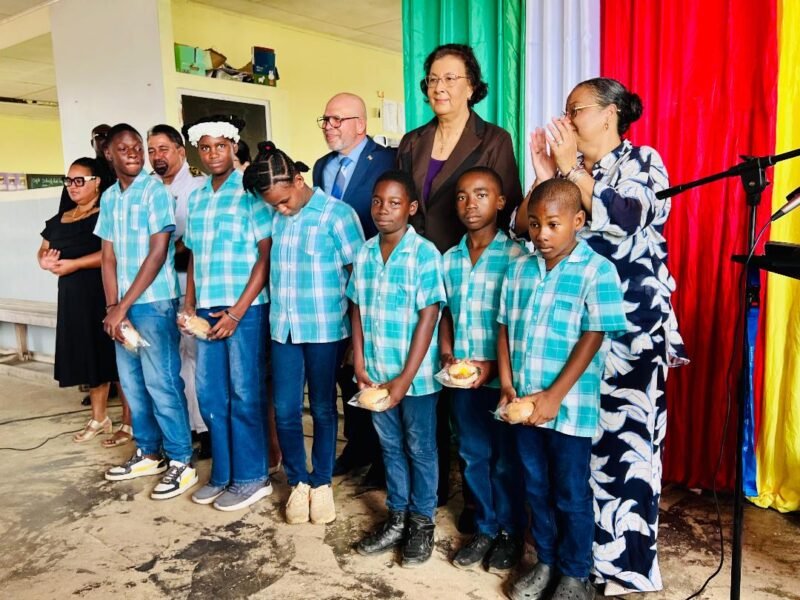
PARAMARIBO — “When we invest in food, we invest in education. And when we invest in local production, we invest in our economic growth.” This is how Mireille Cramer, chairman of the presidential ‘Working Group on School Nutrition’, spoke at the launch of the pre-pilot of the school nutrition project. That happened at the GV Callender school.
The initiative goes further than just providing meals. “It’s about our children, their health, their development, but also their future,” she said. At the same time, the program also affects broader sectors. “It is also about our farmers, about local production and strengthening our own economy.”
“The direction is that we build a system in which local production is central to the provision of our schools and neighborhoods”
MireilleCramer
The experiences from the pre-pilot should form the basis for a more extensive implementation in the next school year. The goal is for the program to grow into a national system that reaches all school-age children. The phased approach should prevent the program from getting stuck in the implementation.
Pilot providing direction
The launch marks the start of a broader development that links nutrition, education and local production. The vision behind this is clear: less dependence and more use of what can be produced locally.
“The direction is that we build a system in which local production is central to the provision of our schools and neighborhoods,” says Cramer. In the start-up phase, there was still talk of a school bread project, but that name was changed. “In areas like Sipaliwini we do not deliver breads, but hot meals such as rice, vegetables, fish and meat,” Cramer said.
The current pre-pilot should provide insight into what is practically feasible. Production capacity, food safety, logistics and acceptance by students are examined. The program is still under development. Evaluations with schools and suppliers should help to adjust the system on the way to expansion.
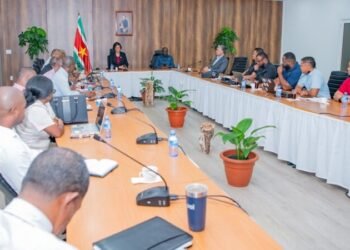
Several steps were taken during the setup, including tendering and selection of suppliers. Of the thirty interested companies, six were ultimately selected to take care of the delivery. Schools are divided into different areas, with each supplier responsible for its own lot. In addition, a working group has been set up with representatives from various ministries to monitor the implementation and quality of the project.
Cramer called for broad involvement. “This is the result of joint efforts, so let’s see this moment not just as a launch, but as the beginning of a movement in which we consciously choose for our children and their future.”
From production to plate
Project coordinator Tania Lieuw-A-Soe placed the initiative in a broader context of system change. According to her, a conscious decision was made to build on our own strength. “What is happening today is that a wish is becoming reality.” She pointed out the importance of the entire production chain: from farmers and processors to the people who prepare the meals every day. Within that chain, explicit attention is also paid to the role of women, who are involved in production and processing at various levels.
The government also placed the importance of the program in a broader context.
The Minister of Youth Development and Sports, Lalinie Gopal, calls good nutrition a basic condition for learning performance and development. Her colleague from Education, Science and Culture, Dirk Currie emphasized accessibility and shared responsibility. Education must be accessible to every child, but that requires preconditions, including nutrition and health. According to him, cooperation with the business community is indispensable.