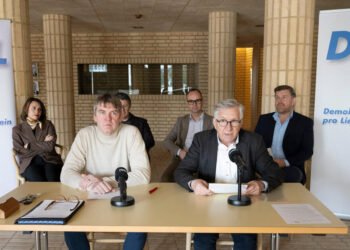
With a vote of 20 to 5, the state parliament decided to set up a parliamentary investigative commission (PUK) to build a new state hospital. The decision came after a debate lasting several hours, which initially focused primarily on procedural questions. FL MP Sandra Fausch was elected as chairwoman of the PUK.
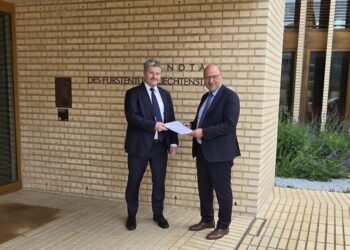
The two MPs from the Free List, Manuela Haldner-Schierscher and Sandra Fausch, submitted the application for the establishment of the PUK, as announced in the April state parliament. The government responded with a 19-page statement that was sent to MPs the next day.
In the debate, Haldner-Schierscher opened the FL’s statements and criticized the fact that there was less than a week to evaluate the statement. She referred to the 57-page GPK report from September 2022, which already documents the responsibilities of the government and the steering committee for the period 2019 to 2022. The government considers the application to be in its current form “Too broad in terms of time and subject matter” – an assessment that the FL clearly rejected.
Dispute over the procedure
The question of how a PUK should be used correctly took up a lot of space: in a single decision or in two stages – first the fundamental decision, then the task definition. State Parliament President Manfred Kaufmann was of the opinion that a distinction must be made between the minority right to set up an investigative commission and the specific design of the mandate.
Haldner-Schierscher and Thomas Rehak (DpL) fought against this vehemently. This was reminiscent of the reception template from Germany, according to which the appointment decision may not change the subject of the investigation specified in the application. A two-stage process would protect minority rights “castrate”says Rehak, because the coalition could rewrite the order according to their ideas at any time. Thomas Vogt (VU) and Daniel Seger (FBP) saw it differently: Since the application was only submitted by two instead of seven MPs, a majority is needed for the appointment anyway, which is why the order should also be supported by a majority.
Martin Seger (DpL) sharply criticized the tone of the government’s statement: “It once again gives the feeling as if the government sees itself in a superior role to the state parliament.” The government does not have the task of telling Parliament how it should design its control instruments. Christoph Wenaweser (VU) agreed with this criticism, but advocated a certain breadth of the mandate so that the PUK could work with an open mind.
Prime Minister Brigitte Haas made it clear that the government was not advocating against the PUK, but rather for its feasibility. The mandate must be clearly defined so that the Commission can achieve usable results in a targeted and efficient manner. Regarding the relationship between the government and the state parliament, she stated: “There is a coexistence relationship between the government and the state parliament. It is not a company with a board of directors and management.”
Dagmar Bühler-Nigsch (VU) spoke out against the timing of the PUK. The new government stopped the deadlocked process and commissioned an in-depth review. One should wait for these results before setting up a resource-intensive investigative commission.
The order
After a short break in the meeting, the Free List presented the revised order, which was sent to the MPs by email. The PUK therefore has the following tasks:
Firstly, it should examine the Inspira I project on the basis of the existing GPK report from September 2022 and the Inspira II project until an external report from February 2026 is available and present the key processes, decisions and developments. Secondly, it must clarify the relevant facts, basis for decision-making, responsibilities and responsibilities in connection with the planning, control, organization and implementation of the new building.
Thirdly, the PUK should in particular clarify whether the government, administration, state hospital bodies, steering committee and external consultants have informed the state parliament and the people in a factually correct, complete and truthful manner; on what basis key decisions were made; whether the existing control and supervisory mechanisms were sufficient and effective; and whether political, organizational, financial or personnel responsibilities arise from the facts identified.
The PUK should be provided with sufficient financial and human resources. After completing its work, it submits a publicly accessible report to the state parliament.
The appointment decision including the order was approved with 20 votes and 25 people present.
Composition of the PUK
Sandra Fausch (FL) was proposed and elected as chairwoman. Other members are the deputy FL MP Benjamin Risch, the VU MP Tanja Cissé, the FBP MP Lino Nägele and the deputy DpL MP Oliver Indra. The staffing was approved unanimously with 25 people present.