Loading Text-to-Speech…
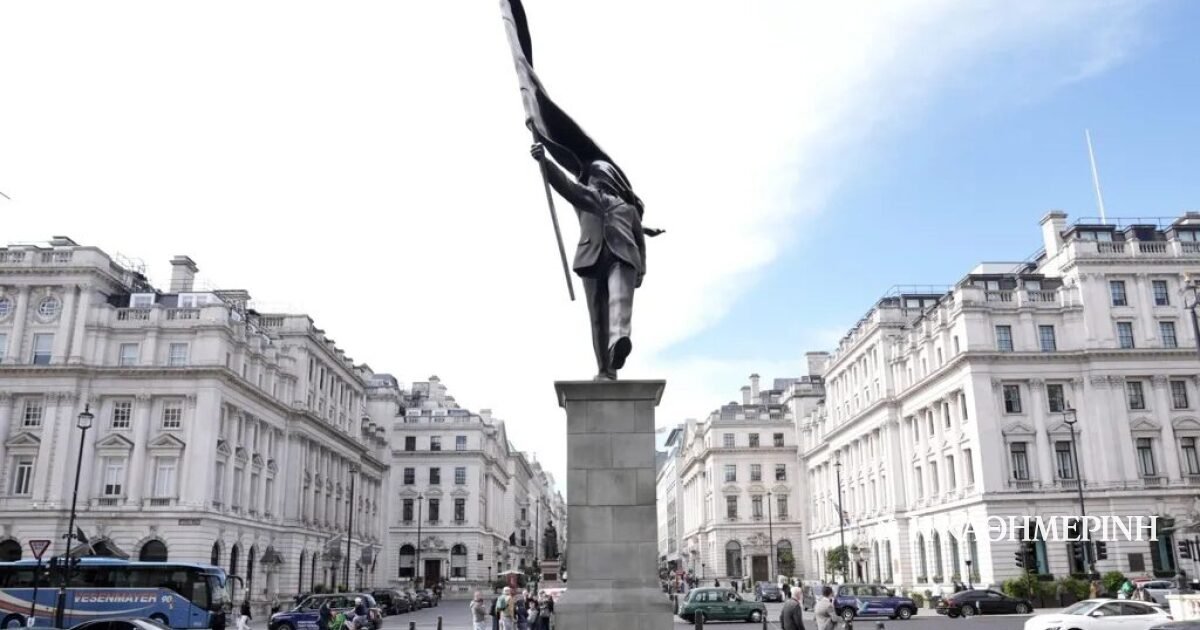
“I don’t like it,” says a passing Londoner, looking at his new statue Banksy at Waterloo Place at London. “I prefer this one,” he concludes, pointing to the Crimean War Guards statue a few meters away.
The sculpture that was “rejected” by the passerby is the newest work of the famous British street artist, which appeared literally overnight in the heart of London a few twenty-four hours ago and quickly attracted attention.
The work, which bears Banksy’s signature on its base, depicts a man dressed in a suit holding a large flag blowing in his face as he prepares to take a step into the void. Interpretations around the work began to be articulated, before the name of the sculpture itself gave the first directions for the artist’s message: “Blind Patriotism”, that is, “Blind patriotism.”
The statue also raised many questions about how such a massive monument was placed in a metropolis. Can it really happen without permission? How strategic was the spot? And at a time when the planet now knows Banksy’s name, what does such a move mean?
“They must be guys who put on a Metallica concert in 24 hours”

The man… blinded by his banner found his place in a very central part of the British capital. On the pedestrianized Waterloo Place, located next to St. James’s Park and just a few blocks from Trafalgar Square.
According to Banksy’s official representatives, the sculpture was placed there in the early hours of last Wednesday. The next day, the artist uploaded a related video on his social media – hence the passerby… – in which we see how a normal business was set up in the night for its installation, with the point isolated with cones, like any legal public intervention.

It was therefore logical for many to assume that now Banksy “joined hands” with the system, which has been blasting in recent decades, in order to have access to this part of the city for a massive construction like this. Mayor Sadiq Khan’s spokesperson statement to New York Times points in that direction: “His work always causes great interest and discussion, and the mayor hopes his latest work will be preserved for Londoners and visitors to enjoy.” However, according to reports that followed in the BBCWestminster City Council had not given any permission to the artist, nor had they been made aware of the venture, yet they welcome it.
The artist, who became known mainly for his graffiti works, also has previous experience with sculptures, since in 2004 he installed Rodin’s “The Thinker” inspired “The Drinker” on Shaftesbury Avenue, again in London. This time, however, we are talking about a large business that needs very careful organization in order to manage to go unnoticed by the authorities. “They must be guys who put on a Metallica concert in 24 hours,” comments the BBC’s James Peak.
Among national symbols

The spot was not only a challenge due to the displacement of the business in the heart of one of its largest cities Europebut also a completely strategic choice that reinforces the message that Banksy wants to convey. The work speaks of patriotism and decides to “squeeze” between monuments that deify the British national spirit.

“Blind patriotism” is surrounded by monuments such as the pillar of Frederick, Duke of York, and Edward VII on horseback, reminders of a glorious and powerful national past. Not by chance, in the video uploaded by Banksy, he chooses to highlight other national symbols, such as the British flag, the “beefeaters” guard, the characteristic black London taxis, but also the statue of Winston Churchill located in Parliament Square.
At the same time, the work comes just weeks after a much-discussed Reuters report revealed Banksy’s identity, ending years of speculation about the man behind the artist. We can only ask ourselves, then, what a work so bold in terms of its placement can mean in relation to this: Banksy has now “taken off his mask” and is operating more institutionally? Or the more people insist on defying their choice of public identity, the more “anarchistic” and “extreme” they operate?