
Ulaanbaatar,
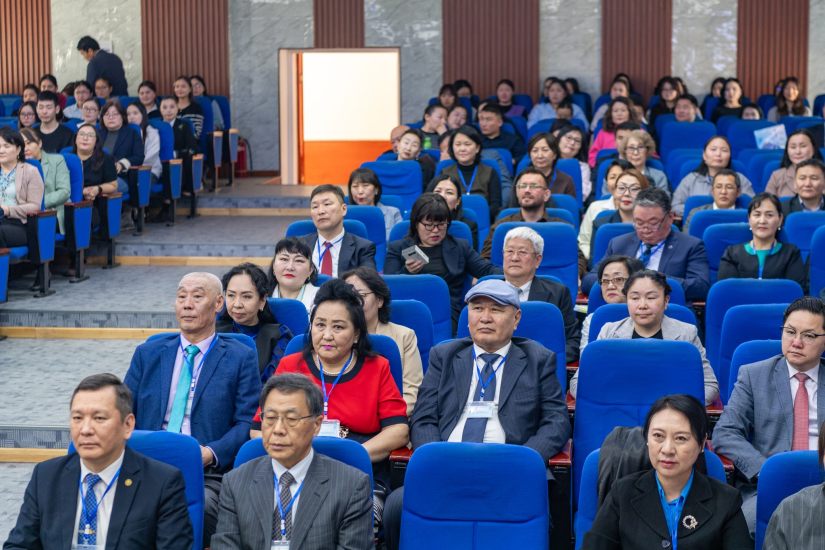
April 17, 2026 /MONTSAME/. The international academic conference “New Era
of Mongol Studies–VI” is taking place at the Mongolian National University of
Education (MNUE) on April 16-17, 2026.
The
conference has been held annually since 2004 under the title “International
Conference on Mongol Studies.” Since 2011, it has been renamed “New Era of
Mongol Studies” and organized biennially by the School of Social Sciences and
Humanities and the Institute of Mongol Studies at MNUE.
Organizers
highlighted that the conference serves as an important platform bringing
together international scholars. It provides a valuable opportunity for
Mongolia’s leading research institutions to present their work in Mongol
studies to the global academic community and share research outcomes.

State
Honored Teacher and Dr. Unurbayan Ts. noted in his presentation that Mongolians
have long been a nomadic people across the vast Eurasian region. As Mongols
made significant contributions not only to the region but also to world
history, the field of international Mongol Studies emerged. He emphasized that
Mongol studies as an academic field has roots in both Eastern and Western
sources, including ancient Chinese historical records and the accounts of
travelers such as Marco Polo. He added that Mongolia’s main centers for Mongol
studies are the Mongolian Academy of Sciences, the National University of
Mongolia, and MNUE, with MNUE prioritizing teaching and research in the field
since 1951.

Director
of the Institute of Mongol Studies at MNUE, Dr. Ganbold D, said Mongol studies
is a broad discipline encompassing language, culture, ethnology, history, oral
traditions, history of beliefs and religion, ancient texts, and traditional
script studies. Accordingly, we determine our research directions and guide our
activities based on the specialized expertise of our researchers. Since its
establishment, the Institute for Mongol Studies has aimed to intensify
research, improve its effectiveness, and implement specific work with quality
to achieve tangible results. Going forward, it is necessary to give greater
attention at the state policy level and to develop and implement a unified plan
in stages. This is because the main center of Mongol studies should be in
Mongolia.”

Dr.
Undrakhbulag of Inner Mongolia Normal University in China presented a study on
coverage of China in Mongolian media. Based on 2025 data, the research found
that while Mongolian media broadly follows global trends and widely covers
China through both traditional and digital platforms, content is largely
focused on official information such as bilateral cooperation and high-level
meetings. Coverage of everyday life is relatively limited. He suggested
increasing more diverse and in-depth content.
The
conference is expected to facilitate connections between young and senior
researchers and foster new collaborations.
A total of
153 scholars from seven countries are participating in person and online,
presenting more than 100 papers across six thematic sessions. Participants
include 14 Mongolian universities, 17 foreign universities, eight domestic
research institutes, and nine international research organizations.