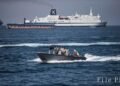
The Navy of Iran stated this Monday (4) that he prevented the entry of warships from United States node Strait of Hormuz by issuing a “swift and decisive warning”, according to state TV. US Central Command, which is blockading Iranian ports to pressure Tehran, said no Iranian vessels were hit.
The semi-official Iranian Fars agency reported that two missiles had hit an American warship near the port of Jask, at the southern entrance to the strait, where the Iranian Navy has a base, but the information was denied by Washington. A senior Iranian official told Reuters that Iran had fired a warning shot.
Central Command said on Monday that it had already escorted two US Navy destroyers, equipped with guided missiles, through the strait. “US forces are actively assisting efforts to restore the passage of commercial vessels. As a first step, two US-flagged merchant vessels have successfully crossed the Strait of Hormuz and are safely on their way,” the statement said.
In yet another dispute between versions, Tehran stated, after the announcement, that no merchant ships passed through the sea.
The United Arab Emirates accused Tehran of attacking with drones an oil tanker linked to ADNOC, the country’s oil company, which was trying to cross the strait. According to the government, the vessel was empty and no people were injured.
“The UAE emphasizes the need for Iran to halt these attacks, ensure its full commitment to the immediate cessation of all hostilities and the complete and unconditional reopening of the Strait of Hormuz,” the Foreign Ministry added.
The country also claimed to have intercepted three drones launched by Iran in an attack on Monday. A quarter fell into the sea, according to the government. An Iranian military officer, quoted by state television, stated that “Iran had no plans to attack the United Arab Emirates.”
European Commission President Ursula von der Leyen called the Iranian attacks “unacceptable” and said they were “a clear violation of sovereignty and international law.” She said the EU will work with its partners “on de-escalation and diplomatic resolution, to put an end to the Iranian regime’s brutal actions, both against its neighbors and its own people.”
Iran had warned Washington’s forces not to enter the sea lane after the president donald trump said on Sunday (3) that the US would guide the ships that are held in Hormuz out of the sea lane.
South Korea reported that a vessel flying the country’s flag was attacked in Hormuz, according to state news agency Yonhap. A spokesman for South Korean shipping company HMM told Reuters that a fire broke out in the engine room of one of its bulk carriers, adding that the cause was still under investigation. He said there were no reports of deaths or injuries.
Trump commented in a social media post that the South Korean ship was not part of the operation and that perhaps it should join US efforts to protect the movement of ships near Iran. The president estimated that American forces sank seven Iranian speedboats. The US military, however, confirmed the destruction of six small vessels.
An Iranian military officer, quoted by state television, later stated that “the US statement claiming to have sunk several Iranian warships is false.”
Trump gave few details of the plan, but said countries around the world have asked the United States for help. “For the sake of Iran, the Middle East and the United States, we have told these countries that we will guide their ships safely out of these waters,” Trump said on social media.
In an interview with Fox News, the American also stated that if Iran attacks US vessels that are guiding ships through the strait, it will be “wiped off the face of the Earth.”
US Central Command said it will support the rescue operation with 15,000 troops and more than 100 land- and sea-based aircraft, as well as warships and drones. In response, Iran instructed commercial ships and oil tankers to avoid any movement that was not coordinated with Iranian military forces.
“We have repeatedly said that the security of the Strait of Hormuz is in our hands and that the safe passage of vessels needs to be coordinated with the armed forces,” Ali Abdollahi, head of Iran’s joint military command, said in a statement.
“We warn that any foreign armed forces, especially the aggressive US Army, will be attacked if they attempt to approach and enter the Strait of Hormuz.”
Iran has blocked almost all shipping in and out of the Gulf since the start of the war, driving up oil prices. oil fire.
Iranian Foreign Minister Abbas Araghchi said the events in Hormuz showed that there is no military solution to the crisis. The chancellor stated that negotiations are progressing with Pakistan’s mediation and warned the US and the United Arab Emirates not to allow themselves to be drawn into a “jam caused by ill-intentioned people”.