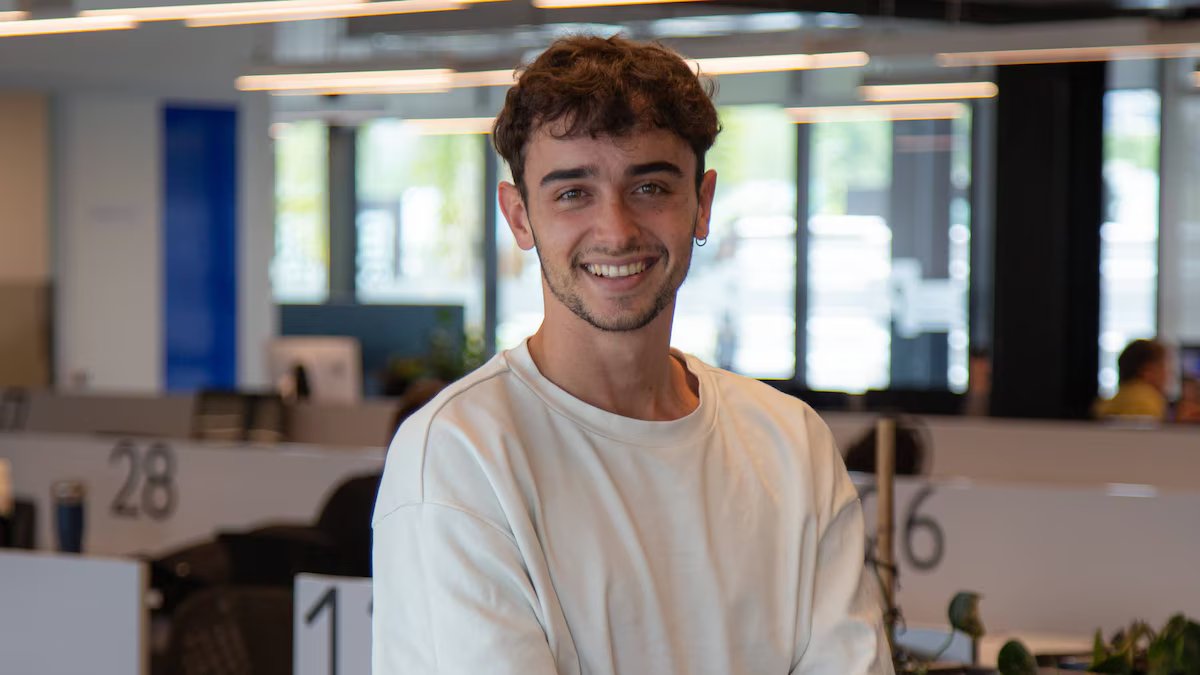
Isolated by the pandemic, Franco Rodríguez Viau looked with deep impotence as the fires in the mountains of Córdoba They devastated the ecosystem and the homes of their loved ones. In the classrooms of the technical school where he studied with his friends he decided transform that frustration into a solution which today is called “Satellites on Fire”, a startup climate-tech that has just raised US$2.7 million in international funds to expand an artificial intelligence system that prevents catastrophes detecting the fire 35 minutes faster than NASA itself.
At 16 years old, Rodríguez Viau, Today he is 22 years old and has become the cofounder and CEO of the startup, together with his colleagues from the ORT Technical School, Joaquín Chamo (Tech & Product) and Ulises López Pacholczak (Innovation), They did not think about investment rounds or international funds when they undertook the task of executing a school project on a tool to detect fires before it was too late. They were looking for a solution that could provide answers to families affected by the outbreaks in different areas and provinces with a high level of fire risk.
“It was a very strong feeling of helplessness. We couldn’t do anything from our homes, but we wanted to try to change that,” he recalled. Rodríguez Viau to LA NACION. Satellites on Fire just closed an investment round for US$2.7 million, led by Dalus Capital, with participation from Draper Associates, Vitamin C and Draper Cygnus VC, among other funds.
The system they had developed in the first instance detected fires with satellite images, but needed to be perfected. They achieved it over time and through trial and error. “The information arrived between three and five days late.”. We didn’t want it to remain a curricular thing, but rather that it could impact people’s lives,” he recalled.
When they presented it to organizations linked to fire management at the national level, they were told that the information with this delay was of no use to them because they needed “early detection“Far from abandoning the idea, the team did the opposite: they started over to perfect the system.”There we understood that the problem was early detection. “We started talking to hundreds of people and rebuilding the solution from scratch,” he said.
Thus, they decided not to depend on building their own hardware—satellites or cameras—which was expensive and difficult to scale. Instead, they designed a 100% software-based platform that brings together information in real time from multiple sources: satellites of the NASA, NOAA and the European Space Agencycombined with 360° rotating optical cameras in the territory and drones from their own clients. Today the system detects fires, on average, 35 minutes before traditional solutions such as those from NASA. “We are a platform that brings together all that technology without depending on our own hardware, and that allows us to grow much faster,” he stated.
The jump from project to company was not immediate. The first paying client arrived a year and a half later: a user in Córdoba who paid about $1000 per month to monitor his house for fires that could break out around him. Then came the first big contract, with Forestal Argentina, the largest forestry company in the country with whom they have been working for nearly four years. Growth accelerated. At the moment, The company has more than 55,000 users globally, under a model freemium, monitors 41 million hectares and operates in 21 countries, focused on Latin America, but also present in Africa, Southeast Asia and pilots in the United States.
As highlighted Rodríguez Viau, today The business model combines monthly or annual subscriptions for forestry, energy, agricultural, insurers and governments, who use the platform to prevent and respond to fires. For young entrepreneurs, technology is the core of the business. The platform integrates satellite information every five minutes, meteorological data, cameras on towers and reports in the territory.
From that, develops three artificial intelligence models: one for early detection, another to identify smoke columns in cameras and a third to predict how the fire will spread. “Today we not only detect the fire, but we can anticipate where it will advance,” he explained. This approach has already had a concrete impact: in Mexico, assured, They managed to reduce the mortality rate of brigade members to zero by improving the information available to attack fires.
Unlike other players in the market, who develop their own satellites or infrastructure, Satellites on Fire chose to be a software platform that integrates existing technologies. This allowed it to scale faster and with lower costs in a market where, according to Rodríguez Viau himself, “There are more and more competitors launching satellites, but with models that are difficult to sustain”.
Validation also came from the investors. “It is a perfect example of how Latin American talent is creating world-class AI solutions to confront climate change.”said Diego Serebrisky, managing partner of Dalus Capital.
The growth of the young entrepreneurs’ project was accelerated. A year and a half ago they had only three clients in Argentina. Today they exceed 30 in different countries and sectors. In 2025, its system helped respond to more than 600 forest fires.
Before this round, They had already raised US$900,000 with investors such as the United Nations, MIT of Massachusetts, Cornell University and the founder of Reddit, Alexis Ohanian. With the new financing, the company plans to improve its artificial intelligence models, advance in parametric fire insurance together with AON in Latin America and expand in the United States.
“The most difficult thing was starting without specific knowledge and having to learn everything: finance, legal, sales, product.“, acknowledged the young man. Added to that was another obstacle: age. Presenting yourself at the age of 17 to large companies or institutions did not always generate confidence. “In general, you trust someone with experience more. That was a big challenge,” he admitted. Today, he is in charge of a team of 23 people, he leads one of the bets of climate-tech most promising in the region, demonstrating that profitability, high-level investment and urgent social impact can sit at the same table.
For Franco Rodríguez Viau, The long-term vision is comprehensive. In a five-year horizon, he projects that the company will not only cover prevention, detection and monitoring, but also direct attack: “We see ourselves integrating drones to put out fires automatically, so that they do the initial containment and reduce catastrophic losses.”.