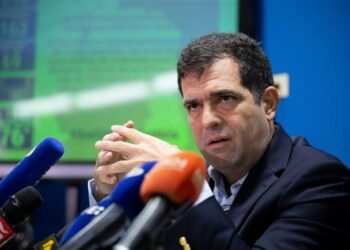
“It is April, and this year’s funding of the Zsolnay Heritage Management is still uncertain. If we cannot change this in the foreseeable future, even this year’s priority summer programs will be in jeopardy” – he wrote densely studded with facts and dates in his open letter Attila Péterffy, Mayor of Pécs, to the outgoing Minister of Innovation and Culture. According to our information, no real progress has been made since then, nor has a meaningful response to this letter been received from Balázs Hankó.
According to the mayor, the situation is also worrisome because, although the HUF one billion operating support of the municipally-owned company is also recorded in the 2026 budget law, the ministry has not even managed to issue the support document necessary for the payment. Moreover, the city administration has not received any answers to inquiries for months. In previous years, it often happened that the support did not arrive until the second half of the year, but according to our information, there has been no such delay since 2022.
According to the mayor, the outgoing government not only endangers programs, but also jobs, and the delay can also cause tourism and economic damage. In addition, Péterffy knows that in fact it is not just a simple slip-up, administrative obstacles. The mayor of Pécs also wrote that the aim could actually be to divert the awarded support. Some would like to ensure that the money does not go to the municipal company, but to the state-run Philharmonic Society Nkft. Although Attila Péterffy does not name who may be behind the maneuver, Telex has learned from several sources that Péter Hoppál, the city’s outgoing Fidesz member of parliament, may have been the one behind it.
In order to clarify the situation, we contacted Balázs Hankó and Péter Hoppál a few weeks ago, but we did not receive an answer. We also contacted Gergely Gulyás, who we asked about this, among other things, at his campaign event in Pécs. The minister in charge of the Prime Minister’s Office at the time he promisedto look into the fate of the support. “If it is included in the budget law, then that money must arrive – following the administrative processes,” he told Telex in March. However, he did not respond to our recent inquiry.
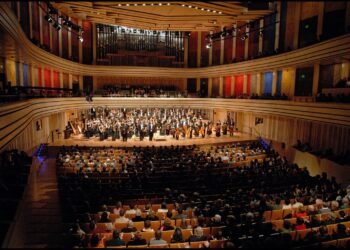
At the same time, Szabolcs Szamosi, the head of the state-run Philharmonic, based in Pécs and with a national scope for a few years, responded. According to the cultural expert, thanks to Péter Hoppál, the government would provide priority program support in 2026 for programs organized in the Zsolnay district, Kodály Center and prominent, iconic locations in Pécs. The ministry would entrust the Philharmonic with the organization of high-level concerts and events to be realized within the framework of the support. Although they did not receive any official documents about this, according to Szamosi, they were prepared for the task. We no longer received an answer as to exactly which priority programs are involved and how much money.
What is ZSÖK and why does it get so much money?
The megaholding of Pécs culture – this is perhaps the most succinct description of Zsolnay Örökségkezelő Nkft. The roughly 150-person, municipal-owned company is the heir to the scandal-ridden European Capital of Culture 2010 program, and was largely formed from the merger of previous cultural institutions. Based on all of this, it is perhaps no wonder that the problems are also coded in the organization that performs the tasks of heritage protection, tourism, cultural public services, public education and asset management. Most of the problems are related to money.
According to EKF feasibility studies, the cultural developments in Pécs (for example the Zsolnay Cultural Quarter) would have been self-sustaining, but it was already known in 2010 that this would not be the case. The city’s budget could not support an institution of this size before, and it cannot support it now. The predictable system of state subsidies was not developed until 2015, when the city-government contract was signed, which guaranteed partial state funding for 10 years.
This contract expired in December 2025. Although this did not come as a surprise to anyone, the opposition city administration tried in vain for years to agree on the continuation with the government. According to the deputy mayor responsible for cultural affairs, Gábor Zag, they regularly initiated negotiations, ministerial hearings, and wrote letters, but these did not lead to success. It was only at the last minute that the institution’s support was included in the 2026 budget.
According to Zag, this support has always arrived in the first months of the year since 2021-2022. “The financing of the National Theater of Pécs is similar, with which there was no problem this year either, the money is already there. This way the operation of the institution can be calculated. This cannot be said for the ZSÖK, there is uncertainty,” said the deputy mayor.
Cables rearranged
I already reported in January that there might be something strange with this year’s funding and news. At the annual press conference of the Zsöfgags Pécsért Egyesület, which will enter the general assembly with Fidesz-KDNP, culture councilor Péter Marsalkó said that, according to Péter Hoppál, the financing of the ZSÖK will not work as before. According to Marsalkó, Hoppál announced that the Philharmonic will be involved in financial matters, and that this year’s support will come through a company connected to the ministry. Marsalkó could not recall details and could not explain the reasons. We then asked the Deputy Mayor for Culture in January, who stated that the councilor may have misunderstood something.
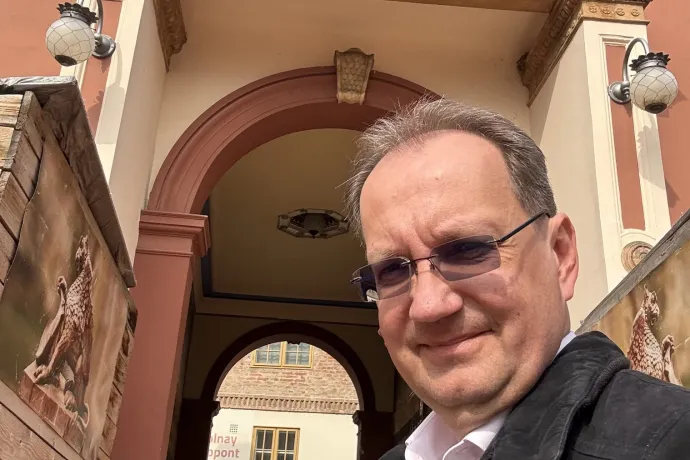
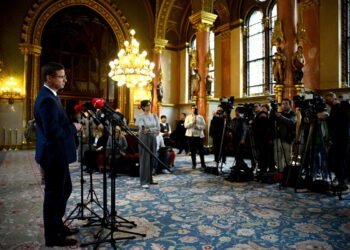
Péter Hoppál in the Zsolnay district of Pécs in March 2026 – Photo: Péter Hoppál / Facebook
According to several of our sources, in order for the money not to arrive in Pécs in accordance with the budget law, a government decision would be necessary. In addition, this is a dedicated operating grant, so it is highly unlikely that it would be easy to divert it specifically to fund programs. We know that the case was indeed on the agenda of one of the government meetings, but no decision was made.
Péter Hoppál did not respond to Telex’s repeated inquiries at all, but several of our sources familiar with the matter unanimously stated that the representative spoke about this financial maneuver already in December. However, it was not possible to find out why exactly this would be necessary?
Even the government institutes, Péter Hoppál his downfall was predictedbut based on these, he could still trust that Fidesz would remain in power. Thus, it is a reasonable assumption that the state-run Philharmonic wanted to put it in a better position with the major’s larger budget. Whoops from his campaign song this may not be clear, but the politician who is leaving the parliament is a doctor of church music and is currently an assistant professor at the Faculty of Arts of the University of Pécs, a member of the department of music theory and choir. And it is relatively well known in Pécs that he maintains a particularly good relationship with Szabolcc Szamosi.
21 Research Centers are still in the running in the March survey also received a larger proportion from his opponent the cable-pulling scandal politician, received half the voteslike Áron Kovács. Oops already on election night foreshadowed his retirementbut for the time being this does not change the situation that the future of 150 jobs in Pécs is uncertain and there may be problems with the priority cultural and tourism programs this year.
The author of the article is the editor of the Mecseki Müzli newsletter about Pécs you can sign up here.