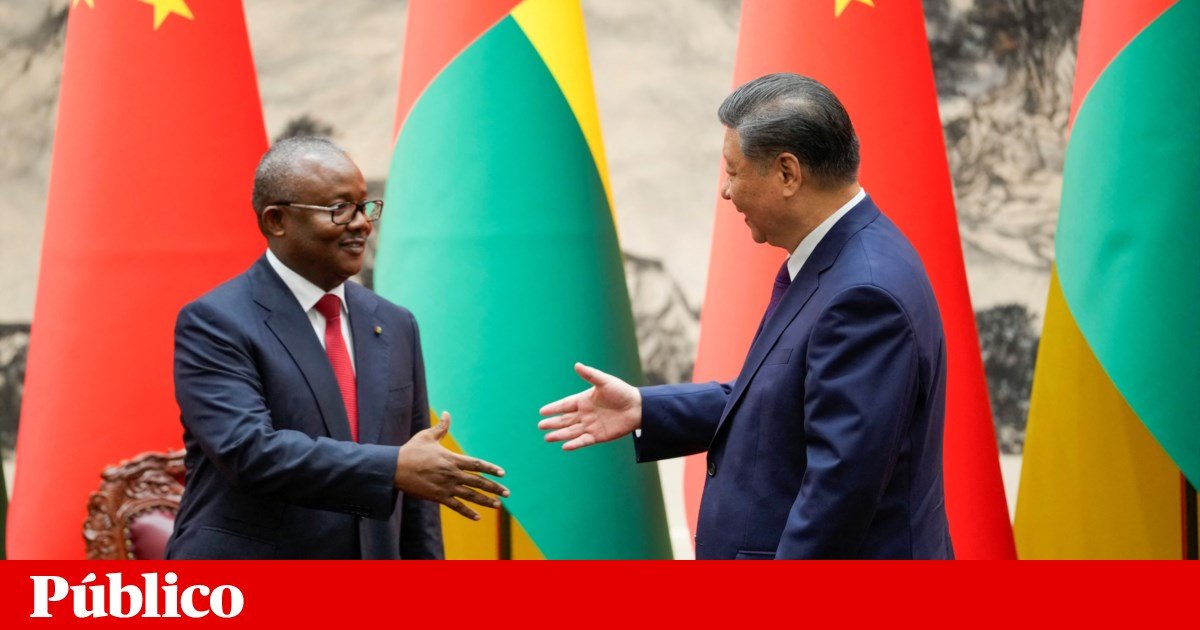
China’s connection with small Portuguese-speaking African countries has been growing closer through the Asian giant’s increasingly greater economic and technological presence in Cape Verde, Guinea-Bissau and São Tomé and Príncipe. “Economic and political fragility”, combined with a desire to find an alternative “to traditional links with the West” has contributed to this rapprochement, says a study by Georgetown University and the think tank The Digital Economist.
“These small countries tell a big and globally significant story about how best to pursue international development in emerging markets,” reads the document, signed by Guilan Massoud-Moghaddam and Robert Miles Chong, from Georgetown University, and William Vogt, from Digital Economist.
Speaking to Lusa, Vogt highlighted that “China is building closer relations with Portuguese-speaking countries through the shared cultural connection with Macau” and recalled that Beijing “also has a history of support for communist comrades in some of these countries during the first years of their independence”.
The current situation in these countries “aligns with some of Beijing’s foreign direct investment priorities, namely the promotion of China’s advanced technological innovations”, explained Vogt. There is, he adds, “a convergence in promoting the dissemination of advanced surveillance technology and the introduction of components, tools and infrastructures essential for its full implementation in new markets”.
“Portuguese-speaking countries stand out in this context because they are motivated to implement such programs to strengthen security, while China seeks to spread its cutting-edge technological innovations in the broader global market,” said Vogt, highlighting that for Beijing this has the additional effect of consolidating firmer economic relations and a market penetration already visible in some of these countries.
According to Voigt, two things combine to make the relationship with China attractive, the fact that it is a “non-Western power, without the historical weight of the abuses of Western imperialist policies” and the “probable understanding of the priorities and development paths faced by these countries”.
Nowadays, “China offers plausible socioeconomic benefits to these countries through products, programs and initiatives considered useful for sustainable digital development”, explains Voigt. At the same time, it maintains “a track record of providing opportunities to develop other profitable industries through investment and tourism infrastructure”.
Cape Verde: hub digital
Tourism, information and communication technologies are the areas favored by China in Cape Verde. Projects such as the installation of submarine fiber optic cables by technology giant Huawei are highlighted as examples of Beijing’s commitment to transforming the archipelago into an international destination and a hub regional digital.
The study states that for “a country with weak financial intermediation and a scarce diversity of natural resources”, direct foreign investment, particularly that from China, has been a “lifeline” for the economy.
Guinea-Bissau: everything Chinese
In Guinea-Bissau, for example, where “the combination of 500 years of Portuguese underdevelopment and a type of state socialism ensured that the country was never able to take advantage of its natural and human resources”, Beijing invested in agriculture, in supporting cashew production, and in energy and telecommunications, notably through deals made by Huawei.
Bissau joined the Chinese initiative of New Silk Road (One Belt, One Road) in 2021, already during Umaro Sissoco Embaló’s term as President, who invested heavily in deepening ties with China, to the point that, in 2024, during Embaló’s visit to China, the two countries transformed the bilateral relationship into a “strategic partnership“. In recent years, almost everything that has been built or is being built has been with Chinese support.
São Tomé: “Qatar of the Gulf of Guinea”
The decision to cut ties with Taiwan in 2016 opened the way for São Tomé and Príncipe to new bilateral agreements with China, particularly in information and communication technology, energy and port sector projects, as well as in agriculture.
The Chinese are interested in demonstrating that São Tomé and Príncipe is much “more than the land of cocoa and coffee” and that for Beijing it is even a kind of “Qatar of the Gulf of Guinea”, due to its privileged geographical location.